Monday, 2 January 2017

Festive Highlights 2016: 1959 La Mission Haut Brion and a 1969 Remoissenet Les Suchots plus others

December 2016: We saw off 2016 with the usual spread of highs and disappointments. Here were the bottles:

​1959 La Mission Haut Brion: A magnificent and utterly enticing bouquet of tobacco, leather and graphite. Velvety texture on the palate, with an admirable liveliness enhanced by a hint of volatile acidity. A rich and opulent classic Graves with layers of complexity, showing at its prime, with just a touch of dry sensation towards the finish. A wine to be enjoyed now and over next 5 years. 18.5/20


2013 Meursault Clos des Bouchères, Roulot: Very closed nose and very tight on the palate. Notes of citrus, lime, toast and a hint of vanilla. This is not ready yet. I would wait another 3- 5 years! 17+/20


1997 Clos de Vougeot, Leroy: Sadly corked and the whole bottle went into the Boeuf Bourguignon on 29th December. (Please refer to earlier blog "20 Vintages of Leroy Clos de Vougeot")


1969 Vosne-Romanée Les Suchots, Remoissenet: This came to the rescue after the corked bottle of 1997 Leroy Clos de Vougeot. A bouquet redolent of stewed black berries, leather, mushroom, damp forest floor. The wine still displayed plenty of energy, with the expected hint of volatile acidity for a wine of this age. Harmonious. Beautifully integrated. Silky mouthfeel. A wine that totally surpassed expectation! 17.5/20


A visitor at the table with the splendid Remoissenet Les Suchots


1966 Haut Brion: The cork looked unusually new.  Although it showed some degree complexity, it did not display the brilliance nor the depth or excitment which this wine has shown in past experience.  15/20


2002 Gevrey-Chambertin Clos St Jacques, Fourrier:  Unfortunately, this was corked too!  But Richard soldiered on......and left some to join the Boeuf Bourguignon pot.


1997 Vosne-Romanée Les Genaivrières, Leroy: A village appellation, at almost 20 years old. This delivered very fine elegance behind the tertiary flavours that testified to the domaine's excellence, and a structure that held the wine together in a most admirable manner for a wine of this age, and of this quality level. Bravo. 16.5/20


1999 Pommard Clos des Epeneaux, Comte Armand (magnum): There was a beautiful ruby hue. On the nose, it was pure red fruit, raspberry, cherry stone, sous bois, leather with some earthy notes. Vigorous, balanced, elegantly opulent, seamlessly integrated, with lengthy finish. There was none of the harshness or tightness that we sometimes expect of vintage 1999. A great example of Pommard at its best!  18/20


(On the same evening, we also opened a 1999 Chassagne-Montrachet Les Caillerets, JN Gagnard and a 1999 Corton Clos des Cortons, Faiveley.  The Chassagne was nicely matured but it did not show any of the nasty aldehydic oxidative notes.  I fear we did not spend enough time appreciating the Corton - but from what I tasted, it had all the makings of a great wine, but it was still quite closed and required more aeration time or just time!)

20 vintages of Leroy Clos de Vougeot


Tasters at work around 20 bottles of Clos de Vougeot
November 2016: It was a tasting of 20 vintages of Leroy Clos de Vougeot that took place at our dear friends' farmhouse after the superlative weekend of Les Trois Glorieuses in typical Bourgogne style. I had taken a while to write this up, as I was afraid that some of my comments might reflect an inadequacy in describing the wines and might even suggest that some of the wines were less than exceptional.


Domaine Leroy's Clos de Vougeot is a blend that could come from 3 separate parcels totalling an area of just over 1.9 hectares. One of the parcels is situated at the top of the Clos, between 255 and 260 metres above sea level, at the northern end, east-facing, with thin topsoil over Bajocian limestone, adjacent to the parcels owned by Méo-Camuzet and Gros Frère et Soeur. Another parcel is between mid and lower slope of the Clos, between 250 and 240 metres above sea level, with more presence of clay. The most notable neighbour here is the parcel owned by Henri Rebourseau, but other neighbours include Philippe Charlopin-Parizot and de la Vougeraie. The third and smallest strip is more towards lower slope at the southern end, with deeper alluvial on marlstone, joining neighbours with Coquard-Loison-Fleurot and Gérard Raphet. 


On the rare occasions when I was able to appreciate the esoteric wines by the venerable Madame Bize-Leroy, I had always been impressed by a timeless sublime elegance and restrained power that crafted such distinguished wines, irrespective of appellations. A number of the bottles in this line-up were purchased upon release, while others were purchased at recent auctions (to fill in the gaps to make this tasting possible!).

Some people chose to start from young to old, while others would go about it in the reverse order. I had decided to go from old to young.  Here are my brief notes:

Vintages 1976 to 1999
​
1976: The bottle had succumbed to volatile acidity. There was hardly any trace of fruit character. Despite the fragile structure, it still retained a certain poise about it and made an interesting post-dinner sip.

1981: This was a beautifully aged example from the domaine. Seamlessly integrated, with a balanced and elegant structure. A very 'altogether' wine!

1989: It was a very enticing waft of tertiary aromas. On the palate, vibrant acidity and complex layers, still boasting a generous showing of fruit character, with silky texture. This was a winner!

1990: There was a less appealing note of burnt sugar/caramelised fruit. The acidity was less than adequate to make this a mouthwatering example.

1992: This was my pick for the best surprise of the tasting.  Well-knit, with bright acidity and lashings of ripe fruit. The finish was long and balanced, leaving the impression of a harmonious wine, totally unpretentious.  A superb example.

1995: Characters of mushroom and earthy notes. A muscular wine, still showing firm tannins that may have just started to yield.  Difficult to tell how this wine would develop but there seemed not sufficient complexity/generosity to support significant upside development.

1996: More developed bouquet, more redolent of truffle.  There was more acidity than the 1995.  I found it slightly better balanced than the 1995, but both bottles would fall short of excellence.

1997: There was an initial whiff of volatile acidity. After this subsided for me, it revealed a wine of graceful elegance, with some resemblance to a well-aged Musigny, if short of the persistence and power were it to be a product of the top houses.  It was generally regarded as a wine at its pinnacle by the tasters present and drinking very well now.  I was keen to try this at home again.  We expectantly opened it on Christmas Day, only to find that it was corked. So the entire bottle made it into the Boeuf Bourguignon on 29th December.  Richard said that was the best Boeuf Bourguignon I had attempted!   (Incidentally, we recently opened a 1997 Leroy Vosne-Romanée Les Genaivrières to keep up the festive spirits and it still retained its elegance, though much weakened in structure, despite it being a village appellation. A perfect accompaniment with Richard's thyme-infused slow-cooked duck breast!)

1998: I detected a whiff or two of brettanomyces. The palate seemed rather dull, lacking in fruit character. Perhaps this deserves a revisit at some point.  Richard's note was more favourable towards this bottle.

1999: A very tight example of the vintage.  One could sense the brilliant and perfect structure underneath, but it was simply relentless at this tasting, determined to endow little pleasure to its eager admirers. 

2000: Moderate acidity.  Perfect for drinking now. Ripe fruit but it lacked excitement.

2001: This was a gorgeous presentation of Clos de Vougeot. Very well-assembled, complete with bright acidity and velvety tannins and fleshy layers of ripe fruit and developing nuances.

2002:  There was a hint of brettamoyces in this bottle. However, this did not detract from the enjoyment of the fleshy, ripe fruit, vibrant acidity while the firm tannins could do with more time to soften. A very stylish Clos de Vougeot.

2005: Again, a hint of brettanomyces. As expected, a muscular Clos de Vougeot, but exceptional quality of tannins and a depth of complexities waiting to reveal themselves. A very distinguished wine.  

2006: There was more than a nuance of brettanomyces for me to enjoy this.  Need to revisit.

2008: The nose was reductive, with savoury and meaty nuances, as well as still eminent toasty and smokey notes. Beautiful balance. Long finish. A very classy wine.

2009: I did not find this so memorable. The marriage with ripe fruit did not seem a harmonious one, though the acidity was admirable for the vintage.

2010: The nose was quite reductive. Tannins were still to be integrated. Oak notes of smoke and toast were still dominant. This would take some years to become better integrated.

2011: This seemed much more overt than 2010, but did not have the structure of 2010.  A lovely wine but not a long runner.

2013: The nose was still very primary. Very admirable structure. A suave example of Clos de Vougeot. 

It would be a good idea to revisit some of the bottles again, in particular the 1998, 2006, 2008 and 2009. My top picks from this tasting would be 1981, 1989, 1992, followed by 1997 , 2001 and 2002, and from the younger vintages, 2005 and 2013.

My overall impression was that while I identified some very fine wines, I did not find any great wines. The hallmark of the winemaker was evident in all the bottles but some of the bottles lacked that inspired excitement associated with a substantial price tag and a prestigious label. Perhaps that could be attributed to the inevitable bottle variation!


20 vintages of Leroy Clos de Vougeot
   

Friday, 21 October 2016

Nuits-Saint-Georges, Fly Me to the Moon!

21 October 2016:

This commune which gave its name to the Côte de Nuits had a little-known claim to fame. In the book “Autour de La Lune” (“Around the Moon”) written by Jules Vernes in 1870, three men took a journey to the Moon and they celebrated their achievement with a bottle of Nuits-Saint-Georges. In a gesture honouring the novelist’s vision, the crew of Apollo 9 mission (James Divitt, David Scott and Russell Schweikart) after visiting the Aeronautic Centre at Le Bourget, were inducted as members of La Confrèrie des Chevaliers du Tastevin by Bernard Barbier, Grand Maître of the Confrèrie as well as Sénateur-Maire of Nuits-Saint-Georges, on 30 May 1969. The following day, at the Mairie of Nuits-Saint-Georges, the party was present at the naming of a barrel of Nuits-Saint-Georges as Cuvée Terre-Lune 1969. Two years later, in May 1971, the crew of Apollo 15 mission: David Scott, Alfred Worden and James Irwin, passed by Clos de Vougeot after their trip to the Aeronautic Centre at Le Bourget, and they were presented with 6 bottles of Nuits-Saint-Georges Cuvée Terre-Lune 1969 for them to take back to Florida. On 25 July 1971, the Mairie of Nuits-Saint-Georges received a telegram from Cape Kennedy, saying that David Scott and James Irwin wished to name one of the lunar craters where they landed on 31 May 1971 as Saint Georges in honour of Jules Verne’s book “De La Terre a La Lune” ("From the Earth to the Moon") written in 1865.

The name “Nui” was first mentioned in 1060 at the Abbaie de Saint Vivant de Vergy. The origin of the name could have come from an ancient word for a flooded valley or the word for a walnut tree, which was very common in the area before 1709. The wines of Nuits gathered fame during the 15th Century under the rule of the Valois Dukes. In 1680, Dr. Fagon prescribed the wines of Nuits to Louis XIV, saying that old wine had marvelous healing effects. All this attested to the excellence of Nuits wines. The current name of the village Nuits-Saint-Georges was formalized in 1892 and thus solved a political debacle around the naming of the railway station in the village (to differentiate from another station also with Nuits as part of its name). During the 19th Century, the climats of Les Didiers, Les Saint Georges and Les Vaucrains were already well know but somehow they were not requested for promotion to Grand Cru status by the Mayor nor the President of the Appellation of Nuits-Saint-Georges in 1936.


Earlier this week, a group of Hong Kong’s trade and media professionals braved the local Black Rainstorm warning and joined the comparative tasting and live broadcast masterclass on the diversity of Nuits-Saint-Georges organised by the Bourgogne Wine Board (BIVB). This edition of the “Rendez-Vous avec les vins de Bourgogne” took us to the heart of Nuits-Saint-Georges vineyards and shared with us the insights of two winemakers, Jérôme Flous, Wine and Vineyard Manager of Domaine Faiveley and Thibault Liger-Belair and their favourite climats in Nuits-Saint-Georges. Winemakers have long respected the multiplicity of this relatively small appellation on the Côte de Nuits, with 41 Premier Cru climats, each with its distinct personality. Nuits-Saint-Georges wines can come from 2 communes, Nuits-Saint-Georges and Prémeaux-Prissey, covering just around 300 hectares, with 160 ha at the village level and 140 ha at the Premier Cru level. Nuits-Saint-George wines are not all red, but the white vineyard area is a mere 3% of the total vineyard area.

Nuits-Saint-Georges could be masculine or feminine, depending on whether you’re at the northern end butting Vosne-Romanée where softer-textured wines with more finesse and complexity tend to be shaped or at the southern Prémeaux end, where the soil contains more clay, giving fuller-bodied and more structured wines. Jérôme Flous said Nuits-Saint-Georges could be an Asian elephant at the northern end, round and tame, whereas the southern end was more like an African elephant, wild and robust. His two favourite climats were Les Porrets Saint-Georges, robust and structured with dark fruit and almost prune like character, and Les Damodes, much more refined, with spicy aromas and juicy fruit. Thibault Liger-Belair chose Les Saint Georges and Les Boudots as his two favourite Nuits-Saint-Georges climats. For him, the former represents the quintessence of Nuits-Saint-Georges, with structure and finesse, whereas latter is all about elegance and softness, being next door to Malconsorts in the Vosne village.

The masterclass included one village lieu-dit Les Argillats and 5 Premier Cru climats, covering Les Damodes and Aux Chaignots at the northern end of the Nuits commune, Les Procès and the celebrated Les Saint-Georges from the southern end of the Nuits commune and one climat from the Prémeaux commune, Aux Perdrix, not to be confused with Aux Champs Perdrix at the northern end of Nuits.

The geology has much to account for the distinct characters of each of the 6 wines, as does winemaker/domaine style. Here in Nuits-Saint-Georges, the closed valleys named Combes in the Côte de Nuits, are much wider and the river Meuzin flows through the valleys, bringing with it a wide alluvial fan with pebbles and silt deposits at the northern end. At the southern end, the alluvia originated from La Combe des Vallerots and the soil at the foothills contains deep marly limestone. In some areas the clay has high iron oxide content, as in Les Saint-Georges.


Nuits-Saint-Georges can be divided into 3 parts. The first part forms border with Vosne-Romanée until the river Meuzin, with 240 metres at the lower end and 350 metres at the top end. Some vineyards are fully facing east, such as Les Damodes and others are fully south-facing, such as Aux Argillats (not the same as Les Argillats tasted in this masterclass). Here we have Les Damodes, Aux Boudots, Aux Chaignots and La Richemone as examples of premier cru climats. The second part begins on the other side of the Meuzin valley and finishes at La Combe des Vallerots. Here we have Les Pruliers, Les Procès, Les Vaucrains and Les Saint-Georges as premier cru examples. The third part is in the Prémeaux commune and it is a much narrower strip with climats as Clos l’Arlot, Clos de la Maréchale, Les Didiers, with hard compact limestone at the top of this strip.

The characteristic finesse and concentration of Les Saint-Georges is due to the topsoil of pebbles deposited from La Combe des Vallerots, helping drainage and acting as heat-traps, and also the high clay content giving structure to the wine. It is located at the border with the Prémeaux commune, where the wines tend to show fuller body and more richness. This is evidenced by the richness and concentration of the Aux Perdrix example by Domaine des Pedrix in the line-up. This is one for the long haul but is not entirely unapproachable now, with richness of ripe fruit coupled with chewy tannin and full-bodied concentration. By comparison, Les Damodes tends to display more elegance and freshness due to its higher altitude and more complexity from the long maturation as a result of its full-eastern exposure. The sample by Frédéric Magnien may be more driven by the winemaker’s style. The Drouhin Les Procès also bears hallmarks of the house style, with its characteristic finesse, understated power, and subtle influence of oak from extended seasoning, despite the high clay content of the climat. Les Argillats combines the freshness from the altitude and the balance and concentration from the vintage of 2014.

2013 was a difficult vintage but the samples tasted showed balance and remarkable freshness. 2014 showed much more concentration and ripeness but it was beautifully balanced as a vintage, without any heaviness at all.

The question of whether Nuits-Saint-Georges would one day have a Grand Cru to justify the quality of its wines still hovered and Jean-Pierre Renard of the Ecole des Vins de Bourgogne gave nothing away!

The wines tasted were:


Nuits-Saint-Georges Les Argillats, 2014, Domaine Philippe Gavignet

Nuits-Saint-Georges 1er Cru Les Damodes, 2013, Domaine Frédéric Magnien

Nuits-Saint-Georges 1er Cru Aux Chaignots, 2014, Faiveley

Nuits-Saint-Georges 1er Cru Les Procès, 2013, Maison Joseph Drouhin

Nuits-Saint-Georges 1er Cru Aux Perdrix, 2013, Domaine des Perdrix

Nuits-Saint-Georges 1er Cru Les Saint-Georges, 2014, Maison Chanzy


Thibault Liger-Belair believes that there are wines for lunch and there are wines for dinner. Nuits-Saint-Georges is definitely a wine for dinner, he says, to be enjoyed slowly, with emotion, with friends. “Never open a bottle alone….and remember: The last glass is always the best.”

Sunday, 4 September 2016

Beautiful Old Riojas: 1964 Vina Ardanza Reserva Especial

2 Sep 2016: This dinner took a while to come together and in the end, we lost some people but gained others. It was a remarkable assembly of beautifully aged Riojas, including the legendary 1928 Federico Paternina Ollauri Gran Reserva and the 1964 Viña Ardanza Reserva Especial (released only 3 times in history, 1964, 1973 and 2001). I found the VA in the 1928 a bit overpowering a short while after opening. It was almost madeira like.  We were able to taste two vintages of La Rioja Alta Gran Reserva 904 side by side: 1964 and 1989. They were both divine: 1964 nicely matured, and 1989 still plentiful of vigour. We were also treated to a 1968 Viña Tondonia Gran Reserva Blanco: amber gold in colour, with layers of ginger, nutmeg, Oriental spices, hints of caramel, still showing lots of freshness and a long finish. 

There's something rather romantic about old Riojas.....the silky texture, the liveliness that's still evident in most of the wines, the layers of flavours slowly unfolding on the palate, and the lingering finish. With these, we do not worry ourselves with single vineyards, just the vintage and the skill of the winemaker.  These are wines for a meditative evening, not wines to be consumed in a hurry! 


My top picks from our evening were:

1964 Viña Ardanza Reserva Especial

1964 La Rioja Alta Gran Reserva 904

1989 La Rioja Alta Gran Reserva 904

A couple of white Bourgogne bottles sneaked into our tasting, but they were both much appreciated.

For a traditional evening, the best venue had to be Olé, which never disappoints with its fabulous execution of classic dishes! (http://www.olespanishrestaurant.com.hk/)


1945 Rausan Segla

3 Sep 2016:
1945 Rausan Segla: "Shipped in wood" to the UK for bottling.  Harmonious, seamlessly integrated, mature bouquet of cigar box, violet and leather with caramelized fruit notes, lingering on the finish. Velvety to taste, with no noticeable acetic or oxidative notes. Incredibly well preserved for its age. An ethereal classic claret. Lacking in depth and richness for the vintage to merit a higher score. 19/20

Thursday, 18 August 2016

A class above - 1990 Hill of Grace

16 Aug 2016: We finally made it to this long anticipated dinner which was originally going to be a Grange mini vertical dinner. With the passing of time, the theme was swapped for the classic Syrah/Shiraz evening. Impeccable and extremely professional service by the team at Another Place by David Myers @ HIP Cellar, and above all excellent and artistically presented dishes.  There was general consensus that the duck course was the star dish - sadly I did not take a photo - it looked so tempting, that we could hardly wait to tuck into it! 

Marinated kodama watermelon, ama ebi, edamame salad, yuzu kosho

1996 Chardonnay Extra Cuvée de Reserve, Pol Roger 
We started with this champagne. Layers of pear, almonds, brioche, rich and exuberant without heaviness, with creamy mousse and a lively crisp finish. Excellent drop, still very fresh at 20 years! 18/20


2000 Chablis Montée de Tonnerre, Raveneau
Sadly, oxidised aldehyde notes prevented our enjoyment.  This calls for another bottle from the same case to be tasted soon!


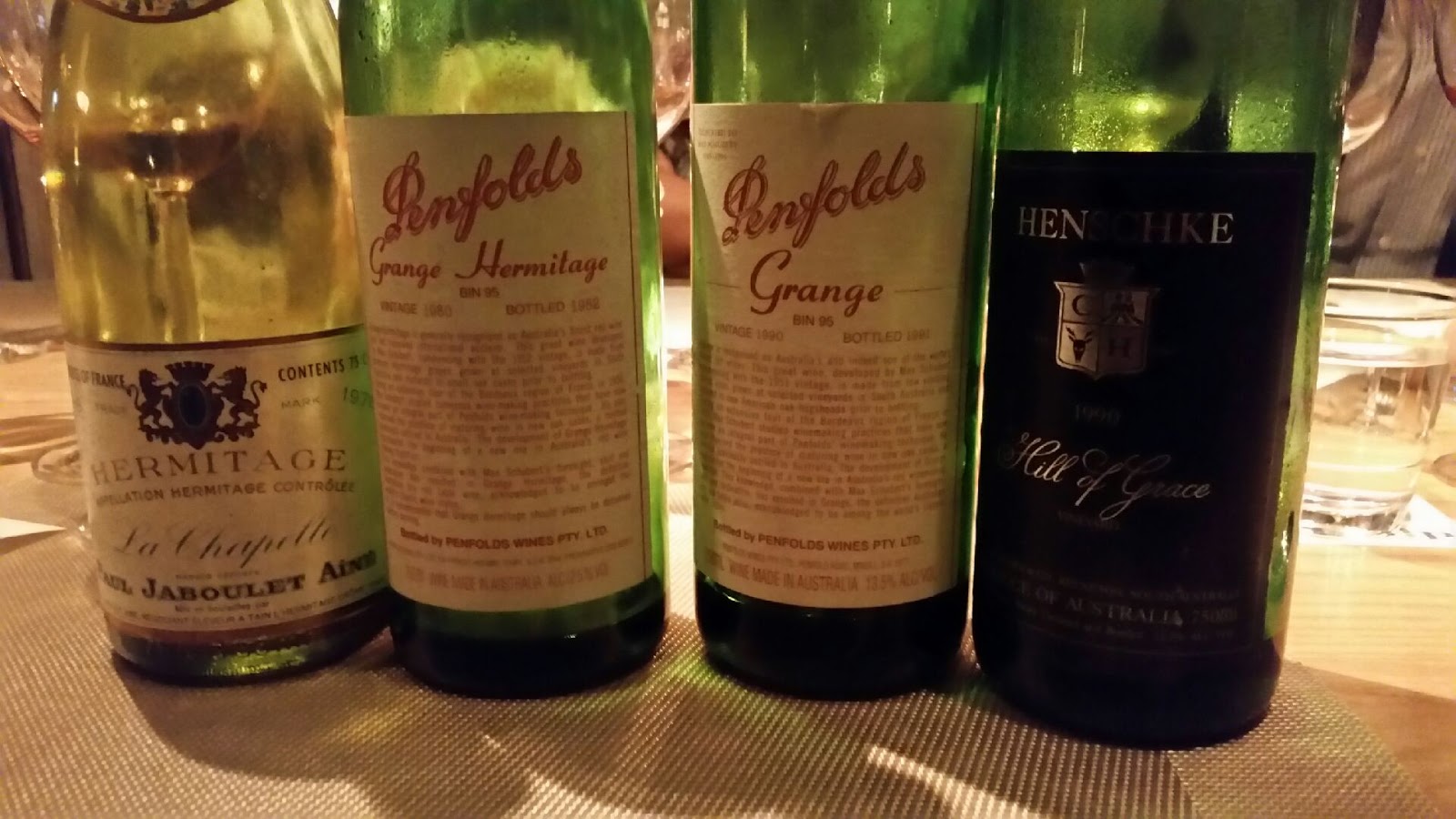
The line-up of 4 Syrahs


1978 Hermitage La Chapelle, Jaboulet
Black plum, cardamom, cinnamon, nutmeg, wild herbs, game, black pepper, whiff of VA, vibrant acidity, elegant tannin, very long finish. Not quite the gargantuan 100-pointer that we were expecting. Wine lost its freshness and revealed a dull and coarse palate after about an hour. Worth investigating with another bottle from the same case to see if this wine is at risk of decline. 17/20


1980 Grange, Penfolds
Sweet vanilla, coconut, blackberry, minty chocolate, black pepper, firm structure, velvety tannin, firm acidity. A lush wine with a slightly rustic edge, not quite as suave. Lacked personality. 96% Shiraz. 4% Cabernet Sauvignon. Drink now and over next 8-10 years. 17/20

Interestingly, the 1980 Grange cork did not have any engravings on it.
Just a plain cork.


1990 Grange, Penfolds
Topped up with 2006, recorked in 2011. Blackcurrant, spicy, vibrant acidity, sweet vanilla, coconut, the elegant palate belies a big and powerful structure. This recorked bottle seemed youthful but very ready to please . 95% Shiraz, 5% Cabernet Sauvignon for original vintage. Long way to go. Drink now and over next 10+ years. 17.5/20

Slow-cooked Iberico pork loin, confit fingerling potatoes, yuzu jus


1990 Hill of Grace, Henschke
Gamey, slight hint of black pepper, sweet finish, harmonious, integrated with velvet tannins, minty chocolate, hint VA but enough to detract from its singular beauty and elegance. A stylish wine that has aged magnificently and gracefully. A class above the rest of the flight. Very persistent finish. Drink now and over next 10+ years. 19.5/20 (Very beautifully paired with the duck cooked under sous vide!)


Strawberry shortcake, almond milk, burnt miso ice cream


1882 Ne Oublie, Graham's
Quite different from the Scion. Layers of toasted walnuts, dried orange peel and balsamic nuances. Beautifully integrated. The anticipation from watching the bottle being extracted from the heavy encasement, to being opened, then the pouring and finally the tasting was simply breathtaking. On the palate, there was a freshness that kept the body of the wine lithe and vivacious, whereas from memory, the Scion was more unctuous and opulent. The bouquet lingering on the glass was simply mesmerizing. A very memorable end to a wonderful dinner. 20/20


Our menu - highly recommended!

Wednesday, 29 June 2016

Domaine Senkin defining the ‘New World’ of Japanese sake

June 2016:
I recently had the opportunity to meet Kazuki Usui, the CEO of Senkin Shuzo (or Domaine Senkin, as Usui-san prefers it being known) at a masterclass and dinner hosted at the China Club by the Drinks Business Hong Kong, in collaboration with Jebsen Fine Wines. As the 11th generation running this ancient brewery that dates to 1806, Usui-san believes that it is his duty to sustain the traditions while innovating with new techniques and styles to ensure the brewery’s continuation in a world challenged by evolving palates in both alcoholic beverages and food. With formal training as a wine sommelier, Usui-san never set out to be a traditional brewer of sake, following the standard recipes for sake brewing. He also understands that to a degree, wine selection at restaurants is driven by grape variety with regional style to pair with the food, whereas sake is more likely to be chosen based on the popularity of the brand. Therefore, his priority was to build the brand for Senkin. Putting a stamp on his individuality, he decided to adopt the Burgundian name of ‘domaine’ for Senkin, and to follow the concept of ‘domaine’, that he would only make sake with ingredients under his full control.

 
Kazuki Usui clutching a bottle of Senkin Tsuru-Kame 19

As demonstrated in the first half of the masterclass where we tasted 5 sake examples from 5 different breweries and prefectures, each with their own qualities of water, defined as hardness of water (amount of calcium carbonate and minerals such as potassium, magnesium and phosphates), water seemed a more dominant factor in influencing the style of sake, much more so than the rice variety. This was brought to light by the example of a sake from Hyogo with hard water called miyamizu and Nagano where the water hardness measured the lowest amongst the 5 examples (almost 1/6 the level of the water in Hyogo). Today, Senkin uses the same water to grow the rice and to brew sake. All the rice varieties in his sake portfolio come from fields in the Tochigi prefecture where the brewery is based.

Further, the brewery has eschewed the special designations requirements (Tokutei Meisho). Instead, Usui-san has developed his own range of ‘Classic’ and ‘Modern’ where in the former, the seimaibuai (rice polishing rate) for both kake mai and koji mai is 50%, giving a rich and rounded style, and in the latter, the seimaibuai for koji mai is 35% and for kake mai, 50%, giving a more elegant style. (Typically in sake production, koji mai or koji rice accounts for about 15-20% of total rice requirement. This is rice inoculated with koji mould that serves to split the starch into sugars for fermentation by yeast into alcohol. Kake mai is the remaining steamed rice.) The more the rice is polished, the closer we get to the shinpaku (starch core), the more refined, balanced and pure the style of sake, with pronounced aromatic profile, smoother texture and crisp finish. Within the special designation sake or premium sake which only accounts for 30% of total sake production in Japan, a sake can only qualify as Honjozo with a minimum of 70% seimaibuai, and 60% for Ginjo and 50% for Daiginjo, although 35% seems the norm for high quality Junmai Daiginjo. Rice polishing is laborious and requires time and care. Usui-san has just produced a barrel of sake with just 7% seimaibuai. It took 15 days to achieve this level of polishing rate, which reduced the brown rice grain to just a mere white speck of extreme fragility. This nerve-wrecking process would necessitate meticulous instructions in soaking and steaming, all supervised with extreme care. It was produced in batches of 20 kg and the soaking took exactly 1 minute 30 seconds, no more no less, in water at 6°C. This was followed by steaming for 45 minutes. (Compared with a 50% seimaibuai batch of 200kg, the steaming would normally take 90 minutes.) For 2.5 tonnes (2,500 kg) of rice, this method only produced 400 bottles, instead of the standard 5,000 bottles. Senkin produced one barrel only of this 7% seimaibuai sake, made with Kame-no-O, the signature rice of Tochigi prefecture, that has earthy complexities, dry style and a high degree of acidity. Half of this barrel was exclusively bottled for Jebsen Fine Wines for their own label Kikusaki. It is no surprise that Kikusaki Nana (‘Nana’ is the Japanese word for ‘seven’) comes with a high retail price tag of HK$ 3,200 a bottle. Usui-san recommended service temperature of 8°C.  


When asked Usui-san why he went for 7%, he replied that another brewery had produced 8% and he wanted to push the boundary further. While he can continue to experiment with the seimaibuai (ie going lower), he will turn his attention to refinement of other production techniques. We tasted his Nature-un. It was made using the kimoto technique, with natural lactic acid bacteria and natural yeast, and a seimaibuai over 90%, quite the reverse of the 7%. The intensity of umami flavours was astonishing, with such savoury complexities of dried Chinese mushroom, truffle and yeast. From the expressions on the face of a few participants, it might be more of an acquired taste. I kept some behind for the dinner and thought it went extremely well with the fried rice with roasted duck, mushroom, shrimp and conpoy in abalone sauce, scented with black truffle, for that explosion of umami flavours!   According to Usui-san, this can be enjoyed at either 18-20°C or at 45-50°C.

In future, Usui-san will also be experimenting with different types of barrels. He used a Bourbon barrel in the production of the 7% seimaibuai sake.

Contrary to the practice of adding water to dilute sake from the genshu state of 17-20% abv, there is no such practice at Senkin. So technically, they are all genshu.  In addition, there is no fining nor filtration at Senkin.

The hallmark of Senkin sakes is the balance of acidity and sugar, sometimes more than barely noticeable sweetness. The acidity was particularly marked for Senkin Issei, a 35% seimaibuai, based on Yamadanishiki rice.  It would go particularly well with fish and seafood, according to Usui-san. The noticeable sweetness could work very well with lightly spicy food, and I would like to retry the Modern Senkin Yamadanishiki with Thai cuisine for example. In fact, everyone thought this sake went very well with the ginger in the dish of braised pork spareribs with citrus fruit paste and young ginger, but the sweetness of the citrus fruit paste was a bit too overpowering for the sake.

Perhaps the widely acknowledged all-rounder and most wine-like was the Tsuru-Kame 19, with 19% seimaibuai and Kame-no-O as the rice variety. Usui-san recommended serving it at 8-10°C.  I likened it to a Chablis, with energy, tension and balanced freshness. 

Senkin is definitely charting new waters for a traditional beverage of over 1,500 years. The mystique of sake is that unlike wine (a grape variety, married with climate and soil, that would give an expected style), with sake, it is not so obvious, with so many variations that could make a difference, from water quality, soaking time, soaking temperature, rice polishing rates for koji mai and kake mai, kimoto or sokujo, natural yeast or cultured yeast, pasteurization or not, filtration or not, to ageing methods, and so much more! This matrix of variations is not meant to be confusing.  Rather, it opens up new avenues for a traditional beverage to find new amateurs who can enjoy it with different types of cuisine and on different occasions. There should be a sake for everyone and every moment!

The sakes tasted in the masterclass and dinner were:

Masterclass

Flight 1 

1) Manotsuru Junmai Daiginjo (真野鶴純米大吟醸実来): Koshitanrei, 35% RPR, Niigata Prefecture

2) Hakuko Junmai Daiginjo 50 Sarasoju (白鴻純米大吟醸沙羅双樹50): Yamadanishki, 50% RPR, Hiroshima Prefecture

3) Fukuju Junmai Mikagego (福寿純米御影郷): Yamadanishki, 70% RPR, Hyogo Prefecture

4) Takizawa Tokujo Honjozo (瀧澤特撰): Hitogokochi, 59% RPR, Nagano Prefecture

5) Michizakura Junmai Aiyama (三千櫻純米愛山): Aiyama, 60% RPR, Gifu Prefecture

 
Masterclass Flight 1


Flight 2

6) Senkin Tsuru-Kame 19 (仙禽鶴亀19): Kame-no-O, 19% RPR, Tochigi Prefecture

7) Senkin Issei (仙禽一聲): Yamadanishiki, 35% RPR, Tochigi Prefecture

8) Modern Senkin Omachi (モダン仙禽雄町): Omachi, 50% RPR, Tochigi Prefecture

9) Classic Senkin Kame-no-O (クラッシク仙禽亀の尾): Kame-no-O, 50% RPR, Tochigi Prefecture

10) Senkin Nature Un (仙禽ナチュラルアン): Kame-no-O, >90% RPR, Tochigi Prefecture

 
Masterclass Flight 2


Dinner

1) Senkin Issei (仙禽一聲): Yamadanishiki, 35% RPR, Tochigi Prefecture

2) Kikusaki Nana(菊咲 7): Kame-no-O, 7% RPR, Tochigi Prefecture

3) Modern Senkin Yamadanishiki (モダン仙禽山田錦): Yamadanishiki, 50% RPR, Tochigi Prefecture

4) Senkin Tsuru-Kame 19 (仙禽鶴亀19): Kame-no-O, 19% RPR, Tochigi Prefecture

5) Classic Senkin Kame-no-O (クラッシク仙禽亀の尾): Kame-no-O, 50% RPR, Tochigi Prefecture

6) Modern Senkin Omachi (モダン仙禽雄町): Omachi, 50% RPR, Tochigi Prefecture

7) Modern Senkin MUKU (モダン仙禽無垢): Hitogokochi, 50% RPR, Tochigi Prefecture

8) Senkin Ume-jiri (仙禽梅尻)

 
Dinner Selection


Ganpai!