Showing posts with label Rhone. Show all posts

Tuesday, 9 October 2018

Revisiting Curnonsky's Famous Five

8 October 2018: This was a very special dinner. At Arcane Restaurant in Hong Kong, our host had invited nine friends to revisit and assess Curnonsky's famous white wine classification from the 1930s. Born Maurice Edmond Sailland in 1872 in the town of Angers, France, Curnonsky became a most influential food and wine writer of his generation. He was voted "Prince of Gastronomes" by Le Bon Gîte in 1927. In the 1930s, Curnonsky declared the following to be the world's top five white wines: Montrachet, Clos de La Coulée de Serrant, Château Grillet, Château Chalon and Château d’Yquem. And of course they were all French!

The chef had curated a very thoughtful and daring menu to go with the white wines. We were fascinated by the thought of pairing Château d'Yquem with Wagyu rump steak and a blue cheese fondue.

As we were 10 people, we had two wines instead of just one for each of Curnonsky's famous five. 

Château Grillet:
For this monopole appellation of 3.8 hectares based on 100% Viognier, we were served two vintages: 2006 and 2013, ie one pre-Pinault acquisition and one post. Château Grillet has long been a wine of great repute, and has featured in the collection of famous personalities. Thomas Jefferson visited it in 1787 and the inventory of the cellar of Château de Malmaison, residence of Empress Joséphine de Beauharnais, first wife of Napoleon I, featured 296 bottles of this wine in 1814. This property remained in the family of Neyret-Gachet between 1827 and 2011, when it was sold to François Pinault, also owner of Château Latour in Pauillac, Bordeaux and Domaine d'Eugénie in Vosne-Romanée, Bourgogne.  The property was awarded the appellation d'origine contrôlée in 1936.

Planted on steep slopes of the Rhone Valley and over 76 terraces supported by stone walls, the vines average 45 years. Detailed vineyard analysis has allowed each lot to be separately vinified, whether in oak or in tank. Ageing in French oak barrels for 18 months, with around 20% new oak.


2006 Château Grillet: a perfumed bouquet of honeysuckle, ginger and dried apricot. A voluptuous wine of intensity and concentration, with the soft acidity highlighting the succulence of the wine. Long finish. 17/20

2013 Château Grillet: by comparison, this wine showed a taut mineral core despite the relatively moderate acidity for the grape variety. The signature pear and apricot note was subtle, underscoring the youthfulness of the wine.  I particularly liked saline finish which gave the wine much needed freshness and a point of difference leading to the dry finish. I find it a very much more linear and precise expression of the appellation. It went particularly well with the dish of lightly smoked mackerel with herb mayonnaise. 18/20


Clos de La Coulée de Serrant:
Next we had the Clos de La Coulée de Serrant, a 7-hectare appellation in the Loire Valley, based on 100% Chenin Blanc, exclusively owned by the Joly family.  Vines were first planted here in 1130 by the Cistercian monks.  Declared the 'golden drop' by King Louis XI, this wine has enjoyed a very long reputation. Planted on steep slopes on thin (20-40 cm) topsoil above a red schist bedrock, the vines are oriented S/SE, with an average age of 30-40 years. The yield is around 20-25 hl/ha, compared to the permitted 40 hl/ha for the appellation.  The harvest takes place over a long time allowing the pickers to pick the grapes with the most colour maturity and presence of botrytis. The objective is to allow the grapes to express the most minerality.  Aged in 500 litre barrels, with no more than 5% new barrels. The Joly family has been practising biodynamics since 1980 and all the vineyards of the family have been fully biodynamic since 1984.


1996 Nicolas Joly, Clos de La Coulée de Serrant: The wine revealed a deep amber-golden hue. The bouquet showed maturity and complexity of toasted hazelnut, bruised apple, with caramelised notes. There was a marked level of volatile acidity. Depending on the taster's sensitivity, this VA either enhanced complexity or reduced enjoyment but it certainly gave the wine a fresh lift to the palate and finish. 16.5/20

1997 Nicolas Joly, Clos de La Coulée de Serrant: The wine showed a bright golden colour.  An attractive bouquet of honey, stewed apple, dried fruit and herbal notes. It was an opulent full-bodied wine, boasting a richness that was deftly balanced by vibrant acidity.  There was a chiseled minerality that filled the core of the wine. A wine of understated finesse. Very long finish 18.5/20

The pairing was less obvious for me as the Alaskan King Crab had a lightness to it, whereas the wines were full-bodied, though with heightened acidity.  The spiciness of the gazpacho essence was carried off nicely by the very ripe Chenin Blanc fruit though.

Montrachet: 
Possibly the finest expression of Chardonnay and a Bourgogne Grand Cru appellation, Montrachet is located across the villages of Puligny and Chassagne.  Its greatness owes much to the early study and work carried out by the Cistercian monks and the Lords of Chagny.  This Grand Cru appellation covers 7.8 hectares, and is shared by 16 owners.

The dish to accompany below wines was a Sautéed potato gnocchi with charred cévenne onion, cep vinaigrette and shiitake duxelle.  It was a very tasty dish but I thought it was a bit too overwhelming for the delicate (non-oxidised) Bourgogne wines.


2004 Comtes Lafon, Montrachet: unfortunately this bottle was heavily oxidised

2004 Ramonet, Montrachet: This was a very classy wine, showing an attractive bouquet of pear, blossom, almond and nougat, with light toast notes. The acidity was bright and the wine showed great energy in a youthful state. There was an impeccable harmony and finesse presented in a most elegant and sophisticated manner, with a core of minerality that gave the wine a very desirable tightness. Very long finish. 20/20

Our host inserted an outlyer to the Montrachets, given the disappointment with the Lafon Montrachet:
2015 Benoît Ente, Puligny-Montrachet Clos de la Truffière
A wine still showing mostly primary and secondary notes. Green apple, lime zest, blossom, almond, with flinty notes. Linear, with racy acidity and a long finish. 17.5/20


Château d'Yquem:
Château d'Yquem needs no introduction as the most famous Sauternes estate, renowned for its extraordinary richness and complexity. Included in the 1885 Bordeaux classification as the only Premier Cru Classé Supérieur in its class of Sauternes/Barsac, it has been owned by the LVMH group since 1999.  Located on the highest hill in Sauternes, the estate covers 110 hectares, 80% planted with Sémillon and 20% with Sauvignon Blanc.  Now vinified in 100% new oak barrels and aged in barrels for 36 months before release.

The chef had ingeniously paired these two wines with a Wagyu rump cap with spinach and onion compote, blue cheese fondue and girolles.


1959 Château d'Yquem: A well-matured wine, showing complexities of orange marmalade, tea leaves, apple toffee shortbread, dried fruits and honey.  There was a very positive vibrancy on the palate, reflecting a good level of energy.  The hint of VA was a positive developmental addition. Finish was dry but not unpleasant. 18/20

1996 Château d'Yquem: It was a luscious wine with a creamy texture, bolstered by bright acidity. The bouquet had dried apricots, honey and toffee apple. It was not the richest or most complex of vintages but it was elegantly presented in a nice refreshing style.  17/20


Château-Chalon:
Château-Chalon is an appellation for wines made around the village of  Château-Chalon in the Jura region.  Only wines based on 100% Savagnin in the Vin Jaune style can be made using this appellation.  The grapes are late harvested, without botrytis.  After vinification, the wine is aged for 6 years and 3 months before bottling in the squat-shaped 62cl clavelins.  The wine must be stored in oak casks, partially filled, to allow the development of the voile of yeast, which gives the wine its peculiar characteristics, just like the function of flor in the production of sherry.  Only made in the best vintages.

Arbois-Pupillin is an appellation for wines made in the village of Pupillin, just south of Arbois in the Jura region.  This appellation covers white, red, rosé wines and Vin Jaune, as well as vin de paille.


1989 Emmanuel Houillon-Pierre Overnoy, Arbois-Pupillin AOC, Vin Jaune, Jura: My first experience of this wine by the legendary Pierre Overnoy.  It was in the year 1989 when he delegated the winemaking duties to Emmanuel Houillon.  This was a deep amber colour, showing notes of white chocolate, nuts and balsamic, with a prominent saline character. VA is marked here but it is an additional positive to the appreciation of the wine. Finishes extremely long. 19/20

2005 Domaine Jean Macle, Château-Chalon AOC, Vin Jaune, Jura: This was a golden colour. Marked notes of saline, sea salt, yeast with nuances like curry/cardamom. Excellent with the aged Comté cheese. Long finish. 18/20


Towards the end of the evening, our host asked all of us to think of our own choices of top five white wines, from anywhere in the world. It was interesting how we all gravitated towards France. While Montrachet, Château d'Yquem and Pierre Overnoy's Vin Jaune would still feature for some of us, there were suggestions of Haut Brion Blanc, Raveneau Chablis Les Clos or Chablis Montée de Tonnerre, Krug Clos du Mesnil, Trimbach Clos Sainte Hune, Egon Müller Scharzhofberger Riesling Trockenbeerenauslese, and an ageless Madeira Malvasia or Bual.  The question remains unanswered is when we get together to do the 'new' classification tasting?!

Thursday, 26 April 2018

An Epic Cheese, Food and Wine Pairing Evening

25 April 2018
This started off as a somewhat ambitious attempt to stage a multi-course cheese and wine pairing, alongside a wine and food pairing for each course. A few friends volunteered to join me on this educational “expedition”.  To ensure that we have a fresh palate to vote on the best cheese and wine pairing, I insisted on tasting the cheese first before the pairing dish for each course. 

The Wine Selection


The Cheese Selection


Course 1
The first course was paired by a champagne:
2002 Pierre Péters Blanc de Blancs Grand Cru Cuvée Spéciale Les Chétillons: This bottle was much fresher than the last 2 bottles we tried from the same case. This was classy Blanc de Blancs, with the immediate attack of ripe fruit notes (apple compote and pear), overlaid with buttered toast and brioche notes, leading to distinct mineral tones on the mid-palate, with just a hint of field mushroom character. Creamy texture, full-bodied, this was an opulent and classy wine with crystal definition and a persistent finish. 95/100

Cheese pairing:
We paired this with Brie de Melun (Seine et Marne, cow). This soft bloomy rind cow-milk cheese was intensely flavoured, with earthy aromas from the rind. The soft and creamy texture pâte showed marked saltiness and a pronounced and persistent mushroom character.

The chiselled acidity of the champagne was able to cut through the creaminess, cleansing the palate with the fine bubbles. The savoury and mushroom character of the cheese paired quite well with the mature character of the champagne. Given the unexpected freshness of this bottle, next time I would have paired this cheese with a more mature example (a 1995 Krug?).

Food pairing: I paired the champagne with the classic smoked salmon on blinis, with a lemon-flavoured crème fraiche. The fresh acidity from the lemon balanced the richness of the smoked salmon. The toasted and citrus character of the champagne complemented the flavours very well.

Course 2
The next course was paired with a set of wines based on Sauvignon Blanc:
2008 Silex, Didier Dagueneau: 100% Sauvignon Blanc. A rich and powerful wine, layered with overt notes of tropical and green fruit, mango and gooseberry, lifted with refreshing acidity, delivering a remarkable balance and long persistent finish. A Sauvignon Blanc not like others, very distinct. 94/100

2011 Aile d’Argent: A blend of 60% Sauvignon Blanc, 38% Semillon and 2% Muscadelle. The Semillon seemed to have taken over the characters of this wine. The bouquet was floral, peach, pear, with honey and nutty nuances. On the palate, it tasted phenolic, leaving a slightly bitter note at the finish. A rich and opulent wine, balanced but somehow lacking in precision to rank it amongst the finest from Bordeaux. 90/100

Cheese pairing:
I served two goat cheeses: Mothais sur Feuille (Deux Sèvres, goat) and Selles sur Cher (Touraine, goat). Here, we agreed that the pairing was best when we paired the cheese and wine from the same region.

The Selles sur Cher with the firm texture which melted in the mouth, and the interplay of sweet, salty and citrus tangy notes, paired very well with the Silex.

The Mothais sur Feuille with its creamy, oozing texture, and the more pronounced salty and nutty character, found a better match with the Aile d’Argent.

Food pairing:
The vote was unianimous for the Silex when it came to pairing with the dish: Grilled asparagus with Iberico ham, and lemony crème fraiche.

Course 3
The third course was paired first with a pair of Syrah-based wines, followed by a Mediterranean style wine.
2000 Côte Rôtie La Turque, Guigal: This was a blend of Syrah with 7% Viognier, with fruit from the Côte Brune. The structure was initially tight and masculine, displaying ripe fine tannins and lifted with marked acidity. With aeration, it opened up to display a rich bouquet layered with notes of dark chocolate, clove spice, cassis, dates and figs. A flamboyant wine, made with precision. Long persistent finish. Drinking beautifully now, and over next 8–10+ years. 96/100

2000 Côte Rôtie La Mouline, Guigal: This was a blend of Syrah with 12% Viognier, with fruit from the Côte Blonde. This wine was at once more open and evolved than the La Turque. It was sensual aromatically and texturally, diplaying an elegant and fine-chiselled poise. The softer acidity was balanced by refined tannic structure. The bouquet was blackberry, plum, mocha and cardamom spice. An absolute beauty now, drinking so well, and will continue to do so over next 8-10 years. 95/100

1999 Château Musar: a blend of Cinsault, Carignan and Cabernet Sauvignon, each a third. Fermented in cement tanks with extended maceration, followed by a year ageing in French oak. There was the hallmark bretty gamey note, immediately followed by pronounced sauvage character of wild herbs, almost like the garrigue, and notes of prunes and plum. Good lifting acidity provided great balance to this opulent wine, with sinewy muscles. A very elegant wine. Drinking very well now and over the next 6-8+ years. 93/100

Cheese pairing:
24-month Laguiole (Aveyron, cow): the saltiness of the Laguiole and the spicy tangy and savoury notes from the extra aging worked reasonably well with the Syrahs, but I think these two Syrahs were too powerful for the Laguiole. I would pair this with a Saint Joseph or a Côtes du Rhône next time.

Mimolette Extra Vielle (Nord Pas de Calais, cow): Uncooked, pressed cow-milk cheese. Salty and savoury, with caramelised notes. The savoury character worked well with the Syrahs, and the fruitiness of the La Turque in particular went well to complement the salty character.

Ossau Iraty au Piment (Pays Basque, sheep): this pairing had the most votes. This uncooked pressed semi-hard sheep milk cheese from the Pays Basque had a slightly grainy texture, creamy and buttery in flavour, with herbaceous, nutty, floral and spicy notes. This paired very well with both Syrahs, but possibly even better with the La Mouline.

We experimented with Livarot (Normandy, cow) too. The washed rind was not too disastrous for the Syrahs – in that the wine did not taste bitter with the cheese. (I asked our friends to try both, with or without the rind.) The pungent note from the washed rind possibly worked much better with the characterful Musar.

Food pairing: I paired these wines with a 6-hour lamb shoulder with North African spices, chick peas and tomato, served with steamed ratte potatoes and Savoy cabbage. A very fine food and wine pairing, especially with the Musar.

Course 4
Final course was paired with a dessert wine.
1995 Riesling Sélection de Grains Nobles, Hugel: A golden hue. Pronounced acidity balancing the luscious sweetness. Complex notes of apricot, honey, beeswax, nuts and rye, with a slight smokey nuance. Delightfully refreshing and finishes long. 93/100

Cheese pairing:
I paired this with two different blue cheeses, just to demonstrate a bit of diversity amongst the blues.
Fourme d’Ambert (Auvergne, cow): Rich, creamy, with an open texture. Salty, with delicate notes from the blue mould, complementing the buttery and creamy notes. This paired brilliantly with the SGN.

Bleu de Gex (Jura, cow): A drier style of blue cheese, with semi-firm texture, dense and close, lightly salted, spicy and pepper nuances balancing the buttery taste, finishing with a slight bitter note. This actually paired rather well with the Syrahs.

Food pairing:
It had been an epic journey…so we just settled for a sliver of kueh lapis cake, the richness of which was washed down nicely with the acidity from the SGN.

Here's a summary:

Wine
Cheese/Dish
Champagne:
Pierre Péters Les Chétillons, Le Mesnil, 2002

Brie de Melun (cow)

Smoked salmon blinis

Sauvignon Blanc-based:
Silex, Didier Dagueneau, 2008
Aile d’Argent, 2011

Mothais sur Feuille (goat)/Selles sur Cher (goat)

Grilled asparagus, Iberico ham, lemon crème fraiche

Syrah-based:
Côte Rôtie La Turque, Guigal, 2000
Côte Rôtie La Mouline, Guigal, 2000
Château Musar, 1999


24-month Laguiole (cow)/
Mimolette Extra Vieille, 24 months (cow)/
Ossau Iraty au Piment (sheep)

Slow-cooked lamb shoulder with North African spices, chick peas, potato and Savoy cabbage

Sweet Wine:
Riesling Sélection de Grains Nobles, Hugel, 1995

Fourme d’Ambert (cow)/Bleu de Gex (cow)

Kueh lapis cake


Thursday, 18 August 2016

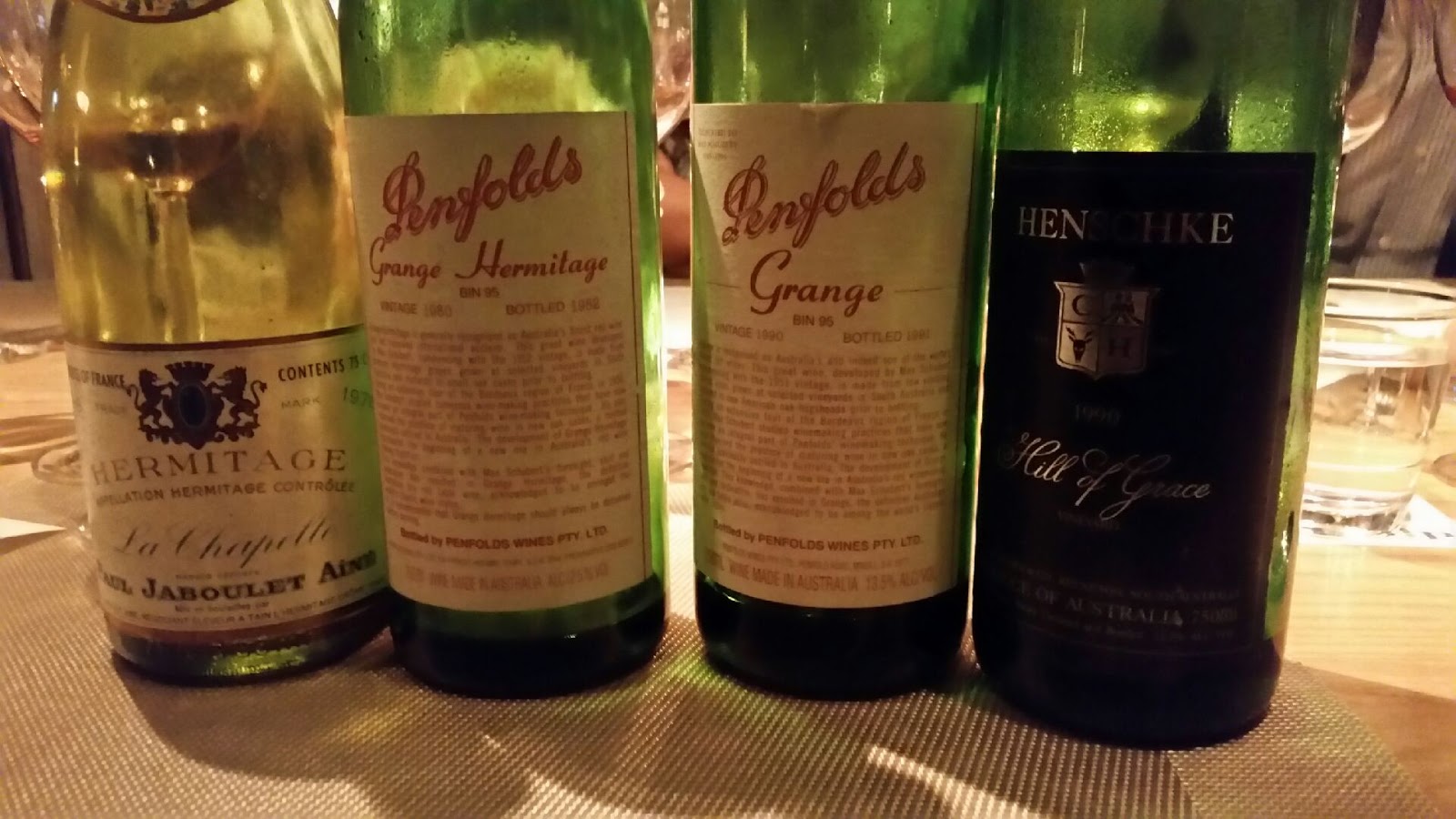
A class above - 1990 Hill of Grace

16 Aug 2016: We finally made it to this long anticipated dinner which was originally going to be a Grange mini vertical dinner. With the passing of time, the theme was swapped for the classic Syrah/Shiraz evening. Impeccable and extremely professional service by the team at Another Place by David Myers @ HIP Cellar, and above all excellent and artistically presented dishes.  There was general consensus that the duck course was the star dish - sadly I did not take a photo - it looked so tempting, that we could hardly wait to tuck into it! 

Marinated kodama watermelon, ama ebi, edamame salad, yuzu kosho

1996 Chardonnay Extra Cuvée de Reserve, Pol Roger 
We started with this champagne. Layers of pear, almonds, brioche, rich and exuberant without heaviness, with creamy mousse and a lively crisp finish. Excellent drop, still very fresh at 20 years! 18/20


2000 Chablis Montée de Tonnerre, Raveneau
Sadly, oxidised aldehyde notes prevented our enjoyment.  This calls for another bottle from the same case to be tasted soon!


The line-up of 4 Syrahs


1978 Hermitage La Chapelle, Jaboulet
Black plum, cardamom, cinnamon, nutmeg, wild herbs, game, black pepper, whiff of VA, vibrant acidity, elegant tannin, very long finish. Not quite the gargantuan 100-pointer that we were expecting. Wine lost its freshness and revealed a dull and coarse palate after about an hour. Worth investigating with another bottle from the same case to see if this wine is at risk of decline. 17/20


1980 Grange, Penfolds
Sweet vanilla, coconut, blackberry, minty chocolate, black pepper, firm structure, velvety tannin, firm acidity. A lush wine with a slightly rustic edge, not quite as suave. Lacked personality. 96% Shiraz. 4% Cabernet Sauvignon. Drink now and over next 8-10 years. 17/20

Interestingly, the 1980 Grange cork did not have any engravings on it.
Just a plain cork.


1990 Grange, Penfolds
Topped up with 2006, recorked in 2011. Blackcurrant, spicy, vibrant acidity, sweet vanilla, coconut, the elegant palate belies a big and powerful structure. This recorked bottle seemed youthful but very ready to please . 95% Shiraz, 5% Cabernet Sauvignon for original vintage. Long way to go. Drink now and over next 10+ years. 17.5/20

Slow-cooked Iberico pork loin, confit fingerling potatoes, yuzu jus


1990 Hill of Grace, Henschke
Gamey, slight hint of black pepper, sweet finish, harmonious, integrated with velvet tannins, minty chocolate, hint VA but enough to detract from its singular beauty and elegance. A stylish wine that has aged magnificently and gracefully. A class above the rest of the flight. Very persistent finish. Drink now and over next 10+ years. 19.5/20 (Very beautifully paired with the duck cooked under sous vide!)


Strawberry shortcake, almond milk, burnt miso ice cream


1882 Ne Oublie, Graham's
Quite different from the Scion. Layers of toasted walnuts, dried orange peel and balsamic nuances. Beautifully integrated. The anticipation from watching the bottle being extracted from the heavy encasement, to being opened, then the pouring and finally the tasting was simply breathtaking. On the palate, there was a freshness that kept the body of the wine lithe and vivacious, whereas from memory, the Scion was more unctuous and opulent. The bouquet lingering on the glass was simply mesmerizing. A very memorable end to a wonderful dinner. 20/20


Our menu - highly recommended!

Monday, 18 April 2016

A Rhone Evening: 1989 vs 1990 Cote Rotie La Turque and 2006 Henri Bonneau Cuvee Marie Beurrier!


15 April 2016: Once in a while, we need a wine theme that's not Bordeaux or Bourgogne (wish it were a joke!). This time the Rhone theme made it to the short list! (A friend did sneak in a couple of non-Rhone bottles.)

2010 Condrieu, Tardieu-Laurent. Golden in colour. Oily texture with a lightness. Honey, candied apricot, honeysuckle, frangipani. Soft acidity. This went rather well with the Thai pizza starter.

2008 Châteauneuf du Pape Blanc, Tardieu-Laurent. Also golden in colour. More lively acidity. Grapefruit, nutty, lanolin, fruit peel.


1989 Côte Rôtie La Turque, GuigalSpice, pepper, liquorice, black berry jam, with nuances of leather, smoke. Very long finish. Quite brûlee in character. Layers of complexity with richness and depth. This wine kept evolving throughout the evening. Extremely long finish. More flamboyant in style.

1990 Côte Rôtie La Turque, GuigalLuscious, bright fruit character, youthful, with lively acidity. Smooth velvety texture. More classic in style. Shorter finish than the 1989.  

(La Turque is approximately 93% Syrah and 7% Viognier.  42 months in new oak.)


2006 Châteauneuf du Pape, Cuvée Marie Beurrier, Henri Bonneau
Plum, white pepper, spicy, fruit cake notes. Velvety texture. Soft acidity. Finished long and a very fine wine! Went very well with five spiced braised beef. 
This cuvee started in 1988. It took the name of Bonneau's aunt. The blend is made from 90% Grenache and 10% Mourvèdre, with small portions of Syrah, Counoise, Vaccarèse occasionally. No destemming normally. Vinification in traditional, concrete tanks. Ageing in a combination of old foudres and barriques.

2007 Châteauneuf du Pape Cuvée Reservée, Domaine du PegauPlum, red fruit, slightly jammy note. It was delicious and correctly made but did  not have the same depth or level of complexity as the previous wine.


2008 Mitis, Amigne de Vétroz, Reserve, Jean-René Germanier (18 months in new oak.) Mango, dried apricot, ripe pear and marmalade with notes of macadamia. Long finish. The wine could do with a bit more acidity. But it's voluptuous and a beautifully balanced drop.

Friday, 11 July 2014

A couple of bright stars from 1974!

9 July 2014:


We did the 1964s earlier....now it's the turn for 1974s......and thank you to the birthday boy for bringing them to dinner at Upper Modern Bistro!

1974 Louis Roederer: Amber gold colour. On the nose it was caramel and honey, toffee apple-like, with notes of roasted hazelnut. We had it served in a white wine glass. Delicate mousse, creamy texture, with a long caramelised finish. Almost like dessert...There was a good deal of complexity, coming in layers on the palate but it didn't quite have enough acidity to give it that extra dimension and lift! 16/20


2004 Chablis Les Preuses, William Fèvre: Pale gold hue. Nose of lemon peel, almond, pear, herbal, lightly spicy. Rich in texture, almost full-bodied. Crisp long complex saline finish. Great detail, precisely structured with such purity. Very classy. 18/20

1974 Cabernet Sauvignon Reserve, Simi Winery: (I did not look at the back but I guess this would be predominant Cabernet Sauvignon, with a minor percentage of other Bordeaux blend grape varieties?) Deep garnet colour. Mineral graphite note, paired with earthy, cherry, plum, with a slight herbaceous note which surfaced with extended aeration in the glass. Medium bodied, delivered great freshness, intensity of flavours and silky tannin. An excellent effort for the vintage! 16.5/20

1974 Cabernet Sauvignon, Inglenook: (Francis Ford Coppola purchased this winery in 1975 intent on restoring the former glory under Gustave Niebaum the founder and his grandnephew John Daniel Jr - so this would have been the last vintage made by its previous owner which was Hublein Incorporated.) Started off being slightly maderised but settled down a little with some aeration. On the palate, it was rich, fleshy, layered and chewy still. The fruit, still very much present, was very ripe (probably over-ripe), dried fruit and cooked prunes, with some dusty and liquorice notes. I didn't like so much the lowish acidity....found it a little cloying and uninspiring. 14.5/20

2001 Barolo Le Rocche del Falletto Riserva, Bruno Giacosa: (This bottle was opened at 3 pm, double decanted after opening, and then decanted at the restaurant from 8 pm till about 10 pm.) Deep garnet colour. Hot tar, tobacco, plum, redcurrant, earthy, liquorice spice on the nose. On the palate, it showed an opulently smooth texture, with perfectly balancing acidity. A powerful wine of immense structure, but rather elegantly presented and nicely proportioned. The finish was exceptionally long! An awesome wine (but I really think it should wait another 6 - 8 years before we enjoy it again)! 18.5+/20

1983 Hermitage La Chapelle, Jaboulet: (Decanted for an hour and a half before we tried it) This seemed rather subdued when served next to the Giacosa! A very attractive bouquet of red fruit, black pepper, herbs, leather, violet, with savoury and earthy notes. Really gorgeous, silky smooth on the palate, with wonderful acidity keeping the palate refreshed, Plenty of finesse and depth. Not a particularly long finish but I did not sense any dryness at the finish. Not a huge Hermitage, but a very elegant one it was and nowhere near its decline. Drink over next 5 - 6 years. 17.5/20

What a treat! The food was totally on form last night....I got my favourite pig's trotter dip, smoked salmon toast and artichoke macaroni. Those who went for the meaty main courses said that the chicken main course was really good! And of course, you cannot miss Jeremy's selection of cheese - I picked for us Comté 48 months, Coulommiers, Abbaye de Tamié, Fourme d'Ambert, a cheese like Saint Félicien but called Petit Mosellan and a couple others slipped in by our very friendly waiter (think one was Colombier). Absolutely delicious...and definitely worth saving room for it!

Tuesday, 22 October 2013

A Gamey Evening

20 Oct 2013: We were going to serve grouse at supper on Sunday, with a few friends. Grouse does have a very strong gamey flavour and it is probably not to everyone's taste. So as the hosts, we made sure we gave our guests some advanced warning, just in case. And what do you serve with a gamey bird? One rather pungent and gamey grape variety did come to mind - Mourvèdre! And we did have one bottle that would feature this grape variety rather prominently: the Hommage à Jacques Perrin


We started with a champagne made with 6 of the grape varieties from the Champagne region: a 2000 Moutard Cuvée des 6 Cépages, disgorged in June 2004.  Medium lemony robe. A gorgeous bouquet of lemon, pear, apple, acacia, with just the faintest hint of toasty notes. A fine creamy mousse, with just enough acidity to balance out the richness on the palate, giving it a harmonious mouthfeel with complex flavours filling out the middle palate, finishing long and smooth. Gorgeous! I doubt we could identify the taste profile of the individual grape varieties but the sum was definitely much more than the individuals! 18/20

Our first course was grilled langoustines, with tarragon butter. These yummy crustaceans were happily washed down with 2001 Bourgogne Chardonnay, Coche-Dury. What a remarkably youthful 12-year-old Bourgogne blanc this was! We all felt rather stricken by this display of seemingly eternal youthfulness. Vibrant acidity giving the wine poise, energy and freshness, with a lively lift at the finish. Slightly waxy, lemon peel and pear notes.

While Richard was serving up the grouse with red cabbage and fried bread, accompanied by a delicious wild mushroom bake brought by our friends, we started on the flight of 3 wines from Southern Rhone. The idea was that we could compare them in pairs. First pair was 1990 and 1989 Rayas. The 1990 Rayas revealed a bouquet of redcurrant, plum, white pepper and tarragon. The palate showed more spicy notes. The fine tannins were still a little astringent. Overall, the structure seemed taut. There seemed more complexity and generosity on the nose than on the palate. Drinking very well now and probably will benefit from further ageing in bottle and can keep for 10 - 15 years. 18/20 The 1989 Rayas, with its deeper garnet colour, by comparison was lush and rich, with a robust structure lying underneath the velvety coating. Redcurrant, even some dried strawberry or currant, layered with notes of spice. A truly sensational Rayas, ticking all the boxes, for balance, opulence, complexity, structure, finish and longevity. Very fine. 19/20

We were supposed to retain some 1989 Rayas in the glass so that it could be compared with the 1989 Beaucastel Hommage à Jacques Perrin. Frankly there was very little comparison to be made, as the styles and flavour profiles were so very different. Here we had an intensely deep, almost ruby colour. The nose was distinctly gamey and sauvage, with very ripe underlying bramble fruit. A very fine and robust structure of vibrant acidity, giving a wonderful lift to the robust and masculine structure. Some astringency at the finish. This made such a fantastic pairing with the grouse and ceps in the mushroom bake. An exotic, utterly toothsome and truly memorable wine. It was quite hard to go back to the lushness of the Rayas after having your senses so awakened by the Hommage à Jacques Perrin. You could drink this now with decanting.....and it will continue to improve over next 8 - 10 years, drinking well way beyond this. 19.5/20

Some of us were still thirsty after these 3 beauties. So Richard pulled out the 2005 Henri Bonneau Cuvée des Célestins. This showed much promise but was frankly too young and drunk too fast! (I didn't really get round to this, being a very slow drinker!)

We finished the evening with a 1966 Graham's. This was unctuous and there was remarkable freshness underneath the layers of rich flavours of cherry, plum, toffee, and fruitcake. Great acidity balancing all this richness. Here we were shown what great ports could do to you - you couldn't stop sipping it! A very long finish.  A formidable tour de force!  19.5/20

These great Châteauneuf du Papes were so magnificent because they were allowed to age gracefully and slowly. I adore southern Rhone wines - I love that boldness, that ruggedness wrapped up in that herby and spicy veneer, that wild untamed beauty. And needless to say, the grouse-Hommage à  acques Perrin pairing was simply spot on......I was left speechless!

Sadly that might have been our last bottle of Hommage à Jacques Perrin!.......It will be very interesting if one could retaste the 1989 pair in 10, 15 and 20 years' time! And time will be the judge!

Monday, 8 April 2013

The Class of 1990: a great all-round vintage

8 Apr 2013: Alfred and Maria treated us to dinner at Ming, a new restaurant in Causeway Bay (5 Moreton Terrace) that seems to be on everyone's lips and comes with very good pedigree: a manager-owner with great track record gained from Victoria City and Fan Tang and a team of chefs who have worked at Victoria City, Fan Tang and Fu Ho. Alfred chose the menu extremely well, heeding the fact that we were expecting some rather big wines. We started with a number of starters, including Shun De style spare ribs, deep-fried lemongrass spare ribs, and Shanghainese style stir-fried shrimps. This brilliant array of starters was followed by steamed crab in chicken fat and Shao Xing wine. The braised garoupa with bean curd was simply delicious and worked wonderfully with the 1990 Ausone. The rich sauce of the braised goose webs and dried Chinese mushroom was no shy partner to the 1990 Haut Brion. The skin of the deep fried chicken was wafer thin and crispy, topping the succulent and flavoursome meat. A pinch of the five spice-salt on the chicken did wonders to the enjoyment of the 1990 Haut Brion! The final dish was a stir fried beef cubes with wild mushrooms was just what we needed to go with the bigger 1990 Hermitage La Chapelle.
The class of 1990
My brief notes on the wines:

1990 Dom Perignon: Deep lemon core. Notes of brioche, acacia, nuts, rich apple tart, coffee and caramel. Still preserving the very fine persistent bubbles but less of that zest on the palate. Much more evolved than the last bottle we tried. 17.5/20

1990 Krug: Deep lemon robe. Compared to the Dom Perignon, this showed much more energy and verve. The very mature Krug nose of toffee apple, digestive biscuits with acacia, stem ginger and cinnamon. Mature, but still vigorous.Still very fresh on the palate, the creamy mousse delivering a very long and complex finish. Seriously delicious. It went very well with the steamed crab in chicken fat and Shao Xing wine. 18.5/20
1990 Chevalier Montrachet, Michel Niellon: Lemon core. A very expressive bouquet of saffron, cinnamon, ginger, fig, pear, honeysuckle, with layers of beeswax, toast and grilled hazelnut nuances. Some mineral notes still linger on the palate, enhancing the rich and intense flavours, just balanced by the assertive acidity, and finishes long and spicy. 18/20

1990 Mas de Daumas Gassac: Garnet core. A very sauvage and aromatic bouquet of garrigue, dried lavender, herbal, plum, with notes of menthol. Supple, good acidity, smooth texture, slightly astringent finish. We tasted this wine blind and it took all of us by surprise how well it showed because one would expect this wine to be drunk within 10 years of its life! 17.5/20

1990 Ausone: Bricking at the rim. Very tertiary nose of animal, leather, graphite with some blueberry and five spice notes, and a hint of orange peel. Lowish in acidity. Rather weak mid palate, the fruit seems to have receded. Dryness on the finish. This bottle probably past its peak and on the decline. I think storage could be a possible explanation here. 16/20

1990 Haut Brion: A very unmistakable and alluring Graves nose of blueberry, cassis, plum, graphite, gravel, cedar and cigar smoke. Supple and well-chiseled. Very classy palate that shows intensity, breed and complexity, within a medium frame of fine ripe tannin and a good level of acidity. A long and fine finish. Can definitely be enjoyed now and for the next 10 - 15 years. 18.5/20

1990 Montrose: Ruby core, just a little bricking at the rim. A bold and intense bouquet of dried fruit, raisin, fig, cassis, stewed blackberry, with hints of eucalyptus and graphite. More mineral notes on the fleshy palate, with palate-staining flavours coating every corner of your palate. Remarkable richness, concentration and power, bolstered by vibrant acidity. This wine took a while to open up. A massive (in every sense) and brooding wine that is going to take some years to unwind fully but it is drinking perfectly well today with all its pomp and fanfare. Try again in 5 years' time and drink over the next 20 - 25 years! 19.5/20

1990 Hermitage La Chapelle, Jaboulet (from magnum): This would be my favourite wine of the evening, with the 1990 Montrose closely behind. A very sophisticated expression of Syrah and its most pedigree terroir. A gloriously youthful bouquet of black cherry, blackberry, plum, violet, pot pourri, black pepper, with spices of cloves and liquorice and savoury notes. On the palate, the wine showed plenty of vigor and power, with very profound depth and multi-dimensional character. The velvety structure belies the very ripe tannin, which has totally integrated into the texture of the wine, and a freshness that begged you to return to the glass (and the magnum bottle) again and again. Incredibly long and complex finish. Totally seductive! There is definitely no hurry to drink up this wine, which will continue to drink well for 25 - 30 years. Yet why wait, when it can be so dazzingly beautiful and an absolute nectar to imbibe right now! 20/20

What a marvellous line-up! One thing that was clear was the importance of storage and provenance. It's a very good sign that a fabulous dinner was enjoyed by all when the next dinner date was already agreed before the end of the evening!

Wednesday, 20 March 2013

Birthday Treats

20 Mar 2013:  Last weekend, we were treated to a couple of post birthday celebrations:


The first of which took place at The Principal where the chef delivered a truly Michelin-starred array of dishes for us. I particularly liked the slow-cooked egg with artichoke and truffle and the suckling pig, with lemon puree, endives and thyme jus.

1990 Dom Perignon: Straw lemon colour. A very fresh and fragrant bouquet of apple compote, brioche, honey, grilled almonds and ginger. Underneath the creamy mousse of very fine bubbles, the tension and energy is very evident, with vibrant acidity and minerality on the finish. Finishes long and crisp. Enjoy now or over next 6 - 8 years. 19.5/20

1990 Krug: More golden amber in colour. The evolved nose reveals the richness and opulence from caramelised notes of coffee, nougat and hazelnuts. The firm acidity livens up the richness and smoothness in the texture of the mouthfeel. This is a great food wine (it went very well with the slow cooked egg!), to be enjoyed now but there is no hurry to finish this. 19/20

2000 Chevalier Montrachet, Bouchard: Exotic fruit and white flowers dominate this gorgeous bouquet with herbal nuances. Initially little tight on the palate, but with aeration, this takes on weight, elegance and complexity. Love the minerally finish. 18/20

1993 Chevalier Montrachet, Leflaive: This is class act, combining maturity, flamboyance, concentration and depth, a very authentic expression of the terroir. The fine details are not lost in the layers of liquorice, nutty, toasty and vanilla notes. Finish goes on and on. 19/20

2001 Chevalier Montrachet, Michel Niellon: A nose of citrus confit, spice and nuts. The palate is painfully stony and austere. The wine seems to be encased in a woody corset, refusing to harmonise. Everything about this wine is of gargantuan dimension, but I cannot find the harmony in all this. 16.5/20

2001 Clos Saint Denis, Ponsot: A brilliant ruby core. The nose is all about purity of red fruit, with a sappy note on the palate. Refined and delicate. A very elegant and classy Bourgogne. Finishes long. Drink now and over next 8 - 10 years. 18/20

2001 Richebourg, Anne-Françoise Gros: Sappy, herbal, earthy and gamey notes dominate the nose. Balanced and nicely structured, but not an outstanding effort. Seems to have reached peak. Drink now and over next 4 - 5 years. 16.5/20

2000 Chambertin, Rousseau: I rather liked this. An expressive wine that speaks of class, power and depth. There was the purity of red cherry, layered with savoury, underbrush, coffee,mushroom, and earthy nuances.  This is not a typically powerful Chambertin, but rather a subtle display of character and depth, with plenty of complexity and suppleness. 18/20

1990 Hermitage, Chave: This really is a fantastic wine. Blackberry, leather, pepper and savoury notes pack out the intensively complex bouquet. The palate was a sensational explosion of palate-staining flavours, with a very very long finish. An incredibly complete wine that probably deserved more time than we gave it. My best wine of the evening! Drink now and over next 15 - 20 years. 19.5/20

1990 Clos des Papes: A true to form Clos des Papes. Fullness in every sense: a very complex nose that almost resembled port, medicinal, slightly sappy, with notes of kirsh, prunes and figs. The fleshy palate was a velvety display of very fine and ripe tannins, bolstered by vibrant acidity, keeping this rich nectar fresh and alive. This is drinking beautifully now, and needed the right food to go with it. Braised lamb shank or a venison stew would be quite perfect with this! Loved the long and complex finish. Drinking now and over next 10 - 15 years. 19/20  


The second dinner we were invited to took a rather different format!  We all had to guess the wines, with the help of tasting notes by experts (without the name of the wine and the vintage!).  It was quite interesting to see how we all drank quite a bit more at these blind tastings, which no doubt helped the atmosphere of the room!  We started with 2004 Taittinger Comtes de Champagne, which was nicely taut on the palate. The purity and energy of the wine was very admirable and I adore the zinginess and minerality on the palate, with notes of lemon, Granny Smith apple, white flowers and crushed stones!  For white wines, we had a 2002 Chevalier Montrachet, Vincent Girardin with the unmistakable ripe pear, peach, floral, smoke and toasty notes (perhaps more evolved than expected) and a honeyed and lanolin-like 1990 Laville Haut Brion Blanc.    My best wines of the evening were the double magnum of 1995 Masseto (100% Merlot) and the 2001 Domaine de La Janasse Cuvée Chaupin (100% Grenache).  I really enjoyed these single varietal wines and admired how brilliantly they expressed the sense of place!  The 1992 Grange was the final red wine and perhaps it paled a little in comparison to the 2 previous wines.  It did not possess the power and concentration of the best vintages, but it showed a very refined structure of smooth fine-grained tannin, perfectly balancing acidity and lush and spicy notes of liquorice, menthol and blackberry.   The 1997 Yquem was unctuous and a delight to enjoy its bright golden robe, intense notes of honey, marmalade and acacia, with a nice clean finish, not cloying.  I must confess to preferring this to the birthday cake!   Thank you so much to our generous hosts!      

Wednesday, 6 March 2013

A Nice Treat: 1996 Salon

2 Mar 2013: I was recently treated to a very yummy dinner at Bonheur, a fixed menu restaurant which I hadn't been to for almost 6 or 7 years.  If my memory served me right, then both food and service had really improved.  I started with a Caear salad with smoked eel - I really liked it, the Caear Salad perfectly dressed, without the distraction of over garlicky and greasy croutons, and the smoked eel had a lovely firm texture and a delicately smokey taste.  The Irish razor clams were available as a starter but I asked the restaurant if they could do a pasta dish for me with the razor clams instead. Spaghettini cooked al dente, with garlic and olive oil, spiced up with some chili.  The razor clams in garlic butter nicely perched on top of the pasta.  It was yummy! The rather substantial portion of pasta left me with no room for desserts, but the souffle and apple tart looked rather appealing!

As for the wines, we started with Salon 1996.  A gorgeously bright lemon robe. A very expressive nose of fig, pear tart, ripe apple, acacia, fig, acacia, with smokey and shortbread notes.  Medium bodied and well delineated. Creamy mousse, firm acidity, lots of precision, giving this an invigoratingly long, complex and minerally finish.  Still very much in its youth but sensational!  19.5/20

1982 Château de Rozay, Condrieu: This was the biggest surprise of the evening, as everyone had expected it to be over the hill.  Medium lemon colour.  Intense and elegant bouquet of honey, toasted almond, quince and pear.  Some richness on the palate, giving a medium-full body. Amazing how the wine is holding out, despite the low-ish level of acidity. Crisp and honied finish.  A fabulous match with the razor clams in garlic butter. Drink now. 17/20

1995 Hermitage La Chapelle, Jaboulet: Deep garnet.  Black pepper, plum, chocolate, liquorice with some savoury notes.  Medium bodied.  Lacks concentration and depth, but still an elegant expression of Hermitage.  A drying sensation on the finish which carries a hint of sweetness of the Syrah grape.  Quite a rustic style. Drink now and for next 8 - 10 years. 16/20

1986 Pichon Baron: A very Pauillac nose of cedar, blueberry, blackcurrant, with earthy and leather notes.  A lighter weight Pauillac with a relatively loose structure, that focuses on elegance and freshness than concentration and richness.  Slightly astringent finish but does not detract from the enjoyment of the wine. Drink now.  15/20

1998 Darmagi, Gaja (in magnum): Deep ruby colour.  Black cherries, forestberries, liquorice, chocolate with smokey, tar and herbal notes.  An opulent wine, well balanced and structured with velvety tannin and relatively modest acidity, compared to most Italian reds.  Needed some aeration to shake off the initial austerity.  Initially tight on the finish, and slowly opening up to give a smooth and complex finish.  Definitely a wine to go with food. Drink now and over next 6 - 8 years. 17.5/20

1998 Yquem (in half bottle): Lovely golden colour.  Intense perfume of honey, apricot tart , pineapple and acacia notes.  There is nice complexity, accompanying the richness, without the viscosity, weight or density of the greatest vintages.  A refreshing Yquem with long ageing potential, though perfect to be enjoyed now from half bottle formats. Drink now or keep for next 20+ years.  18/20

The restaurant was rather accommodating in terms of number of glasses per head.  We had 4 per person, plus a dessert wine glass at the end.  Excellent service! 

Tuesday, 23 October 2012

1983 Chave Hermitage

14 Oct 2012: Garnet robe.  A mature nose of animal, violet, coriander seeds and earthy notes. Just perfectly balanced with firm acidity and the sweetness from the ripe fruit, with a velvety texture.  An honest wine, perfect now.  Drink now and for next 5 - 6 years.  17.5/20

Thursday, 16 August 2012

Beauties from Central Italy

16 Aug 2012: Wine tasting dinner earlier this week and the theme was 'Anything Red but Bordeaux'. We went to Zhejiang Heen (very tasty food!!)  The food was Shanghainese (or nearby) cuisine, with all the usual favourites, such as braised meatballs, honeyed ham sandwiches, stir fried chicken and pine nuts in a rice crispy cone, smoked fish, and crispy eel, etc. Given the theme, the wine selection was rather eclectic amongst the 16 people who attended.  There were some rather big and powerful wines, such as the inky dark monolithic 2008 Joseph Phelps Insignia, with painfully intense aromas and flavours of cassis liqueur, blackberry jam, liquorice and tar, packed into an unctuous texture with ripe but very toothsome tannins. Great concentration, lengthy finish but it really wasn't ready, even with the 2.5 hours of decanting time.  Try again in 5 years time.  The 2005 Chave Hermitage was equally backward and needed every bit of the 2.5 hour of decanting time that we gave it.....but it could do with tons more. Compared with the 2003 that we had recently, this was made in a slightly more austere style (earthy, herbal and spicy notes) with quite angular tannin and bright acidity, quite extracted, which would require a lot more patience to mellow to display its superior heritage.  Should give it another 8 - 10 years before enjoying again, with a very long life ahead.

What really impressed me and what really went so well with the food were the Italian wines!  I was particularly impressed by the magnum of 2001 Sportoletti Villa Fidelia, a Bordeaux blend mainly consisting of Merlot with some Cabernet Sauvignon and Cabernet Franc, from Umbria.  Made by the Sportoletti family, with advice from Riccardo Cotarella.  Lovely cedar, graphite, blackberry, blueberry and liquorice notes, with velvety tannins and marvellous intensity and balance. A very charming wine, an absolute pleasure to drink now and went amazingly well with the braised meatballs and honeyed ham sandwiches! Drink now and for next 6 - 8+ years for optimum enjoyment. 17.5/20

The other wine I really liked and which I thought went beautifully with the crispy eels (and other dishes!) was the 2003 Isole e Olena Cepparello (100% Sangiovese from the estate's best sites in northern Chianti Classico, aged in French barrels for about 18 - 20 months).  I loved the gorgeously classic bouquet of floral, plum, cherry, spicy liquorice and some earthy notes, with a most elegant structure and balance of acidity and ripe velvety tannin.  There was this wonderful definition of generous ripe fruit and balance that gave the wine much elegance and poise, without any signs of over-ripeness from the hot vintage.  A beautifully crafted wine with a very long finish, bravo to the proprietor Paolo de Marchi.  Drink now and for the next 10 - 12 years. 18/20

The 2004 Argiano Brunello di Montalcino was a little muted on this evening.  It could have done with a bit more aeration to flaunt its elegance and finesse. There was some hint of ripe fruit but it lacked depth and intensity on the palate.  

While on the subject of Italian beauties from Central Italy, I enjoyed a bottle of 1998 Falesco Montiano last night with a few friends and was absolutely delighted by a most charming and elegant wine, fashioned out of 100% Merlot from Lazio, aged in French oak barrels.  A mature bouquet showing black cherry, plum, chocolate, liquorice, tobacco and some hints of leather.  The palate was a very smooth, cashmere-like texture of silky tannin, with just sufficient acidity to give the wine a very harmonious structure to pair with the eggplant parmigiana that I made.  Gorgeous effort (the wine and my eggplant parmigiana).  Loved the long finish! 18/20

Sunday, 26 February 2012

Syrah and Shiraz

19 Feb 2012:  The theme was a very broad one: Syrah or Shiraz.  No vintage or region was specified.  So the bottles that everyone brought did cover a wide scope but what was interesting was that after all said and tasted, all displayed a true expression of variety and regional characteristics.  Wines from  cooler climate regions faithfully showed more peppery character and a less chunky frame and those from warmer climate regions something a little more beefy and a more hefty structure and richer texture.

All the wines were served blind (except they were known to the owners of the bottles).  To keep us focusing on the wine, I had kept the food simple: steak, lamb chops and sausages on the barbie, with some eggplant curry, spicy chickpeas and salad.  Everyone had to say something about each wine, before the owner revealed the identity of the wine.

1992 Hermitage Blanc, Guigal: Still showing an unmistakable Marsanne nose of honey, quince, grilled nuts and a hint of marzipan. Not much acidity left, hence a slightly cloying feel on the palate endowed with richness and weight. Still drinkable but past peak.

1990 Seppelt Show Sparkling Shiraz: First time trying a sparkling shiraz with such age.  (I've never really quite understood sparkling shiraz, so it was very interesting for me to try this sparkling shiraz with age!)  I didn't know what I was expecting, but probably something like leather and spice. Still showing a lovely creamy mousse and persistent bubbles, the immediate impression was how youthful this tasted, displaying such sweet plum and blackcurrant fruit, with hints of pepper and liquorice. Karen and I both thought it was rather like a sparkling blackcurrant fruit juice!

1990  Underhill Shiraz, Yarra Yerring: From Yarra Valley, Victoria, Australia.  100% Shiraz.  Made from vines planted in 1974, from soils with a high clay content.  Use of stalks prevalent for this cuvee from Yarrra Yerring.  A lovely herbal garden perfume of garrigue, brushland, earthy, with leather and savoury nuances complementing some dark cherry notes. Elegant and graceful, harmonious, within a medium body with well-integrated fine tannin and mild acidity.  Drinking very well now and for another 10+ years.  (http://www.yarrayerring.com/)

1996 Reserve Syrah, Kathryn Kennedy Winery: From Saratoga Santa Cruz, California, USA. (Thank you, Vernon, who dutifully decanted the wine at home before getting into the taxi!) This really was lovely. Harmoniously rich in texture and intense in flavour, with a depth of character, that belied its New World identity.  Dark fruit, pepper, liquorice and floral. Soft ripe tannin.  Loved the chewy texture and freshness on palate. Not particularly high in acidity.  A very fine example of extremely high quality Syrah from the New World. (http://www.kathrynkennedywinery.com/)

1971 Penfolds Grange, reconditioned in 2004: Strictly this did not qualify, as it was 87% Shiraz and 13% Cabernet Sauvignon.  A blend of grapes from Kalimna Vineyard, Barossa Valley, Magill Estate, Adelaide, Clare Valley and Coonawarra.  As it was reconditioned by the Recorking Clinic in 2004, David said it could have been topped up with the 1998 vintage. Menthol, spicy and peppery, but rather dominated by baked blackberry fruit and raspberry preserve.  Given how "this was always considered one of the great vintages of Grange" (best since 1955), this was a little disappointing in complexity and character.  There was a good display of medium firm tannin and a good level of acidity in the robust structure, but what seemed to be missing was some tertiary character (smoke, savoury, earthy) to give credibility to its age. I wonder how much of the more recent vintage was used to top up.  Could it have been topped up with the same wine from the same vintage, rather than tweaking with a younger vintage?? (http://www.penfolds.com/)

2005 The Laird, Torbreck: A 100-pointer wine from the Wine Advocate.  First vintage of this brandnew wine from David Powell.  From a single 2 hectare vineyard of Shiraz in the Marananga sub-region in Barossa planted in the 1960s. Aged for 3 years in new French oak barrels. 14.8% alcohol. A powerful wine, harmonious and elegant at the same time.  Loved the sweet and opulent nose of plum, dark cherry, fruitcake, black pepper, roses, herbal and menthol with savoury nuances.  A good dose of acidity, giving freshness to the rich texture of very ripe and velvety tannin. Mouthfilling, with plenty of concentration and complexity.  A wine with everything in sync, leaving you not asking for much more!  Finishes extremely long.  Better enjoyed with a few more years of bottle age.  From 2015, with another 15 - 20+ years ahead! (http://www.torbreck.com/)

2000 Côte Rôtie La Landonne, Guigal:  100% Syrah.  Pepper, plum,  blackberry, liquorice, kirsch-like, with some earthy, leather and mineral notes.  Elegantly structured.  Rather simple and much less interesting when compared to the far more superior 1999 vintage (which we were rather generously treated to by Stephen just 2 days before this dinner - Stephen had his wine decanted for about 3 hours before we tried it).  Perhaps it would have benefitted from a longer decanting time.  Not a hit with us.  Definitely drinking well now and for the next 6 - 8+ years.  (http://www.guigal.com/)

2004 Poker Face, Sine Qua Non: A 100-Parker pointer wine.  96% Syrah, 2.5% Mourvedre, and 1.5% Viognier.  Vines from  the Eleven Confessions, White Hawk, Alban, Bien Nacido, and Alta Mesa vineyards in Santa Barbara.  At 15.5% alcohol, it was more like a fortified wine to me than a wine.  In fact, I left it to pair with the chocolate brownie dessert.   Dark chocolate, raisin, dried prune, fruitcake, blackberry, very dark cherry jam, kirsch with some nutty and toasty oak character (reminiscent of a black forest gateau).  Totally explosive on the palate, mouthfillingly unctuous, totally intensely flavoured ripe fruit character.  Mind-boggling purity, intensity, concentration and density (only wish there were less alcohol!).  Dense and opulent, this wine deserved a much longer decanting time than we had given it......in fact, if I had a bottle (which I don't), I would probably leave it for 5 - 6 years before trying again! 

1969 Dom Perignon Oenotheque: George introduced to us this concept of 1969 Dom Perignon Oenotheque and Pu-Erh tea to cleanse our palate (and our head) before leaving the party!  Honey, yeasty, marzipan, dried apricot, slightly spicy, and Chinese liquorice, with that very particular bitter-sweet quality analogous to the flavour of really good quality Pu-Erh tea (unfortunately, our supply at home was not of this quality). A fully mature wine and to be drunk now!  A rather nice way of ending what was a most indulgent and educational evening. 

It was a wonderful way to share bottles!  I was most impressed by the Kathryn Kennedy bottle which for me gave the best balance of style, character, elegance and power.  The sheer power and concentration of The Laird and Poker Face rendered most of us speechless but I would prefer to try them again in 4 - 5 years' time.   Thank you so much to our friends who brought all these great and interesting bottles!  (Next time, we should start an hour or two earlier, so that we would have more time to finish the bottles!)