Showing posts with label Fine Dining. Show all posts

Monday, 17 September 2018

Enchanted by Sangiovese

Sep 2018:  On our way to the Panzano in Chianti Wine Festival, we took the opportunity to stop by in Florence for a few days to visit the historic city. We decided to try a different expression of Sangiovese from different regions of Tuscany during our four evenings.

2014 Poggio Valente, Fattorio Le Pupille (based on Sangiovese, with Alicante and others), IGT Toscana
A very pleasant wine that at once delights with its freshness and elegant expression of Sangiovese lifted by the addition of Alicante. Vineyard in Pereta in Maremma. Vinified in 500-600 litres barrels. Silky texture delivering a delicately rounded mouthfeel, lifted freshness, complemented with the openness of bright red cherry and a floral character, spiced with balsamic, that is so endearing. The readiness to approach belies a linear structure and a refined elegance. A medium length finish. A beautiful that deserves to be enjoyed now, but equally over the next 6-8 years. 16.5/20


2014 Nipozanno Chianti Rufina Riserva, Marchesi FrescobaldiA well-proportioned Chianti with balance, freshness, a measured dose of complexity and a Rufina elegance that makes this wine so attractive. It delivers the expectations of a fine Chianti that would go well with a Florentine steak.  Where it let down on depth or length, partly due to the vintage, it definitely gained on elegance, finesse and a very readily approachable charm. 16/20


2010 Asinone, Poliziano, Vino Nobile di Montepulciano DOCGThe wine took half an hour in the glass to come together. When it did, we tasted a wine with the richness and immense concentration expected of the vintage, with layers of complexity that combined dried red berries, balsamic, tea leaves and coffee notes, and a refined savoury minerality at its core. An intense expression of Sangiovese with a unique personality and a very persistent finish. A beautiful wine that is sensibly priced. Asinone is only made in the best vintages. Aged in French barriques. Compared with wines from the more illustrious DOCG in Montalcino, this less fashionable example from Montepulciano DOCG delivered excellent quality for its price (as far as Michelin-starred restaurant price lists go)! 17.5/20

This bottle we tried at Il Palagio at the Four Seasons Hotel in Florence.  The service was professional and friendly. As it was a balmy evening, we were able to take our dinner outdoors. The vegetarian starters were particular highlights!

This is a 2015 vintage bottle whereas we had the 2010 vintage.

2012 Percarlo, San Giusto a Rentennano, IGT ToscanaA wine at once immensely alluring to the nose and the palate. Percarlo is a blend of 6 Chianti crus.  A suave and elegant Sangiovese, with balance, intensity and depth, vibrancy, purity of bright fruit and a finesse that transcends from initial attack to the persistent finish. Notes of redcurrant, cranberry, dried herbs overlying a mineral core. It is a very fine example of Sangiovese at its best. Still very youthful and will develop well over next 6-8 years. A modern classic.  18.5/20

We enjoyed this bottle at Enoteca Pinchiorri.  The service was formal, professional and very appropriate for its 3-Michelin star status. The food was exceptional, in particular the risotto with deep fried marrow and capers with red pepper reduced sauce, and the pigeon baked in a chocolate crust. What I found of particular interest was that there seemed to be two dining rooms in the restaurant and every table in our dining room was occupied by foreigners.  Could it be that they put the locals in one room and the foreigners in another???

It was also a little strange that we were not given petits fours with our coffee.......our hope for a little souvenir gateau was sadly squashed too as we were escorted into our taxi at the front entrance!  


The sensational risotto dish, with deep fried bone marrow and capers


The yummy pigeon dish with an original mango chutney and caramelised carrots

Monday, 13 August 2018

Delicious Cheeses from the West Country: much more to offer than its world-famous Cheddars

August 2018: Last week, we managed to squeeze in a quick visit to the West Country (UK) to our summer holidays. This has been a hot and dry summer in the UK, with occasional heatwave spikes. The West Country is an area located in the southwest of England, comprising typically the counties of Dorset, Somerset, Devon and Cornwall (as delimited in the PDO rules for West Country Farmhouse Cheddar), but sometimes including Wiltshire, Gloucestershire and Bristol. To say we 'visited' was perhaps an exaggeration, but we did cover a few kilometres in the counties of Dorset and Somerset, driving through the unusually dry landscape of rolling hills and cows in search of the sparsely distributed green spots. With relatively modest altitudes of the hills, cooling influence from the English Channel was a welcoming feature.


It was at dinner at Little Barwick House where we were able to try a few fine examples of this area's cheese offerings. For this evening's cheese selection, the restaurant featured the following cow milk cheeses: Mrs. Montgomery's Cheddar, Wedmore, Cornish Yarg, Tunworth, Sharpham Brie, Isle of Wight Blue, Bath Blue and two goat milk cheeses: Little Wallop and Driftwood.


Clockwise from far left: Mrs Montgomery's Cheddar, Wedmore, Cornish Yarg, Tunworth, Driftwood, Isle of Wight Blue (hidden behind the Bath Blue), Bath Blue, Sharpham Brie, No. 1 Little Wallop in the middle


I was keen to try those that were new to me - so I selected the following:

Clockwise from far left: Bath Blue, Isle of Wight Blue, Sharpham Brie, Driftwood, No. 1 Little Wallop, and Wedmore (front centre)

Wedmore: this is a cheese made with pasteurised cow's milk (Holstein-Friesian) and vegetarian rennet, produced by Westcombe Dairy near Shepton Mallet in Somerset. It was a cheese originally developed by the Duckett family, being an adaptation from the recipe for Caerphilly, inspired by the lush country landscape. The resulting cheese balances the rich crumbly flavours with a refreshing lactic tang spiced with the piquant and herbal character of chives. Dry natural tan-coloured thin rind with some white/grey mould spots. A pale cream paste with a thin olive-green band of chives in the middle. The texture is firm but supple and slightly crumbly to taste. Citrus tang adding to the mildly salty, lactic creamy notes, with just a hint of smoke overlaying the piquant vegetal flavours. Zesty finish with a mineral aftertaste. Perfect picnic cheese. Apparently very good melted on toast too!


Sharpham Brie: This soft-ripened bloomy rind cheese from Sharpham Dairy, Devon is made with unpasteurised Jersey cow's milk and vegetarian rennet. The example I tried had a nice maturity and was already showing orange spots through the white rind. The paste was a creamy yellow colour, more densely packed and firmer than a Brie, more like a Coulommiers. Mildly salty, with just a faint hint of mushroom and earthy notes over the buttery flavours. Finishes with a distinctive bitter aftertaste. The version we had was a 300g square but it can be available in 500g and 1.2kg rounds.


Isle of Wight Blue: Despite the fact the the Isle of Wight is not part of the West Country (it lies in the English Channel, off the coast of Hampshire, but part of it shares the chalky soils dominating the Dorset hills), the restaurant manager and co-owner of the Little Barwick House told us that she allowed this deviation as this cheese was too good to be excluded. It was an excellent recommendation! Ash-covered blue cheese made with pasteurised Guernsey milk from the Arreton Valley, produced by the Isle of Wight Cheese Company. Sold between 3-5 weeks of age. This was first developed in 2006. The natural rind was covered with green, grey, blue and white moulds, and the ivory paste was rich and creamy with an even distribution of blue mould. The taste was buttery and mineral, with the piquancy of blue mould and complemented with a nice dose of salt. It is a tiny cheese about 200-230g in weight, perfect as the centre-piece of the cheese board.


Bath Blue: A blue-veined cheese made by the Bath Soft Cheese Company at Park Farm, near Bath using organic pasteurised cow's milk (Holstein-Friesian) and following the Stilton recipe, aged for 8-10 weeks. It has a dry natural rind, with some white/grey moulds, and a matt yellow paste with evenly spread blue mould. The mineral and piquant flavours from the blue mould are entirely harmonious with the buttery flavours, complemented with a citrus tang. It finishes with a fermented tangy and clean aftertaste. This superb cheese won the World Cheese Champion at the 2014 World Cheese Awards.


No. 1 Little Wallop: Another great centre-piece for the cheese board. A small (140g) goat milk cheese, made with pasteurised milk and vegetarian rennet. The cheese, a collaboration between Alex James and White Lake Cheeses at Bagborough Farm, Somerset, is washed with Somerset cider brandy to heighten its pungency and distinct fermented tang. Covering with vine leaves also helps the cheese retain moisture, giving the creamy cheese an urgency to ooze out after opening. This example was very mature and started to show notes of ammonia, amidst the distinct caprine aromas. A strong cheese.


Driftwood: Another fabulous cheese from White Lake. A log-shaped ash-covered goat cheese made with thermised milk and vegetarian rennet. There was a blue/grey downy rind, and an ivory coloured silky smooth paste that turns to creamy and runny at room temperature. The aromas were reminiscent of hay, meadows, with a sharp citrus tang at the finish.


This was a very indulgent way to end a delicious meal at the Little Barwick House, a restaurant with rooms in Somerset, run by husband Tim (chef) and wife Emma (restaurant manager) team who took over in 2000. Every dish was a harmonious and beautifully presented assembly of flavours. The style of cuisine was classic, with contemporary delicate touches. The tables were well-spaced and there was a lovely refreshing breeze that drifted in from the opened windows. It was not our intention to overhear other people's conversations but we could not help picking up the flow of compliments offered to the chef and team by fellow diners. Richard particularly enjoyed his aperitif selected from the wine by the glass list - a Reid Wines Blanc de Blancs supplied by his favourite merchant in the West Country - another great local touch to this charming restaurant. We look forward to returning for a proper stay (www.littlebarwick.co.uk) .


After returning to London, we visited a couple of cheese specialist shops and managed to try some more fine cheeses from the West Country:

Rachel: an award-winning cheese from White Lake. A washed rind cheese (with brine), made with thermised goat milk and vegetarian rennet. It has a thin orange-coloured rind, with occasional spots of red/orange, with a pale ivory paste. The taste is very faintly lanolin, with nutty, floral, sweet hay notes. The finish is clean and mineral. This is a 2kg cheese. I tried this at The Fine Cheese Company, London.


Katherine: This is the raw milk version of Rachel, made with unpasteurised goat milk and animal rennet, washed with Somerset cider brandy. It has a more distinctive orange coloured rind, with spots of grey and orange on the dry rind. The paste is a cream colour, firm but supple and densely packed. It has a slight granular texture. Initial attack is a trigeminal piquancy, then the palate is filled with umami flavours, overlaid with sweet ripe apple and tropical (pineapple) notes, finetuned with the sweetness of hay. Only a very faint hint of goat character is detected. The finish is persistent with a piquancy that refreshes the palate. This is available in 250g and 2kg. We tried this at La Fromagerie, Marylebone, London.


This was my selection: Washbourne (sheep), Single Gloucester (cow), Katherine (goat), Bosworth Ash (goat).


I will follow with a separate blog on Suffolk/Norfolk cheeses.

But I wanted to add two more cheeses that we also tried and are worth recommending:

Bosworth Ash: Ash-covered log-shaped goat cheese made with unpasteurised milk and animal rennet, from Innes Cheese at Highfields Farm Dairy, Staffordshire. The natural rind showed blue/grey mould, under the rind was a tan-coloured halo, around the silky white paste. The cheese on the cheese platter was nicely matured and the paste was firm and had a granular/chalky texture that melted in the mouth, hanging onto the palate like fudge. The flavours were a mix of sweet vanilla balancing the light saltiness, turning to pineapple and grassy, before hitting the almond and marzipan notes, with a hint of citrus tang lingering on the clean finish. We tried this at La Fromagerie, Marylebone, London.


Beauvale: A softer, milder, creamier take on Stilton produced by the Cropwell Bishop Dairy in Nottinghamshire. The cheese takes its name from the Vale of Belvoir. It has a cream coloured paste with evenly distributed blue mould and a thin natural rind. It has a rich velvety texture, combining the delicate piquancy of the blue mould with a decadent rich buttery flavour. The closet description would be Gorgonzola Dolce. A remarkably rich, creamy and indulgent blue cheese and best with a glass of chilled 20-year Tawny!

This was Richard's selection: it's obvious he loves washed rind....Maida Vale, Limburger and Stinking Bishop all on the same platter!

Monday, 19 February 2018

A Valentine's Day Special with 2004 Ramonet and 1993 Musigny

14 Feb 2018:

A Valentine's Day special for us and two dear friends - we decided to venture out to Kowloon Bay to be pampered by Chef Edward Voon's creative culinary skills at Le Pan.

We started the evening with a glass of the menu champagne which was a Dhondt-Grellet Premier Cru Rosé NV, before we moved onto the main wine characters of the evening.

The two 2004 Ramonet wines were such contrasts that made them so perfect throughout the entire menu. We darted between them to find the best pairing with Chef Edward's dishes.


The 2004 Ramonet Bienvenue-Bâtard-Montrachet was infused with bright minerality, lovely citrus and yellow fruit and frank purity, balanced with freshness and character. The caviar with langoustine tartare delivered a very just pairing with the Bienvenue, with the saline character of the caviar complementing the minerality of the Bienvenue and the acidity of the wine pairing very well with the richness of the langoustine tartare. The Bienvenue did an equally fine job pairing with the next course of oyster in a watercress velouté, with lemon compote.
 
Royal Oscietra caviar, Nordic langoustine tartare


Fine de Claire oyster, watercress veloute, lemon compote


The 2004 Ramonet Montrachet was initially very tight but slowly opened up in the glass to reveal depth, richness and an immense structure, with an exceptionally long finish. I found it an excellent complement with the opulent crab ravioli with sea urchin dish in an intensely savoury flavoured Vermouth sauce.

 
Atlantic brown crab ravioli, Savoy cabbage, sea urchin, Vermouth


The next course of Brittany lobster with the Granny Smith emulsion and the tartness of the crispy green apple slice, returned me to the Bienvenue which delivered the better pairing, in my view.

Brittany blue lobster, artichoke, Granny Smith apple emulsion

There was no question that the Ramonet Montrachet divinely showed off the chicken main course, with the crispy wafer-thin chicken skin atop a piece of perfectly executed Bresse chicken breast with black truffle and Albufera sauce. The pairing was exceptional.

 
Perigord black truffle, Bresse chicken, celeriac, Albufera sauce

I would have very happily stopped here with the tasting of the two sensational white Bourgogne wines. I guess for many a dinner would not be complete without a dash of red. Given it's a special occasion, we allowed ourselves to be a little indulged. We tasted two bottles of 1993 Musigny, although initially not quite side by side. The second bottle was opened rather as a second thought, seeing how urgently the first bottle was depleted.


The first bottle was a 1993 Louis Jadot Musigny. The second bottle was a 1993 Jacques Prieur Musigny which probably should have been opened earlier to benefit from aeration and appreciation over a longer period. The Louis Jadot Musigny had aged gracefully, showing predominantly tertiary character amid a lithe and still elegant structure, but the legendary understated power of Musigny was replaced by a mature but dignified languor. On the contrary, the Jacques Prieur still boasted abundant ripe blackberry and preserved prune fruit notes. While it was lush and opulent with the class and power dominating the mid palate and finish, it did not quite have the finesse of a benchmark Musigny.  We should have reversed the order of serving these two wines. For me, I would sip the Louis Jadot Musigny to contemplate life, but I would turn to the Jacques Prieur Musigny for immediate hedonistic pleasures. I think the Prieur could benefit from further cellaring (3 - 4 years) to fully unravel its layers of complexity.


Based on these two bottles, I would score the 1993 Jadot Musigny 16/20 and the 1993 Prieur Musigny 17.5+/20.

Harder to score the two 2004 Ramonets as they were both excellent in their own styles. I would give 18/20 to the Bienvenue and 19+/20 to the Montrachet.


Chef Edward's cooking has given fine dining a new definition in Hong Kong. A self-taught chef from Singapore, each dish was executed with talent, care and instinctive innovation.  Here's the menu to remind us of our indulgence:


Royal Oscietra caviar, Nordic langoustine tartare


******
Fine de Claire oyster, watercress velouté, lemon compote


******
Atlantic brown crab ravioli, Savoy cabbage, sea urchin, Vermouth


******
Brittany blue lobster, artichoke, Granny Smith apple emulsion


******
Périgord black truffle, Bresse chicken, celeriac, Albufera sauce


******
Rosette


Rosette (so divinely light!)

Thursday, 18 August 2016

A class above - 1990 Hill of Grace

16 Aug 2016: We finally made it to this long anticipated dinner which was originally going to be a Grange mini vertical dinner. With the passing of time, the theme was swapped for the classic Syrah/Shiraz evening. Impeccable and extremely professional service by the team at Another Place by David Myers @ HIP Cellar, and above all excellent and artistically presented dishes.  There was general consensus that the duck course was the star dish - sadly I did not take a photo - it looked so tempting, that we could hardly wait to tuck into it! 

Marinated kodama watermelon, ama ebi, edamame salad, yuzu kosho

1996 Chardonnay Extra Cuvée de Reserve, Pol Roger 
We started with this champagne. Layers of pear, almonds, brioche, rich and exuberant without heaviness, with creamy mousse and a lively crisp finish. Excellent drop, still very fresh at 20 years! 18/20


2000 Chablis Montée de Tonnerre, Raveneau
Sadly, oxidised aldehyde notes prevented our enjoyment.  This calls for another bottle from the same case to be tasted soon!


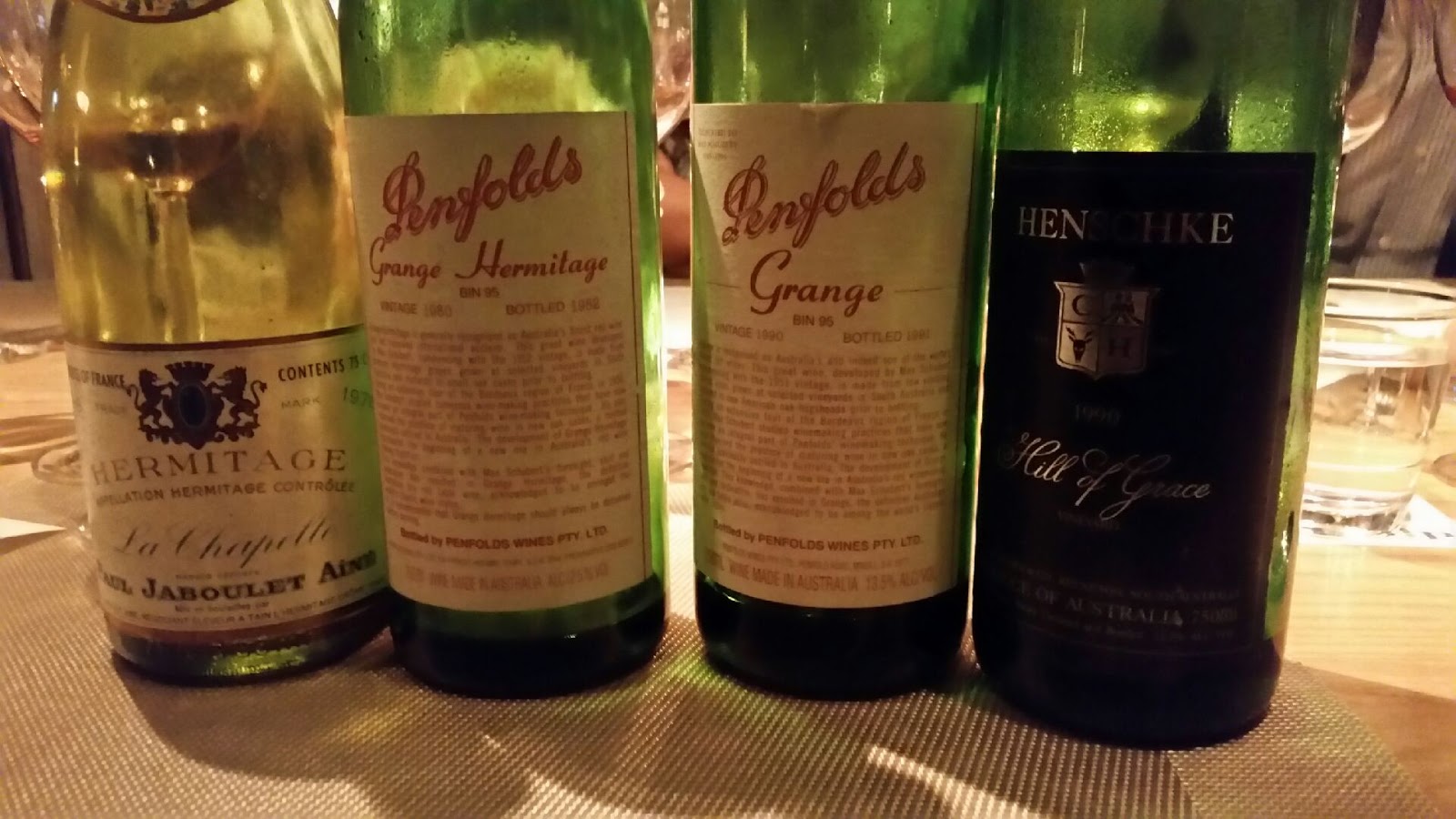
The line-up of 4 Syrahs


1978 Hermitage La Chapelle, Jaboulet
Black plum, cardamom, cinnamon, nutmeg, wild herbs, game, black pepper, whiff of VA, vibrant acidity, elegant tannin, very long finish. Not quite the gargantuan 100-pointer that we were expecting. Wine lost its freshness and revealed a dull and coarse palate after about an hour. Worth investigating with another bottle from the same case to see if this wine is at risk of decline. 17/20


1980 Grange, Penfolds
Sweet vanilla, coconut, blackberry, minty chocolate, black pepper, firm structure, velvety tannin, firm acidity. A lush wine with a slightly rustic edge, not quite as suave. Lacked personality. 96% Shiraz. 4% Cabernet Sauvignon. Drink now and over next 8-10 years. 17/20

Interestingly, the 1980 Grange cork did not have any engravings on it.
Just a plain cork.


1990 Grange, Penfolds
Topped up with 2006, recorked in 2011. Blackcurrant, spicy, vibrant acidity, sweet vanilla, coconut, the elegant palate belies a big and powerful structure. This recorked bottle seemed youthful but very ready to please . 95% Shiraz, 5% Cabernet Sauvignon for original vintage. Long way to go. Drink now and over next 10+ years. 17.5/20

Slow-cooked Iberico pork loin, confit fingerling potatoes, yuzu jus


1990 Hill of Grace, Henschke
Gamey, slight hint of black pepper, sweet finish, harmonious, integrated with velvet tannins, minty chocolate, hint VA but enough to detract from its singular beauty and elegance. A stylish wine that has aged magnificently and gracefully. A class above the rest of the flight. Very persistent finish. Drink now and over next 10+ years. 19.5/20 (Very beautifully paired with the duck cooked under sous vide!)


Strawberry shortcake, almond milk, burnt miso ice cream


1882 Ne Oublie, Graham's
Quite different from the Scion. Layers of toasted walnuts, dried orange peel and balsamic nuances. Beautifully integrated. The anticipation from watching the bottle being extracted from the heavy encasement, to being opened, then the pouring and finally the tasting was simply breathtaking. On the palate, there was a freshness that kept the body of the wine lithe and vivacious, whereas from memory, the Scion was more unctuous and opulent. The bouquet lingering on the glass was simply mesmerizing. A very memorable end to a wonderful dinner. 20/20


Our menu - highly recommended!

Tuesday, 29 March 2016

How useful is the Michelin Guide? (And to Whom?): Reflecting on recent experiences in Beaune, France and Germany

March 2016:  Do you rely on the Michelin Guide to make your restaurant choices when you visit a city that is covered by the Guide? The Michelin Guide started publishing in 1900 in France, as a guide with maps, given away free of charge to motorists so that they could locate local mechanics, hotels and petrol stations. In 1926, the Guide started awarding stars to dining establishments. In 1931, the hierarchy of one, two, and three stars was introduced and at the same time the cover of the Guide changed colour from blue to red. In 1936, the criteria for the starred rankings were published:

  • *: "A very good restaurant in its category" (Une très bonne table dans sa catégorie)
  • **: "Excellent cooking, worth a detour" (Table excellente, mérite un détour)
  • ***: "Exceptional cuisine, worth a special journey" (Une des meilleures tables, vaut le voyage)
Later, the Guide added the Bib Gourmand feature, listing restaurants offering “exceptional good food at moderate prices”.  So what prices are deemed moderate?  The menu items must be priced below a threshold determined by local economic standards.  (Wonder how often these economic standards are reviewed?) “Bib” is the company’s nickname for Bibendum, the Michelin Man, the corporate logo.

I was driven to research the above guidelines as I am increasingly confused by the standards represented by various rated restaurants. My experiences at equal-ranked restaurants in different cities have certainly been varying – for example, compare Hong Kong and London.  There seems to be a lack of global consistency. Some restaurants should be really categorized as Bib Gourmand, rather than the venerable starred restaurants.  At least for Hong Kong, the presence of a star does not mean much in terms of quality of food, and the rating rather equates to the degree of difficulty in making a reservation.  For example, ‘three stars’ means close to impossible, unless you try many months in advance or you have special connections.  (Having said this, Richard is a loyal ‘collector’ of the Guide and he buys all the European Guides and the rather unhelpful HK Guide every year.  What is more, they usually make up a reasonable percentage of luggage weight when travelling to Europe.)

During the week of Les Grands Jours de Bourgogne (21 - 25 March 2016), we had the opportunity to dine at a few restaurants in Beaune which boasts a couple of one-Michelin-starred restaurants (the city has 4 altogether, with no higher rated restaurants), as well as a number of casual places.  


Our Poulet de Bresse being prepared.
The Bistro de L’Hotel was our first dining venue.  It produced good honest bistro cuisine, with consistent quality, from potato cream soup, deep-fried artichoke, to ris de veau and a perfectly roasted Poulet de Bresse, complete with crispy skin, succulent meat and tasty garlic-flavoured jus.  One could describe it as gastro-bistro, to justify the elevated prices for a Poulet de Bresse (EUR 90 per Poulet to be shared by two or a Poularde de Bresse at EUR 110). The main course of ris de veau was EUR 42. The starters were relatively less expensive, with the Vichyssoise at EUR 16 and the deep-fried artichoke at EUR 17.  These prices matched those of the city’s one-Michelin starred restaurants, as we will see.  (I was told it was frequented by a number of serious wine collectors, from the US as well as Asia. One might draw comparison with another famous bistro in Paris: L’Ami Louis.)  And not to forget ‘les frites’ (the French fries). The wine list was extensive (especially for the Bourgogne selection) and included a number of vintages, which was a plus for their targeted clientele as most restaurants in Beaune would typically feature wines no older than 2007/2008, and even then would only be less than 5% of the selection, with the majority being 2011 – 2014.  (The Michelin Guide did comment on the impressive wine list.) Service was impeccable and Jeremy the sommelier looked after us and the bottles of 2005 Raveneau Chablis 1er Cru Montée de Tonnerre (EUR 210) and 2002 Fourrier Gevrey-Chambertin 1er Cru Les Goulots (EUR 385) drank brilliantly.  Both bottles were chosen from the restaurant wine list.  The champagne by the glass was a grower blanc de blancs, perfect for the job at EUR 16 a coupe.  Approximately EUR 250 per head including the wines mentioned. The restaurant allows brought-in bottles and corkage is EUR 50 a bottle. Sounds like a fair deal.

The following evening we dined at a similar convivial set-up: La Maison du Colombier set in a building that dates to 1574 and includes a charming hexagonal turret. Chef Roland Chanliaud formerly ran the kitchen at Le Jardin des Remparts is at the helm at La Maison du Colombier producing seasonal dishes and creations of the moment. We actually returned a subsequent evening for an apero before dinner.  We were five people and were assigned a nice table upstairs.  Downstairs is a lively bar area made up of 3 vaulted cellars where people just come in for small bites/tapas, washed down with a nice selection of reds and whites by the glass.  At the time, they offered 2 crémants and 2 champagne by the glass (an Extra Brut (EUR 12 a glass) and a Bollinger).  When we were there, there were a 2013 Ladoix (Camille Giroud), a 2011 Volnay (Thomas Bouley) and a 2013 Auxey-Duresses blanc (Benjamin Leroux).  For our dinner, we shared a few tapas (excellent mackerels poached in white wine and vinegar, mini sardines on Poilâne toast, smoked salmon rillette and monkfish liver with piment d’Espelette, a plate of Bellota ham). All were about EUR 8 to EUR 16 per dish.  For main courses, I had 3 plump scallops (with coral), grilled with chorizo crumble and garlic butter (EUR 7 per scallop).  The others had a creamy gâteau de foies (like a mousse), with langoustines and a lamb stew (about EUR 15 – 17 per main course).  Portions were moderate and designed to be preceded by a few tapas.  I loved the atmosphere, the ambiance and the efficient and charming service.   For wine, we had a bottle of 2012 Hubert Lamy Saint Aubin 1er Cru Clos de La Chatenière (EUR 84) and a 2010 Hubert Lignier Morey St Denis 1er Cru La Riotte (EUR 142).  Roughly EUR 85 per person.  Somewhere I definitely look forward to returning to…and they even have a few apartments/suites.

Le Jardin des Remparts

The following evening, dinner à deux at Le Jardin des Remparts, a one-Michelin starred restaurant, set inside a lovely 1930’s villa bourgeoise with the remparts behind. In the summer, the terrace is a lovely spot for pre-dinner cocktails.  We arrived about 8:30 pm and we finished our meal around 10 pm.  We only delayed departure so that we could finish our bottle of 2008 Marquis d’Angerville Volnay Taillepieds. The amuse-gueles arrived in a hurry, even before our white wine was served.  They showed creativity and the boudin noir and mushroom ball was rather delicious. We decided not to have an aperitif as disappointingly they only had one choice of champagne by the glass, a Veuve Clicquot yellow label, nothing wrong with the consistent quality of the Grande Marques, but one would expect a restaurant of this quality to feature a more eclectic option to excite the palate. The chef’s welcome dish also arrived rather promptly. This was not as interesting as the 4 little amuse-gueules earlier. In fact, I could describe it as a plate of two large and bland-tasting beans – we could not see the point in this welcome dish.  I ordered a small salad to start – the chef was kind to accommodate my off-menu order but my first few mouthfuls of lamb’s lettuce (mâche) were filled with grit.  Richard’s white asparagus was much more successful and up to standard, as was his sirloin beef main course was excellent, perfectly executed, tender and juicy (The dish was Pièce de Bœuf Rôtie, Pommes de Terre Fondantes et Condiment Échalote, Kumquat de Michel et Bénédicte Baches, at EUR 45).    I ordered another starter as main course and the concept behind this creation really eluded me: the over-creaminess (taste-wise) of the avocado cream rather exaggerated the blandness of the squid confit (tasted more like steamed). It definitely needed lots of black pepper!  (The dish was: Crémeux d’Avocat, Encornets à l’Huile de Genièvre Frais des Hautes Côtes de Nuits et Bergamote at EUR 35.) According to the sommelier, she only had one bottle of Bourgogne red wine from a vintage older than 2007 – it was 2006.  We asked for a 2007 bottle and it was already sold out.  The selection of Bourgogne reds spanned about 3 pages, but did not feature that many appellations, with very rare appearance from the Côte Chalonnaise or even some Côte de Beaune emerging appellations (Pernand-Vergelesses, Savigny, for example).  I thought it was a slightly feeble attempt to feature a single Fixin, after the Gevrey-Chambertins, and it was from Domaine Leroy, vintage 2009, priced at almost EUR 280. They did not clean the table (clearing away the crumbs) before serving the cheese course either.  The cheese platter here was EUR 14 (compared with EUR 15 at Bistro de L’Hotel). The sommelier looked hassled and uninterested to entertain any discussions about the wines.  She didn’t look as though she was enjoying herself as all she did the whole evening was going round the tables, topping water and wine and opening bottles.  Service lacked charm and I couldn’t help feeling like being ‘processed’ in a factory.  It was about EUR 230 per person with wine included (think the 2008 Angerville Volnay Taillepieds was around EUR 150).


The evening before we left Beaune, we tried another one-Michelin-starred restaurant, Le Carmin.  We heard great things.  The chef Christophe Quéant was previously at Michelin-starred Château de Pommard. Le Carmin has a great location, right on the Place Carnot and very close to L’Hôtel Dieu. I liked the modern chic and clean décor, using grey and red colours, with contemporary lighting fixtures.  I often find the amuse-gueules served with aperitif exciting and innovative creations by the chef.  However, here they seemed rather mundane and disappointing, compared to those served at Le Jardin des Remparts.  The cold and soggy gougère was particularly off-putting.  To accompany the amuse-gueles, we had a glass of Henriot champagne (EUR 12 a glass). The rest of the food was tasty but did not hit high notes.  Richard had a slow-cooked egg with morels and green asparagus (EUR 33), followed by a simply grilled pork chop, served with rich mashed potato (EUR 36).

Steamed monkfish with carrot and ginger jus
I tried the salmon, smoked with vine ‘sarments’, served with lemon cream, white toast and a small salad (EUR 21), followed by steamed monkfish with carrot jus and ginger (EUR 44). It sounded a lot more exciting than it tasted.  It was not a harmonious creation – while the carrot and ginger enhanced the endive that wrapped the monkfish, these two flavours did not make great company for the monkfish.  Richard ordered a tarte fine aux pommes (EUR 12) which strangely arrived cold – normally, it would be made à la minute, served hot with the ice cream just about to melt on top.   The service was charming and professional.  The wine selection was well-appointed, with offerings across a number of Bourgogne appellations, with price per bottle ranging from EUR 40 to 400. There were good showings from Auxey, Ladoix, Marsannay, Beaune, Savigny, Chorey, Nuits, Pommard and Volnay, just that the vintages tended to be rather young – 2013 and 2014. (Big tick from me!)  We ordered two half bottles: a 2010 Louis Jadot Chassagne Montrachet Morgeot Clos de La Chapelle, Duc de Magenta and a really yummy 2011 Bouchard Beaune-Grèves Vigne de L’Enfant Jésus (the latter EUR 67 for half bottle).  I was very impressed by the manager/sommelier’s immediate acknowledgement of the white’s prematurely oxidized state (when he poured for us to taste before serving) and prompt recommendation of a 2014 Rapet Pernand-Vergelesses Clos du Village (EUR 37 for half bottle).  When asked if it would be too young, he assured us of the accelerated development in a half bottle and that 2014 would not seem young at all.  (Sad to report) he was absolutely correct!  The red was really delicious with silky texture and harmonious mouthfeel, beautifully integrated flavours, and not too young to enjoy either!   About EUR 140 per person.  We were not convinced about its 1- star award. 

As mentioned above, 1-star means the food is very good in its category, according to the Guide.  Le Carmin is listed under Cuisine Classique and Le Jardin des Remparts Cuisine Moderne.  The differences in these category definitions are a little too subtle in this case.     

Earlier in the day, we made room for lunch at Caves Madeleine. I had exactly the same dish that I had there 3 years ago. It was a warm cabbage salad with bacon.  It was simple but really tasty.  Richard said he had the best cabillaud ever, served with olive oil from the Douro, and a tasty Vichyssoise to start. (He said the cabillaud was far better than the fish course he had at a 3-Michelin starred restaurant in the Black Forest where we were 9 days ago, on this same trip.) Our guests had a lovely endive salad, a suprême de canette in a nice broth and a great vegetarian pot-au-feu.  Portions were well-measured, and prices were reasonable.  EUR 12 for my salad.  EUR 28 for the daily menu.  Caves Madeleine features a classic selection of wines, as well as paying attention to interesting new domaines, natural wines and even a biodynamic beer. We had a gorgeous bottle of 2012 Lafon Meursault Désirée and a 2008 Lafarge Volnay Clos des Chênes – a great comparison with the Angerville Taillepieds from the previous evening.  I found the Angerville more appealing at this stage while it seemed a bit precocious to enjoy the Lafarge now, given its more serious structure. Convivial ambiance, friendly service.  Definitely a place to return to. 

Both the Caves Madeleine and La Maison du Colombier are not listed in the 2016 Michelin Guide.
We would have loved to try La Dilettante (also not listed) if we only we could get in! I was also recommended Bissoh for great yakiniku and sushi, if you felt like a late supper and the chef would just prepare in front of you. It would be ‘mission impossible’ to convince Richard to go to a Japanese restaurant in Beaune though.

Just before Beaune, we spent 5 days in Germany where we tried a number of restaurants, including a couple of 3-Michelin starred restaurants within 6 km of each other within the Black Forest.  

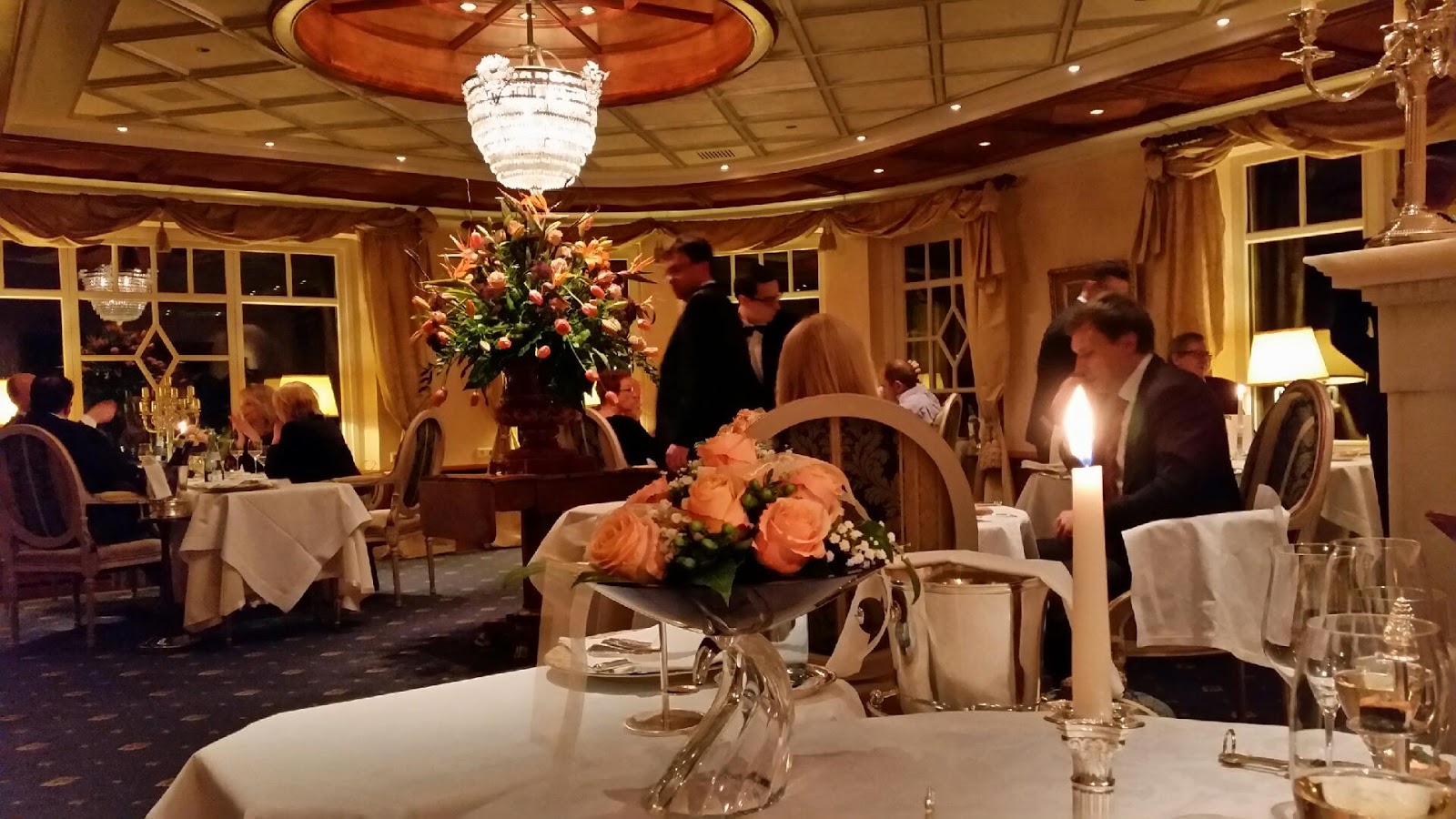
The very charming dining room at Hotel Bareiss
The gastronomic restaurant of Hotel Bareiss in Baiersbronn-Mitteltal is a paragon of 3-star holder. It got its first star in 1984; a year later the restaurant was awarded one more star till 2007 when it was awarded 3 stars and has been since.  Everything is impeccable here, from service to ambiance to quality of food.  If you had to criticize something, you could argue their bread selection is rather limited.  It is a lovely dining room, not too big, with classic upholstery, a warm crimson colour, and a beautiful large chandelier as centre-piece.  The ambiance is cosy and romantic. The prestige cuvée by the glass was a Pommery Cuvée Louise 2002 (EUR 25 a glass), and a very delicious one too!  They very kindly accommodated my request for a small salad to begin, followed by what I thought was the best sole dish I have ever had in a restaurant (bravo to Chef Claus-Peter Lumpp). 

The pan-fried sole with croutons
It came in 3 ways: 1) pan-fried with croutons, served with asparagus tips and Béarnaise sauce, 2) gratinated sole cannelloni with asparagus noodles and grape seed oil vinaigrette and asparagus consommé with strips of sole and small spring vegetables.  It tasted fresh, and each way of cooking as exciting as the last, with the firm texture of the sole forming a great contrast with the soft texture of the white asparagus, and the flavours melted into one harmonious assembly. This dish was EUR 76.  Richard rated his turbot middle course equally highly: Breton turbot, semolina with sorrel lemon powder and lemon butter sauce. The lamb dish was perfectly executed (Cassolette of milk-fed lamb with raw marinated artichokes fregula sarda and wild garlic).  Dessert is a highlight here – the pastry chef does a really fine job if you still have room.  Otherwise, the petits fours are quite divine too.


The dining room at Schwarzwaldstube

6 km away in Tonbach, the Schwarzwaldstube has continuously been a 3-Michelin-starred restaurant since 1992.  We were greeted by both the proprietor and the chef Harald Wohlfahrt separately. We went for lunch – therefore it was not a direct comparison.  Perhaps it was lunch, the clientèle seemed more business-like and the décor of the dining room is an interesting mix of country wood panels and fine chandeliers.  The colour scheme here is mauve blue. They have a vegetarian menu which is every bit as exciting as the normal gourmet menu.  I actually took 2 dishes from the vegetarian menu for lunch: a salad with cereal grains and artichokes followed by the mushroom tart with truffle.  Richard had the same mushroom tart, followed by the sole.  I thought the mushroom tart was perhaps not their finest creation, as the tofu in the middle was moist and let out quite a bit of moisture into the shortcrust pastry, which was a bit too thick for our liking and absorbing the moisture from the tofu, it turned a bit soggy.  The salad of grains was really delicious though.  Richard’s sole was over-cooked and not quite a 3-Michelin star quality dish.  Another great feature about this restaurant was its wine list.  There were some great (reasonably-priced) gems here, especially from France.  Something we started noticing was that the prices of top German Spätburgunders on wine lists were very similar to some Village/Premier Cru wines from top domaines in Bourgogne. 

The Bareiss was definitely a 3-star experience, but we need to return to Tonbach to have dinner for a proper verdict.  Based on the lunch experience alone, it did not quite merit 3 stars.

In Baden-Baden, we visited 2 restaurants, one with 2 stars (Brenners-Park) and the other with just one (Le Jardin de France).  There was one really positive thing about the Park restaurant was that there was one whole page of vegetarian menu and one whole page of gluten-free and lactose-free menu, out of a 4-page menu!  

A very fine vegetarian starter
I did not feel that my dishes lived up to the Michelin star standard, in fact, my monkfish was rather unexciting.  It did not help that I had to have a long discussion with the manager/sommelier that we didn’t like the wine he recommended, that we all thought it was too ‘bretty’ and simply not enjoyable (it was a 2005 GG Spätburgunder), and I didn’t react too well when his only comment was that he had sold a few bottles of this wine and nobody had complained before. In the end, we just paid for it but also ordered another bottle of a much younger Spätburgunder.  Aside from this interlude, the service was generally friendly, but I did not feel that we had any high points. Richard was indifferent about his turbot main course.  Approximately EUR 230 per head.  I don’t particularly feel a hurry to return.   It would be hard to call this worth a detour, as it was right in the heart of Baden-Baden.  Perhaps the Guide has another definition that they internally use.

Le Jardin de France on the other hand is a small restaurant run by a couple.  The room is not particularly charming, in fact, with the conservatory-like exterior, it felt a little ‘cold’ and ‘impersonal’, compared with the warmth of the old world décor at the Brenners Park.  The food was classic French, with probably too much cream in a few dishes, but tasty and suitably salty.  It was asparagus season and 4 out of 5 of us had the stir-fried white and green asparagus in a parmesan cheese cream sauce, with morels.  I had that as my main course and started with a cappuccino of asparagus velouté above a tasty green pea mousse.  Richard’s main course of rack of lamb was perfectly executed while others enjoyed the monkfish and lobster casserole in a rich lobster sauce. We returned to a French wine selection of Condrieu followed by Pichon Baron 1999.  The patronne served us herself and she was charming and friendly.  Bread was very good here, with the potato bread being particularly recommended!

Did they live up to their Michelin star award?  I thought the Park’s 2-star award was questionable and Le Jardin de France deserved its star for tasty classic cooking that delivered consistent quality each time we visited (we have been 3 – 4 times) but lacked creativity/innovation.

A bit like wine-tasting I suppose, a lot of factors could affect our dining experience: mood, ambiance, company, freshness of ingredients, execution (often less is more!), and expectations based on food critics and guides.  From our week in Beaune, I felt that we had far better/more satisfactory experiences at places that don’t even feature in the Michelin guide and certainly without a star.  And as a consumer, my first question is always: “Would I return to it?”, recalling the Michelin Guide’s definitions of the award system.  For me, it has to be more about the food – the food is but one aspect of the entire experience.  Sometimes simple honest food, well-cooked with quality ingredients, with friendly and charming service, combined with the ambiance of the room, is well worth a return.