Showing posts with label Fine Cuisine. Show all posts

Monday, 28 July 2014

Nurrrrr-ishing dishes with style

26 July 2014: We were invited to a relatively newcomer to the restaurant scene in Hong Kong. Nur (www.nur.hk), by chef Nurdin Topham, who came to us with years of experience gained with Raymond Blanc at Le Manori Aux Quat' Saisons in the UK....and also Noma, Copenhagen.  The chef's philosophy is to treat fresh produce with respect and to use as much local fresh and organic produce as possible.  The décor, as the food, brought an immediate impression of lightness and freshness.  The tables were well spaced, but close enough to give a lively ambiance to the dining room.  There was a terrace and a single couple was brave enough to enjoy their meal in the humid heat.  The amuse-bouche platter looked almost like a platter of petits fours, so delightfully delicate and colourful!  There are two menus - we had the one called Light.

The Egg dish
The starter of Tomatoes was stunning, packed with sweet and fresh heirloom tomato flavours (all differently coloured) and intensely flavoured tomato water, delicately enhanced by a gossamer of basil essence.  This most refreshing starter was followed by a dish called Crab, which was king crab, pomelo and garden herbs (the herbs are grown on the terrace of the restaurant), another very refreshing creation, but enhanced with the bitter sweetness of the pomelo.  The Salmon dish that followed used organic Irish salmon, with cucumber, smoked buttermilk and dill. This went brilliantly with the 2010 Tasya Reserve, Grace Vineyard that our hosts brought!  Next was the Egg dish: Taiyouran egg, whole grains, shiitake mushroom, with garlic chive.  The warm and crusty house baked organic sourdough bread was gorgeous, spread with mushroom butter!  Two of us then had the Beef dish: roasted Mayura Wagyu skirt, served with black garlic paste.....and the other two had the same dish, replacing the beef with roasted beetroot, equally tasty and nicely textured, with the beetroot perfectly roasted!  Dessert was Watermelon: watermelon and rose, apple custard, sprinkled with pomegranate.  It did not sound like much, but the dish packed with freshness and intensity....very wholesome!  We left the restaurant feeling so 'well-fed', in the best sense possible, with such wholesome, fresh, tasty and artfully presented creations!

Watermelon!

We had brought our own wines but corkage was a little on the high side.  I did not have a chance to look at the wine list....I'll make sure I do that at our next visit, which hopefully will be very soon!


Unusual Delicacies at Kin's Kitchen and a Sensational 1995 Charles Heidsieck Blanc des Millenaires

Lau Kin Wai proudly recommending to us some of his own creations! 

25 July 2014: Dinner at Kin's Kitchen (留家厨房) - we were regaled with some rather unusual dishes....made with ingredients for which I don't have the English names. 


The fungus from Yunnan! In season now, till end August!  Hurry!

The four best dishes that got our unanimous votes were: 1) 干巴菌抄蛋 (Scrambled egg with a seasonal wild fungus from Yunnan); 2) 头抽玉米 (stir fried fresh corn with a really tasty soya sauce); 3) Slow roasted pigeon (cooked at 75 degrees for an hour and a half); 4) 凤眼果炆鸡 (braised chicken with this kernel, a mix between gingko nut and chestnut, really interesting!). All so tasty and unique!


Slow-roasted pigeon; the scrambled egg with fungus (already half gone!)

Quite a fortuitous coincidence that we had taken a bottle of 2003 Domaine de Chevalier Blanc to dinner, when Lau told us that Sauvignon Blanc would do something rather amazing to the fungus. So we tried it.....the fresh taste of the mushroom suddenly took on some rather pungent flavours.....almost sulphurous....not sure what chemical reaction that was.....but it tasted as if it had been stir fried with the essence of a thousand-year-old egg (皮蛋)! Amazing! The fresh corn was so simple, yet so full of flavours! The problem with Chinese kitchen is that all the food came rather suddenly and altogether! Quite difficult to manage!


The braised chicken with the gingko/chestnut cousin!  Again only available this month!


For our wines, we started with a 1995 Charles Heidsieck Blanc des Millénaires. Made with Chardonnay from 4 Grand Cru vineyards and 1 Premier Cru vineyard from the Côte des Blancs. Pale lemon. Fine bubbles. A rich bouquet of toast, shortbread, lemon confit, ripe pear, apricot, overlaid with smokey notes. Liquorice, marzipan and candied fruit and hints of minerality filled the finish. Opulent and fleshy, with perfect proportions in every aspect, eager to seduce. Finishes long and still vibrant. A very expressive wine and an absolute delight to indulge! It seemed nicely evolved now on the palate....Drink now and over next 4 - 5 years if you are less keen on the mature style. 18/20 (This yummy bottle was given to us by a friend on another occasion - thank you so much for sharing this with us!)


The 2003 Domaine de Chevalier was much fresher than some of the bottles that we had opened from the same case. Lemon colour. Creamy texture. Pineapple, quince, lanolin and lemon. There was sufficient acidity to keep the palate fresh. It went rather well with the food, and not just in such an amazing way with the scrambled egg with fungus....but it also did a great job with the drunken abalone! It's not a wine for long term cellaring but in the right condition, it makes a great food wine! 16/20


The 1995 Léoville Barton tasted quite meaty and fleshy, with less precise delineation, but packed with blackberry and cassis fruit, with notes of roasted herbs. It lacked a certain precision to be truly exciting. Nevertheless, it was balanced, well-made and certainly a tasty drop! 16/20


The 1995 Mas de Daumas Gassac was sadly corked! So disappointing! Thank goodness, our host even brought a supply of the Léoville Barton, just in case!  Thank you!


Do hurry to get to Kin's Kitchen for these seasonal offerings!  Quite unusual!  Very special!


Sunday, 8 June 2014

A Taste for La Romanee

28 May 2014:  Last night, we were back again to our favourite Spanish restaurant in Asia, DN Innovación,Taipei, for a very special evening with Louis-Michel Liger-Belair to taste a vertical of his family’s crown jewel wine – La Romanée.  It was a magnificent line-up of wine (and wine glasses!) – I felt rather spoilt by such exuberance of vinous generosity, mostly by our host but also by everyone who attended, including Louis-Michel himself!   I genuinely wish that I could have given each wine much more of my attention than the time allocated in the evening!  And this was no ‘jaded’ comment!


We started with a refreshing glass of 2004 Bollinger La Grande Année Rosé.  I loved the pale salmon colour, the creamy mousse enveloping a texture of fine bubbles, a complexity of savoury and toasty notes with the purity of red fruit, overlaying a mineral core. A very gorgeous glass of rosé with a promising future ahead!   18/20

Spanish Carabinero red prawn, so full of umami flavours, perfect with mature champagne!
Our first course was a duo of tapas of Spanish Iberico ham and Spanish “Carabinero” red prawn with almonds.  Both tapas were bursting with umami flavours which were exaggerated by the umami flavours in the next flight of 3 champagnes from the 1973 vintage.  The 1973 Dom Perignon was simply sensational, still in the prime of its youth it seemed.  Golden robe, with a panoply of aromas and flavours: honey, toast, toasted hazelnuts, marzipan and roasted pineapple.  The palate was creamy with a well-delineated structure, with precise acidity, intensity of flavours, and a lingering finish.  Finesse in extremis!  18.5/20 (This paired extremely well with the bold ‘sea’ flavours of the giant red prawn, enhanced with a distinct sense of sweetness.)

The 1973 Dom Ruinart Blanc de Blancs revealed more of its age.  It was decidedly more savoury and nutty on the nose, with flavours of caramel shortbread and preserved fruit on the palate.  A wonderfully aged champagne, still keeping all its elements in perfect harmony.  This worked very well with the Iberico ham, served on thin toast with concentrated crushed tomato.  I scored this 17.5/20.

The 1973 Krug was very evolved, and tasted like a bottle that did not see the best of storage conditions.  Sherry-like notes laced the bouquet and palate, with toffee and nutty aromas.  The colour was amber, rather than the golden colour of the other 2.  14/20

The next flight was a pair of 1973 Meursault Premiers Crus by Leroy….a Meursault-Charmes and a Meursault-Perrières.  They had both come from the same cellar.  The Charmes showed a deep gold colour, and intense oxidative notes dominated the nose – smoked bacon, marzipan, caramel, honeycomb, shortbread, toasted hazelnuts……however, the palate showed fatigue and lacked acidity. 14/20

The Perrières was totally different.  The robe was bright gold.  Grapefruit, cardamom, pear, honeysuckle, almond filled the bouquet.  It tasted almost 20 years younger than the Charmes!  A very serious wine with a finely-chiselled structure, a stoney minerality on the palate led the way to a long finish, leaving the impression of youthful freshness, vigour and elegance. Incredibly well-portioned in every aspect.  18.5/20


Asparagus and tofu.....quite a presentation!
The asparagus and tofu course was tasty on its own but did not quite have the depth of flavours to pair with the Perrières.

The 1973's........the Meursault Perrieres still tasted so youthful!

Next up was a flight of 2 red Bourgognes, both from the 1973 vintage.  1973 La Tâche and 1973 Musigny, Faiveley.  The 1973 La Tâche tasted past its peak……with the acidity starting to poke through the light weight palate and holding firm at the finish.  Only tertiary notes of earth, sous-bois, mushroom and truffle…..not very exciting, but still revealing a shade of its earlier elegance. 14/20

The 1973 Musigny, Faiveley seemed to be retaining still a smidgeon of freshness and energy….and tasted rather suave and harmonious!  Leather, spice, blue and red fruit notes.  The tannin had completely integrated into the structure to give a very silky presence.  Finishes long.  16/20

The mushroom and truffle explosion (olive oil bread roll with a filling of mushroom and truffle pâté that almost exploded with flavours in the mouth) was definitely a thoughtful dish ….though neither wine really had the concentration nor density expected of its climat.

After the distraction of the 1973’s, we started in earnest with the La Romanée vertical.  The vertical had been arranged from young to old: 1993, 1990, 1989, 1985, 1978, 1973, 1962, 1953 and 1949.  Before the tasting, Louis-Michel gave us a brief background to La Romanée and his family’s ownership.  This grand cru climat of just 0.85 hectare is the smallest AOC in France and has been a monopole of the family since 1826. Well not quite, as it (together with La Tâche, Reignots, and others) had been put up for sale in 1933 by the family because of deepening financial difficulties post First World War and global depression.  La Tâche was sold to the current owner but La Romanée was bought back by Comte Michel, grandfather of Louis-Michel, and his brother Canon Juste.  The vineyard produces about 2,500 bottles a year on average.  Traditionally, the parcel had been tended by a share-cropper (the Forey family who looked after the vines from 1946 until 2001). Once the malolactic fermentation had finished, the wine would be sold to a top négociant for an agreed price (with the new barrels being provided by the négociant).  Different négociants had purchased the wine including Thomas-Bassot and one established within the family called Maison C. Marey et Cte. Liger-Belair (established 1852 between Guillaume-Félix Marey and the Comte).  In the 50’s and until 1962, it was sold to Leroy, followed by a brief period with Bichot between 1963 and 1975.  The arrangement with Bouchard started with the 1976 vintage and lasted till the 2001 vintage.  Louis-Michel took back the making of La Romanée from the 2002 vintage, while continuing to share the finished wine (post malo) with Bouchard until 2005. From the 2006 vintage onwards, Domaine du Comte Liger-Belair would be the only domaine selling La Romanée. 


Here are my tasting notes of the vertical:

1993 La Romanée, Bouchard: This wine was still in its youth, tasting almost too young for this occasion.  The nose showed spice, black cherry, with some farmyard notes.  The palate tasted very fresh, with a very taut and vigorous structure of fine materials that have yet to take their time to evolve and harmonise.  A first-class wine but very much closed today.  I would probably wait another 10 years to try it again. 18+/20


1990 La Romanée, Bouchard: Very ripe fruit of raspberry and red cherry, overlaid with animal, sous-bois, savoury, and earthy notes.  Rich and intense palate.  I felt that this could do with a little more acidity…..it tasted a little flabby. 17.5/20


1989 La Romanée, Bouchard: Similar on the nose to the 1990, but this showed much more freshness and a firmer structure.  Refined and classy.  18/20 (Great pairing with the summer truffle risotto with parmesan shavings.)

Summer truffle risotto with parmesan shavings with other yummy truffle dishes.

1985 La Romanée, Bouchard: Initially, there was an astringency on the palate that continued through to the finish.  Some rich spicy but sappy flavours came through after a while.  Could this improve with more bottle age to resolve the remnant tannin?  17+/20


1978 La Romanée, Bouchard: Notes of plum, mature fruit, earth and spice, with a hint of brettanomyces.  For me, this tasted a bit soupy, it did not have the freshness of the 1973. 15.5/20


1973 La Romanée, Domaine du Comte Liger-Belair: This came directly from Louis-Michel’s cellar, albeit a Bichot wine (hence the label).  A light weight for its climat, but it was lithe and delicate, with a freshness to support the lively palate.  Tertiary and spicy notes. Excellent for the vintage and tasted incredibly fresh with a good degree of complexity and depth!  17/20


1962 La Romanée, Leroy: A gorgeous colour, still ruby at the core. Sauvage, spicy, leather, mushroom and earthy notes, with hints of pot pourri.  Great freshness, balance and minerality on the palate, albeit within a delicate frame.  It was as if you were listening to a Brahms symphony…..hidden amidst the serenity and harmony, was that incredible heightened pleasure.  A wine of class and understated charm. Drinking perfectly now and will hold for another 8 - 10 years! 19/20


1953 La Romanée, Leroy:  Notes of coffee, chocolate and nutmeg spice. Lush and opulently rich, with a velvety texture that needed all of its acidity to avoid the slight soupy impression. Time in the glass helped resolve some initial awkwardness. Finishes very long!  18/20 


Yang Ming Shan chicken leg roll, succulent and so yummy!

The free range Yang Ming Shan chicken leg roll with summer truffle was definitely one of my highlights and it worked very well with the 1962.


We finished with a disappointing pair from the 1949 vintage: a Richebourg and a La Romanée, both bottled by C. Marey.  I thought the Richebourg had suffered from a mild cork taint and the La Romanée had too much volatile acidity to be enjoyable.


The succulent and flavoursome grilled Wagyu beef short rib was very popular though and the 1953 would make a good marriage!


One of the guests was overwhelmingly generous and brought along 4 bottles from the 1973 vintage (which happened to be the vintage for at least 2 very important people at this dinner!).  I had thought we wouldn’t have the capacity nor time to get through them but I turned out to be wrong.  We started with a light 1973 Cheval Blanc, then a beefy, concentrated and opulent 1973 Mayacamas, followed by a pair of Riojas which I would have liked to have given more time to be appreciated properly.  I preferred the 1973 CVNE: suave, silky texture, with notes of ripe red fruit, sous-bois, earthy and tea leaves. Still showing good acidity.  Lovely finish.  The 1973 Muga showed a tighter structure, and less charm, but more concentration, without the complexity of the CVNE.


We finished with a 1945 Croft Port.  This could easily be the wine of the evening for us!  Medicinal, intensely flavoured dried red cherry, spicy notes….velvety texture, lush full body beautifully balanced by a vibrant acidity, the intense flavours gliding through all the way to a very long finish! Still tasting very fresh, with phenomenal energy and verve!  A brilliant port, completely harmonious in every way!  19.5/20


The time passed rather quickly with such great wine, food and company!   For the completeness of historical testimony and educational interest, it would have been a good idea to include a couple of vintages made by Louis-Michel himself….perhaps the 2002 and 2004 vintages if not too young to try at this point in time?

Tuesday, 6 May 2014

Bourgogne in 1993


2 May 2014: We were generously treated to a most memorable evening at DN Innovación, Taipei, which could be named a celebration of the 1993 vintage in Bourgogne! On arrival, our palate was refreshed by a glass of Krug Rosé, lovely creamy mousse of delicate fine bubbles bringing together elegance and vivacity. The chef had prepared for us a tin of Norwegian salmon mousse, topped with orange caviar, to whet our appetite.

Then we were served a platter of 3 tapas: deep-fried tofu skin with caviar, iberico ham wrapped around white asparagus and a pan seared red shrimp, bursting with sweetness from the flesh of the red shrimp. A pair of 73 Dom Perignons were served to go with these tapas.

The 1973 Dom Perignon showed a medium gold robe. The bouquet was a mature expression, with savoury notes, mushroom and rye toast overlaying the honey, caramel, roasted hazelnuts and acacia. Creamy mousse with still persistent fine bubbles within a richer and fuller body than the later disgorged version (Réserve de l’Abbaye). Long and satisfying finish. 17.5/20

The 1973 Dom Perignon Réserve de L’Abbaye had received over 20 years of ageing on lees, compared to the minimum 7 years for the normal vintage version. The bouquet was fresher, as was the palate. Notes of citrus marmalade, orange peel, almond and pear. Distinct minerality lined the energetic and relatively youthful palate. Crisp vibrant finish. A stunning wine that promises a strong mid to long term cellaring potential. There was hardly any sign of the supposed accelerated ageing post disgorgement here…….18/20 (This bottle was sourced in Japan – it seems that the Réserve de L’Abbaye label was first released in 1994 as a late disgorged 1962 vintage champagne in the Japanese market alone. The label is a cream-coloured label, compared to the Oenothèque label which is dark slate grey.)

A quick word about the 1993 vintage here….an excellent year for reds if the awkward tannins did not get the better of the fruit....after a cold start to the vintage, warmer temperatures arrived late May....the earlier part of the growing season was marked by a number of weather hazards (hail storm, torrential rainfall in June/early July)....the vines were then a bit stressed out by the dry hot weather in second half of July continuing into August. Rain came to the rescue early September and allowing the grapes to ripen through to harvest date. For the reds, tiny berries with thick skin. Rain did arrive mid-harvest....and caused a few concerns! When to harvest was a critical decision for this harvest, casting the die for the level of maturity and acidity.

Following this pair, we were served 2 Montrachets from the 1993 vintage, one by Leflaive and the other by Domaine de La Romanée-Conti (DRC).

The 1993 Leflaive Montrachet showed a superlative opulent bouquet…..smokey, very ripe pear, brioche, nuts, quince with liquorice, with tremendous balance, harmony and concentration framed in a full body. The intensity of the flavours and the gargantuan proportions building into a crescendo, with the finish lasting over a minute. Very impressive! This provided very worthy company to the pan-fried goose liver with hazelnut and seasonal berries (and I think I found a piece of roasted pineapple too!). 18.5/20

The 1993 DRC Montrachet was the quiet one at the beginning…..and it took over 45 minutes to open in the glass! Honey, pear, ripe apple initially, and taking on smoke and spicy notes later on. While this did not have the expansiveness and fullness of the Leflaive, this was elegantly balanced, subtle and unassuming in the way it delivered depth and power. Very classy. I think this is nowhere near its apogee, with a long way to go. My neighbour who’s a connoisseur of DRC Montrachets (I think DRC in general) told me that right now we should be drinking the 1982, 1983 and 1985 DRC Montrachets. Not sure I will ever get that chance to imbibe again this heavenly nectar made with such delicate hands! 18+/20

The 1993 Romanée Saint Vivant, Leroy was the perfect Vosne….spicy nose, with beautiful fruit of raspberry and a hint of prune, with some coffee notes. Very supple on the palate, silky to the touch. There was no excess of acidity on the palate, which seemed to be a hallmark of the 1993 vintage. The quality of the firm tannin of the vintage was more vividly felt on the palate, leaving a slightly astringent finish, but the overall impression was still one of harmony. Drinking so beautifully now…….with a long life ahead. 19/20

The DRC equivalent was a bit disappointing. It did not have the same generosity on the palate as the Leroy, though the nose was still very Vosne, but less intense than the Leroy. The acidity and the firmness of the tannin were also more poignant here, more eagerly felt, despite the quality of ripe fruit underneath. I am not sure if there would be enough fruit to see this last another decade! 16.5/20

The long-tailed red snapper in an iberico ham consommé was very delicate!

We next had a pair of 1993 Bonnes Mares: d’Auvenay and Comte Georges de Vogüé. The d’Auvenay was a little restrained today……there was firm acidity and tannic structure. The nose was still very primary, consisting mostly of red fruit and spice. Well-balanced and very elegant. There was just a hint of bitterness detected at the finish. Very youthful today….I would recommend trying this again in 8 – 10 years’ time. 18/20

The de Vogüé version was a deeper ruby than the d’Auvenay version. On the nose, it showed more evolution with ripe fruit, sous-bois, coffee and earthy notes. Much more fleshy on the palate than the d’Auvenay, with greater density and concentration. This paired exceptionally well with the forest of mushrooms with aged raspberries! 18/20

The next flight was 3 Clos de La Roche: Leroy, Rousseau and Dujac. The Leroy was harmonious in every sense…..sweet on entry, great balance and freshness on the palate, with very expressive aromatics of prune, plum, and game. Like silk, it caressed the palate. Finishes long. 18.5/20 (this for me was the best pairing with the pigeon bun, Spanish style! )

The Rousseau seemed a little four-square and less refined, albeit with more than a hint of Burgundian classic characteristics. Sous-bois, earthy and spicy notes. Lacking in complexity and concentration on the palate. It did develop a little in the glass but not enough to warrant a higher rating. 17/20

The Dujac was in a style of its own. Lively acidity, ripeness of fruit, and finesse of structure characterised this gorgeous wine. Mineral notes on the palate, giving this wine an edge of its own. Lithe and elegant, very boutique-ish. A very fine Clos de La Roche! 18/20

The last red wine flight was the Musigny flight. The 1993 JF Mugnier was disappointing….rather light, ungenerous and did not have the weight and concentration of the class. 16.5/20

The de Vogüé was aromatically a bit dumb – it did not really open up in the glass.. Perhaps if we had given it a full hour, the result would have been different. Quite clumsy on the palate too, a bit chunky….did not deliver the finesse expected of a Musigny, while there was certainly weight, complexity and concentration. 17.5/20

We saved the best till last - the 1993 Musigny, Leroy. It was the epitome of Burgundian finesse, elegance and terroir typicity. It resonated a panoply of aromas from plum, prune, to truffle, sous-bois, rose petals and spice. The palate was silk-woven tapestry of complexity, depth, concentration, balance and seamless harmony. A very classy wine and one that left you wanting for nothing more! Perfection in a glass. Drinking very well now but there is enough to keep this going for another 10 – 15 years. 20/20 (this went so seamlessly with the suckling pig croquette with cherry kirsch butter and truffle! And the Wagyu beef short rib too!)

We finished with a sensational 1993 Tokaji Esszencia, Château Pajzos. Lusciously sweet, concentrated, unctuous, and well-balanced. Aromas of date, caramel, rich dark honey, pineapple and lychee. Excellent acidity.  This was serious indulgence.  18.5/20

Mostly the 1993’s we tasted this evening had been of a consistently high quality, with just a couple of less successful examples, justifying the acclaim for this vintage for reds. Even the whites came through with dazzling colours (as it’s only meant to be a ‘good to average’ year for whites by most counts!)

Monday, 21 April 2014

Return to Baden

19 Apr 2014:

The bed of tulips outside Hotel Bareiss's reception

We’re back in Baden-Baden for our annual visit to the Osterfestspiele 2014. Before Baden-Baden, we made a detour to the Hotel Bareiss in Baiersbronn in the Black Forest for an unforgettable experience at the venerable 3 Michelin star institution of Claus-Peter Lumpp. The hotel was going through a major renovation of its guest rooms at the time of our visit but despite the disruption, the service was maintained at a highly professional level. View of the densely planted fir trees in the Black Forest basking in warm spring sunlight was entirely captivating. The fresh mountain air was like heavenly manna to those pollution-filled lungs – each deep breath had felt like an energising boost, a sort of purging of those impurities!


View of a Black Forest hillside from our hotel room


A glass of welcome champagne, a few nibbles of the petits fours in the room, and a restorative visit to the spa, we were ready for an indulgent meal at the gastronomic restaurant. It was so refreshing to be able to enjoy a Michelin star quality meal where every dish distinguished itself by the intensity of flavours, freshness of produce, elegant presentation, meticulous execution and professional service, without any ‘foam’, ‘dust’, ‘jelly’ or mousse! The dishes were refined interpretations of classic flavours and combinations. I started with a cream of sorrel soup, with char caviar and egg of quail, accompanied by a separate dish of char poached in olive oil with herb vinaigrette and pea puree. The char was fresh and delicate, with an almost creamy texture from the poaching in olive oil, this was well balanced by the tartness of the sorrel. My main course consisted of 3 different preparations of sole: sole fillets fried in croutons on glazed tips of asparagus, sole fried in brown butter on asparagus risotto, Bearnaise sauce and spring blossoms, and strips of sole poached in olive oil in warm asparagus salad and chives. All three dishes were excellent, with great contrasts of texture and flavours, something citrusy balancing the brown butter and olive oil. The sommelier recommended a 2011 Castelberg Weissburgunder by Martin Wassman (Bereich Markgräflerland, between Freiburg and Basel) that would have sufficient weight, richness and acidity to go with Richard’s foie gras starter, and yet it would not be too over-powering to pair with my sole dishes later on. A perfect choice. Good aromatic intensity on the nose, with notes of honey, pineapple, almond, toast and smoke. On the palate, the wine was nicely voluptuous, without being too heavy, and well-balanced by the refreshing lift of a lively acidity. Finishes long and refreshing, without any cloying sensation. Perfect now! 16/20


For Richard’s suckling lamb dish, he had gone for a 2005 Volnay Santenots-du-Milieu, Comtes Lafon. The colour was a medium ruby. The bouquet was dominated by primary fruit still, blackberry, dark cherry, dried strawberry, hint of fig and cinnamon. Fleshy texture on the palate, characterised by ripe tannin, which would need quite a few more years to soften and integrate into the wine. At the moment, it felt astringent and not yet in total harmony. Finishes long. A rich and chewy wine and patience will be required. Drink from 2018+. 17/20

The cheese selection was excellent and served with a comprehensive bread selection….at this point, I had had to admit defeat to jetlag! But it did look very tempting!

(I did search for the Black Forest Gâteau but could not find it anywhere in Baiersbronn....I did eventually find it in Baden-Baden! So it exists!)


Advertisement of Black Forest Gateau and coffee at a Baden-Baden coffee shop


We had arrived at Baden-Baden after some rather interesting negotiation of the city’s intricate traffic circulation. Baden-Baden looked totally transformed with spring in full blossom. How different it looked compared to the bleak and wintry feel when we were here last year! Suddenly, the town was rejuvenated with the appearance of outdoor cafés, strollers in the parks, daffodils and tulips decorating the famous Lichtentaler Allee.


Baden-Baden in full blossom

Our first meal was taken at the hotel’s restaurant – the Park Restaurant at Brenners Park Hotel. After the amuse bouche, we were served the bread and selection of condiments: pumpkin seed oil (produced by the chef’s family!), olive oil from Tuscany, butter from Alsace and Maldon sea salt from Britain. The pumpkin seed oil had a very dark colour, viscous texture and a most intense flavour. Absolutely yummy! The food was less impressive than my recollection from last year’s visit. Richard’s turbot main course was a little bland and dry – he had to add some olive oil and salt to it to revive it! I thought my crabmeat starter was adequate but lacked imagination. The organic egg yolk in egg white soufflé, on a bed of purée of peas, parmesan froth and black truffle was closer to the expected standard!


Our choice of white wine was a 2009 Ihringer Winklerberg Riesling Grosses Gewächs, Dr. Heger. We had been hesitant about this choice because of the warm 2009 vintage in Europe, but this concern had turned out to be unfounded. The freshness and minerality of the wine was stunning. The bouquet was characterised by honey, green apple, pineapple, flowers and nuances of petrol/slate/flint. Medium+ body, balanced by precise acidity, complete with vibrancy, depth and refined minerality. This minerality is believed to have come from the strong presence of volcanic soil in the Winklerberg einzellage. The soil of the Bereich Kaiserstuhl is generally based on volcanic stone, mostly covered by calcareous loess and loam top soil. The volcanic soil particularly favours Grauburgunder and Spätburgunder. A beautiful wine and perfect with food. 16.5/20


The restaurant had kindly allowed us to drink our bottle of 1990 Drouhin-Laroze Chambertin Clos de Bèze. We did not feel that the wine needed decanting and were rather perplexed by the head sommelier’s strong disapproval of our decision. A mature Burgundian bouquet of mushroom, sous-bois, animal and plum notes. The palate lacked the depth, power and concentration of a Chambertin Clos de Bèze, even though it displayed a fair degree of complexity and elegance. Finish was not particularly long. There was a good expression of the vintage characteristics but overall it lacked the presence of a top Gevrey grand cru, that it did not quite deliver what was expected of a Chambertin Clos de Bèze – it could well have been a Charmes or Mazoyères Chambertin. Drink now and over next 3 - 4 years. 15.5/20


After the performance of Puccini’s opera Manon Lescaut, we headed over to the restaurant Le Jardin de France for dinner. I thought the opera was technically well performed but it just lacked a certain emotional adhesiveness amongst the actors. The asparagus season (white and green) is in full swing at every restaurant in Baden-Baden (probably Germany too)…..and the theme of morels and asparagus took centre stage on the menu, with an appearance in 4 guises…..simply on their own, with the ubiquitous cream that seems to be an essential ingredient used in liberal amount in most culinary creations in Germany; or with foie gras ravioli, or served with pike perch or with turbot! I went for the pike perch which was really fresh and tasty! 


For white, we went for the 2011 vintage of the same Dr. Heger wine, which tasted quite similar to the 2009 vintage, with less of the richness but more acidity and the minerality was even more poignant. The 2007 Spätburgunder Selection S by Franz Keller was really delicious – Richard said it reminded him of a 2009 Nuits Saint Georges! Ripe red fruit, raspberry, plum, with earthy notes and spices, made a lovely bouquet. The palate was medium bodied, with good balancing acidity, giving it a really nice lift at the finish.  (I rated this 16.5/20.)  At EUR 95 a bottle on the restaurant wine list, this was no mean price and seemed a worthy contender to the Burgundian counterparts which would cost a bit more! We had later gone to visit Franz Keller (as below) and learnt that Selection S was made from an élevage of around 10 months in oak barrels (barriques). Selection A is made from best vines and only from best vintages, made from an élevage of around 12 - 14 months in oak barrels (barriques).


Conventionalism was well challenged by the performance of Bach’s Johannes Passion on the second evening…….the orchestra and the choir were both on the stage and it was rather difficult to follow the movements of conductor Sir Simon Rattle. Most of the time, the orchestra and the choir competed for my attention. I had to admire the choir members singing while performing some tricky ab crunches! It was a good idea to have this piece about the last days of Jesus’s life acted out….but both choir and orchestra on the stage, with the choir taking an active role in enacting the final scenes……it was confusing, at least for me!


The following day, we drove down to Kaiserstuhl for a tasting at both Franz Keller and Dr. Heger, interluded with lunch at Schwarzer Adler (Fritz Keller's restaurant that has had a Michelin star since 1969, and a comprehensive wine list featuring many fine bottles from Bordeaux and Bourgogne!). Based in Votsburg-Oberbergen, Weingut Franz Keller is a family wine estate, now run by 4th generation Fritz Keller, making high quality dry, pure and elegant wines expressive of the different terroirs from 62 hectares of vineyard. We tried a range of Pinots during our visit to the wine shop......very impressed by the Spätburgunder Selection A and S. The grapes for Selection A are mainly sourced from the Eichberg vineyard (predominantly volcanic with some loess) in Oberrotweil and also from the Kirchberg einzellage (a pure volcanic site)....and from certain parcels in Jechtingen and the Achkarrer Schlossberg vineyard (also a pure volcanic site). The terroir here lends the wines a particular harmony, complexity and minerality and a clear delineated structure. We also tried the Selection S of the Weissburgunder (with ageing in oak barrels for a few months) - a very fine accompaniment to the brulée of foie gras that was our amuse bouche at Schwarzer Adler. We each had one course at lunch - Richard had possibly the best turbot on this trip and I had a delicious langoustines in curry sauce. There were so many tempting bottles on the wine list that we decided that a revisit to Schwarzer Adler (with stay in the guest room above the restaurant) seemed like a must-do on our next visit to Baden. Fritz Keller also has another restaurant, more casual and with a focus on local cuisine, across the road - Winzerhaus Rebstock. It was closed on the Monday when we visited.


My langoustines in curry sauce at Schwarzer Adler - rather nice with the Selection S Weissburgunder!

After lunch, we beetled over to taste at Weingut Dr. Heger, based in the Ihringen village. The wine estate started in 1935 when physician Dr. Max Heger acquired some parcels of vines in Ihringer Winklerberg and Achkarrer Schlossberg (both south-facing sites have exceptional microclimate, enjoying long hours of sunshine and particularly known for the dominant volcanic content in the soil). Now it is run by Joachim Heger (since 1982) who took over from his father Wolfgang (affectionately known as Mimus which became the name of a single vineyard wine). Dr. Max Heger built his fame on Silvaner, but now the focus has switched to the Pinots and Riesling. There are two Grosse Lage wines: Winklerberg GG and Schlossberg GG. The wines are typically full-bodied, rich, with vibrant acidity, giving a strong sense of elegance, finesse and freshness, and always with that persistent saline finish. The wine estate also started an entry point range called Weinhaus Heger in 1986 for fresh fruity wines, made with grapes from contract growers. Look out for the 3-star selection of Grosses Gewächs wines.....I liked them all, especially the Grauburgunder and Riesling!


We made it back to Baden-Baden just in time for the concert of Beethoven's Emperor Concerto and Richard Struass' Ein Heldenleben (translated as A Hero's Life). After the concert, we went to a restaurant called Stahlbad, at Ausgustaplatz. I would strongly advise to focus on the 3 signature dishes highlighted on the menu. Richard had the veal schnitzel and thought it was the best he had had.....my pasta with prawns was adequately prepared but not exhilarating!


We had chosen the 2012 Schloss Neuweier Goldenes Loch GG. Schloss Neuweier is based in Bereich Ortenau, which stretches 60 km from Baden-Baden to Berghaupten, near Offenburg. The northern part is based on granite bedrock, giving extremely complex and elegant wines. Schloss Neuweier is better known for its fine Rieslings from Mauerberg and Schlossberg sites....cultivated with vines since 12th Century. The Goldenes Loch is a monopole vineyard of 1 hectare southwest facing amphitheatre between Schlossberg and Mauerberg. The name came from the leaves acquiring a golden colour in the rays of autumnal sun. This 2012 vintage expression was elegant, refined, succulent and rich with minerality.....with notes of citrus, apple, honey and an unmistakable flint-like stoney character.


Schloss Heidelberg up in the hills, overlooking the Neckar River

We left Baden-Baden the following day and headed north towards Mannheim, for the 3-star cuisine of chef Juan Amador. We stayed the night in Heidelberg and arranged for a taxi to take us to the restaurant. The taxi driver had input the restaurant address into the GPS system which took us to a carpark/warehouse site in an industrial district, adjacent to a large supermarket. When we asked various people at the carpark, nobody seemed to know about this restaurant. Then the taxi driver spotted a signage outside a reddish brick warehouse in the corner and thought we would give it a try before calling the restaurant. Sure enough, this was it! Discreetly disguised. We were greeted with a request for aperitif: Cava or sherry......the Spanish chef has instituted an all Spanish wine menu. The chef's greeting followed with a trio of 3 amazing tapas....a clam whose shell was edible and made of tofu, a dish of filled tree bark with black pudding and pear and a chicken dish with crispy skin.


Entrance to Restaurant Amador, a little south of  the city Mannheim

The decor inside the restaurant

Richard had gone for the full menu while I took the more modest 3-course menu. My 3 dishes was 1) octopus with potato, paprika flavoured oil and leek; 2) salsify made to resemble white asparagus, served with beef tongue coated with a crispy coating of quinoa; and the truffle main course, consisting of scallop (in place of the original version with sweetbread), Jerusalem artichoke and pearl onion, all laced with intensely flavoured truffle emulsion, topped with a piece of dried truffle 'bark'!

The octopus in paprika oil, with potato and leek

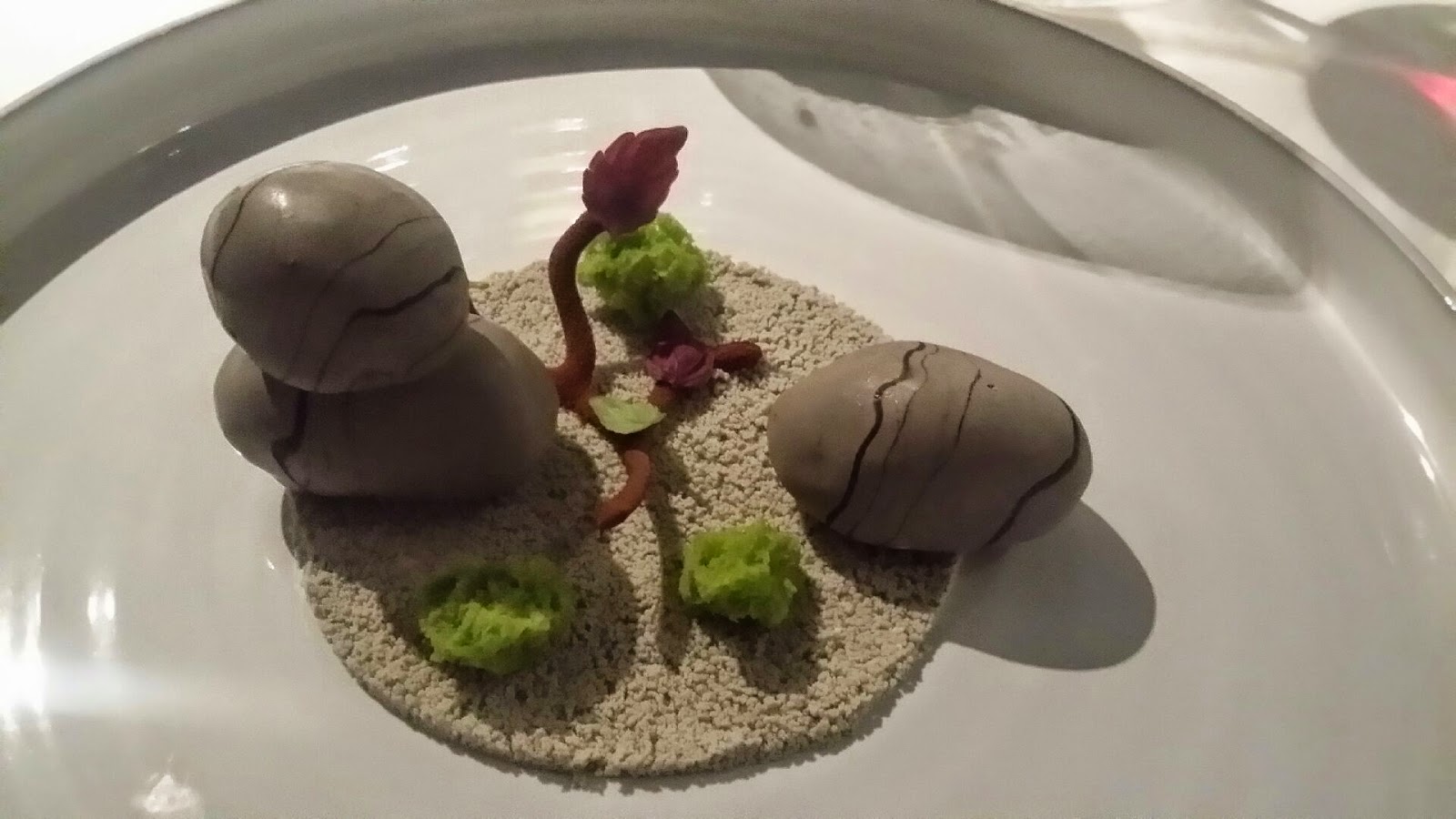
Dessert was a 'Zen' garden of Easter eggs, filled with almond cream, nougat chocolate truffle and pistachio cream. Then there were the petits fours of lollipops, and various candies! It was a remarkable tale (as we understood from the staff)......Born in Germany, this Spanish chef had already had a restaurant with 2 Michelin stars when he first went to have dinner at El Bulli. He apparently was so inspired by this dinner that he decided to dramatically change the way he cooked.....so he experimented and experimented and has now achieved his current reputation and Michelin stars, all by himself! While we were less convinced by just a couple of the creations and the combinations of flavours, we were left in no doubt about the chef's talent and dedication. The dinner had been an absolutely extraordinary experience and one that was truly memorable. Good news for us is that Chef Amador is actually coming to HK in June, cooking for a few days at the Jockey Club....and watch this space!


Dessert in the form of a Zen garden!


The menu actually offered a wine-food pairing option, but we had gone for our own wine choices instead (with the help of the enthusiastic and knowledgeable sommelier): a 2010 Tomás Postigo Rueda, Fermentado en Barrica and a 2007 Roda I Reserva.


The 2010 Rueda went rather well with a number of dishes, especially the octopus and Richard's gooseliver course. Herbal, citrus, pear, honey, ginger, with a hint of smoke. Medium body, could do with a bit more acidity to keep the palate fresh.....15/20.

The 2007 Roda I Reserva was a great wine, but worked less well with our food. Deep ruby colour. Red fruit, sandalwood, and spice. Ripe but still firm tannin coating the palate, with acidity giving the wine a nice refreshing lift at the finish. Quite a powerful wine, but there was plenty of elegance and vibrancy to keep this harmonious and intriguing to the palate. Gorgeous now with some aeration....and over the next 10 - 15 years.....a roast lamb rack with harissa or lamb tagine with couscous would have been a better choice with the wine. 17/20

This concluded our visit to Baden in 2014.......and with the few new tips acquired from this trip, we are already planning the next visit!

Monday, 7 April 2014

Les Grands Jours de Bourgogne 2014

The Hill of Corton, picture taken from the shuttle bus!

March 2014: This was my first experience of Les Grands Jours de Bourgogne (a week-long trade tasting that takes place every 2 years), and a rather unforgettable one, that was. The organisation was superb - the number of participating domaines from each region, the logistics of registration, transport, glassware, tasting booklets for each day and food, and the quality and quantity of the wines presented. At least for me, I had only come across a few occasions (usually around mid afternoon) where the domaine had run out of wine....but it was rare and usually with the more popular/best known ones. I found it very meaningful to have the tastings organised at different regions - it emphasised the diversity of Bourgogne and broke up the monotony of tasting at one single location for 5 straight days, even though it meant that some people would have to forego a few tastings, if tasting at the speed of light wasn't their thing, or if they felt more like taking their time to talk to vignerons. Not every day was organised at multiple locations, only the 2 days which were likely to attract the most attention......the Château du Clos de Vougeot would have been impossible had the tasting of wines from Vosne-Romanée not been one out of 4 tastings on that day!


We arrived early morning at CDG and immediately drove down to Chablis in the hired car. Day 1 was not to be missed! "Les Portes d'Or de La Bourgogne" featuring the wines from Chablis and Grand Auxerrois. Both floors of the Maison des Vins de Chablis were taken up by exhibiting domaines as well as the marquee on the lawn. It was so nice to see such a high turnout on Day 1 especially when there was no shuttle service from Beaune and everyone would have to make his own way to the tasting. The jetlag dissipated with the hustle and bustle and the bright sunshine and balmy weather also helped us settle into the mood of the tasting. After a few sips of Chablis, you could understand why the oyster-shuckers probably had the toughest job that day! Some domaines showed 2011 and others a mix of 2011 and 2012. For 2012, the quality across left and right banks seemed consistent - the Right Bank showed more richness and fleshy mouthfeel, but deftly balanced by complexity, minerality and vibrant acidity, whereas the Left Bank generally showed great precision and nervosity - a sense of cleanliness was felt all round! Simply sensational wines. We couldn't taste at all the domaines but here are a handful of recommendations that I managed to record!

Romain Bouchard: 2011 and 2012 Vau de Vey

Christian Moreau: 2012 Chablis Les Clos and 2011 Chablis Les Clos, Clos des Hospices

Domaine du Colombier: 2012 Fourchaume and 2011 Bougros - very impressive!

Alain Geoffroy: 2012 Beauroy, 2012 Vau Ligneau - very good examples, very expressive

Louis Michel: 2012 Montmains, 2012 Montée de Tonnerre, 2011 Vaudésir

Bessin: 2012 Valmur, 2012 Montmains, 2012 Forêts - loved the precision and persistent minerality

Pinson: 2012 Mont de Milieu, Forêts and Fourchaume

William Fèvre: 2012 Vaillons, 2012 Bougros Côte de Bouguerots, 2012 Les Clos

Simonnet-Febvre: 2012 Vaillons,2012 Montmains, 2011 Les Clos and Blanchot


Because of the number of people who naturally would flock to Vosne-Romanée and Chambolle-Musigny, most companies allocated different staff to attend different tastings to get the most out of the day. We started at the Joyaux en Côte de Nuits - a tasting of wines from Marsannay, Fixin and Gevrey. For me this was a great tasting (not least because the lunch buffet included some really delicious hot vegetable potage, which turned out to the most practical, sustaining type of food to be taken effectively standing up!) as I got to taste at some long-admired domaines at Marsannay. The 2012 showed such class and style, with the complexity and elegance to complete the picture. The Marsannay I tasted at Sylvain Pataille, Bruno Clair and Olivier Guyot were expressive, of the terroir and the winemaker's style. Huguenot showed well too. I could recommend the 2012 Marsannay Rouge En La Montage by Olivier Guyot, the 2012 Marsannay L'Ancestrale and Clos du Roy by Sylvain Pataille, the 2011 Marsannay Les Longeroies by Bruno Clair and the 2012 Champs Perdrix by Huguenot. I was expecting the Fixins to taste a bit more austere, but most were rather elegant with fine tannin and good depth....particularly liked the 2011 Fixin Vieilles Vignes by Humbert Frères. His Gevrey Premiers Crus were rather tasty too: such contrast between the very approachable and elegant Craipillot and the more structured and mineral-laden Poissenot, both from the 2011 vintage. Amongst all the Gevrey domaines I tasted, I particularly admired the wines by Domaine Tortochot. There you could taste a very expressive and well-made range of 2012 wines, from the village wines of Aux Corvées and Les Champs Perriers to the premiers crus of Lavaux Saint Jacques and Champeaux. The Charmes Chambertin was delicious and rated better with me than the Mazis!


After a brief lunch break, I headed to the Château du Clos de Vougeot for the Vosne tasting - Vosne Millésime - Noblesse des Clos Vougeot. I guess the stands had already been well raided in the morning, leaving some stands rather empty and unoccupied when I arrived just after 2:30 pm! That must have been the case with Sylvain Cathiard, whose wines I was rather looking forward to trying. Domaine des Perdrix had also run out of wine when I finally made my way there! I was really impressed by the number of domaine owners (including some top names) who came out in support of Les Grands Jours, pouring wines for the tasters........Some domaine owners even brought round a few bottles from earlier vintages, as top-up after lunch, given the popularity of the wines. The 1999 Clos de Vougeot, Drouhin was a treat!


Here is a selection of some interesting ones that I tried and liked (I did try more than what I listed here….but still merely a fraction of what was available to be tasted and if you could get close to the person pouring!):

René Cacheux: 2012 Les Suchots (expressive nose), 2012 Les Beaux Monts (good minerality, complexity)

Bouchard: 2012 Clos de Vougeot

Bertagna; 2012 Clos de Vougeot (good perfume) and 2012 Vosne (very elegant)

Confuron Cotetidot: 2012 Vosne Village (purity of lovely fruit), 2012 Les Suchots

A.F. Gros; 2012 Clos de La Fontaine (pretty fruit!), 2012 Aux Réas, 2012 Echézeaux and 2012 Richebourg

Joannet; 2012 Vosne Village and 2012 Les Suchots (very good balance, underwhelmingly classy) - domaine also has vineyards in Pernand-Vergelesses and equally commendable! Young winemaker worth checking out!

Comte Liger-Belair: 2012 Clos du Chateau (très bon nez, good complexity) and 2012 Echézeaux (great persistence)

Georges Noëllat: 2012 Les Chaumes (stylish and good concentration without heaviness) and 2012 Les Beaux Monts (beautiful aromatics, fleshy), 2012 Grands Echézeaux (classy and elegant)

Méo-Camuzet: 2012 Chaumes (gorgeous), 2012 Clos de Vougeot (very fine and complex), 2012 Echézeaux (a top example with fine tannin) - the tannin here not as silky, quite noticeable at the moment, will take some time to integrate

Daniel Rion: 2012 Echézeaux and 2012 Les Chaumes

Tortochot: a vertical of 2008, 2011 and 2012 Clos de Vougeot was shown and I liked the 2012 best! 2012 was the most complete wine, with good concentration, complexity and intensity; 2011 was approachable already, very supple texture; while 2008 showed well but lacked the depth or concentration of the 2012.


Unfortunately, I had run out of steam by the time I got to the Nuits tasting hall - so I just waited for the last shuttle back to Beaune, taking in the much needed crisp fresh air while waiting!


Richard had gone to the Chambolle tasting instead of the Vosne tasting....and here are some highlights from his notebook:

Bertagna: 2012 Clos de Vougeot, 2012 Vougeot 1er Cru Clos de La Perrière and the 2012 Chambolle village was a good example

Christian Clerget: 2012 Chambolle village a fine example

Clos de Tart: 2012 Clos de Tart, a top wine!
Drouhin: 2012 Chambolle village and 2012 Clos de La Roche (rich and powerful, quite closed for the time being)

Fougeray de Beauclair: 2012 Bonnes Mares (concentrated and powerful, long and serious wine, for the long haul)

Hubert Lignier: 2012 Morey-Saint-Denis (top example) and 2012 Morey 1er Cru La Riotte (complex and sexy, long and beautiful, lots of stuffing) - Richard said all he could do was thrusting out his arm with an empty glass, through the crowd, and somehow when he brought his arm back in, wine would have been poured inside! Amazing!


Day 3 was an easier day as all the different regions were accommodated in the Palais des Congrès. The 4 themes were: Symphonie Mâconnaise, L'Autre Bourgogne, Quinté Sens and Beaune Couleurs Vins. Let's start with Beaune Couleurs Vins. Again, this is just a mere selection of some of the highlights I tasted!

Bouchard: 2012 Beaune Rouge du Château (from 17 parcels, lovely fruit and floral aromatics), 2012 Beaune Clos de La Mousse (supple, elegant and good intensity), 2012 Beaune Grèves Vigne de L'Enfant Jésus (intense nose, lots of complexity, depth, a very classy wine), 2012 Beaune Clos Saint-Landry (nice and supple white, good balancing acidity)

Château de Meursault: 2012 Beaune Grèves, 2012 Beaune Les Cent Vignes (expressive, aromatic, elegant and supple)

Domaine des Croix: 2012 Pertuisots (rounded mouthfeel, smooth tannin), 2012 Bressandes (good aromatics, structure and elegance), 2012 Les Cent Vignes (supple and aromatic), 2012 Beaune Grèves (structured)

Drouhin: 2011 Côte de Beaune Blanc (good nervosity, minerality), 2011 Côte de Beaune Rouge (beautiful aromatics) – sadly I was not offered to taste the Clos des Mouches (which I saw in the background!)


Quinté Sens was the group name for the wines from 5 villages: Aloxe-Corton, Chorey-lès-Beaune, Ladoix-Serrigny, Pernand-Vergelesses and Savigny-lès-Beaune. I had the most fun discovering these appellations and I had become an absolute fan of Pernand-Vergelesses (both reds and whites)!

Follin-Arbelet: 2012 Pernand-Vergelesses Les Fichots (lovely lift in aromas, minerality, finesse and finishes with good crisp acidity), 2012 Aloxe-Corton Les Vercots (more astringent tannin, a firmer structure but very elegant) – I was so happy to be tasting the 2004 of the Les Fichots last night (5 Apr 2014) at a dinner hosted by a friend in HK....it was much less charming than the 2012 but did not show any of the vegetal characteristics that sometimes could be too apparent in some 2004's and showed the underlying minerality of Les Fichots!


Joannet: 2012 Pernand-Vergelesses Les Fichots (very elegant) - only produced 400 bottles (the white did not work so well for me)

Pavelot: 2012 Pernand-Vergelesses Blanc Sous Frétille (lovely balance and complexity, good energy), 2011 Rouge Ile des Vergelesses (gorgeous example, loved the sous-bois, coffee, plum and floral nose), domaine certified organic

Rapet: 2012 Ile de Vergelesses (great intensity, ripe fruit, depth, beautiful minerality, lots of energy), 2011 Beaune Grèves (supple)

Rollin: 2011 Les Fichots (finesse), 2011 Ile des Vergelesses (intense nose, very fine, elegant, plenty of character), 2012 Pernand Blanc (very mineral, beautiful fruit), 2012 Pernand Les Cloux (good balance here)

Simon Bize: it was nice to see Chisa pouring the wine here.....a vertical of Les Bourgeots was tasted here. 2009 was ripe and very nice. 2010 showed a fine tannic structure and 2011 was rather supple.

Chandon de Briailles: I rather liked the 2011 Savigny Les Lavières and the 2011 Pernand Ile des Vergelesses (there was an interesting sauvage character behind the fruit)

Doudet-Naudin: 2011 Pernand Blanc Sous Fretille (from 80-year-old vines,a brilliant white, great tension and complexity), 2011 Savigny Blanc Redrescul (a 0.6 ha monopole of Doudet-Naudin’s, younger vines of 25 years, grapefruit and spice, waxy texture), 2011 Pernand Les Fichots (love the red fruit and spicy nose)

Dubreuil-Fonatine: 2012 Pernand Blanc, 2012 Pernand Blanc 1er Cru Clos Berthet (nice weight, freshness keeping in balance), 2012 Pernand Ile des Vergelesses

And from the Mâconnais, I tasted at:

La Soufrandière/Bret Brothers: 2012 Pouilly-Vinzelles Les Longeays, 2012 Pouilly-Vinzelles Les Quarts (loved them both, the Les Quarts showed more richness and complexity, but the Les Longeays showed great vibrancy and energy)

Thibert: 2010 Pouilly-Fuissé Vignes Blanches (refined nose, good tension, a wine with cellaring potential)

La Soufrandise: 2007 Levrouté Velours d’Automne (velvety, ripe peach, with some noble rot, great with foie gras)

Olivier Merlin: 2011 Mâcon-La Roche-Vineuse Blanc Vieilles Vignes (expressive and complex), 2011 Terroir de Vergisson (ripe pear, honey, citrus, supple), 2011 Saint-Véran Le Grand Bussière (minerally), 2012 Saint Véran (great freshness)


Day 4, We did take a day out to enjoy the beautiful sunshine and spring warmth....not necessarily a good thing for the vines, as this unexpected amount of sunlight and warmth had accelerated the budburst which would make the young buds rather vulnerable to frost in the coming months. The famous warm Epoisse mousse at Auprès du Clocher in Pommard was well worth the trip! The chef probably thought us rather strange to begin the lunch with cheese but it had been so highly recommended to us that we wanted to make sure we had sufficient stomach space for it! A tartine of melted Epoisse, served together with a pot of warm Epoisse creamy mousse, with pieces of pain d'épices (gingerbread) in the bottom of the pot! What indulgence! It went rather well with our 2011 Givry 1er Cru Crausot by François Lumpp. My scallops were beautifully cooked and Richard's fish tasted fresher and was much more expertly executed than the fish at Le Clos du Cèdre. The walk back to Beaune in the vines was a lovely trip and we made sure we stopped to pay homage to the Clos des Mouches vineyard! The cherry blossoms were in full bloom, against the clear blue sky!

From Pommard to Beaune!


Cherry blossom and Corton vines!


The final day was again organised into 4 different tastings and unfortunately, we could only fit 2 into the day....and we had chosen the Terroirs de Corton in the morning and Trio Inédit en Côte de Beaune (Meursault, Volnay and Auxey-Duresses) in the afternoon. The Terroirs de Corton was definitely a highlight for me, as it was so inspiring to be able to taste/differentiate the different terroirs in the same tasting! The overall quality was very high and very terroir expressive!

Bouchard: 2012 Le Corton (very fine, elegant, persistent finish), 2012 Corton-Charlemagne (steely, long finish, very fine)

Chandon de Briailles: 2012 Corton Blanc (freshness, not heavy at all, good energy), 2012 Corton-Bressandes (finesse)

Maurice Chapuis: 2012 Corton-Languettes (normally made into white wine, only 2 domaines make a red here - violet, spices, red fruit, very refined, elegant, good minerality)

Cornu: 2011 Corton (sauvage, good structure, long finish)

Denis Père et Fils: 2012 Corton Les Paulands (a small hectare of vineyard split between 2 domaines, of which this was one), good aromatics, intensity, rounded mouthfeel, elegantly structured

Doudet: 2012 Corton Maréchaudes (very deep roots, 70 year vines, good freshness, finesse, structure, refined), 2012 Corton-Charlemagne (finesse and freshness)

Drouhin: 2012 Corton (supple, a little sauvage), 2012 Corton-Charlemagne (expressive nose, balanced, spicy)

Dublère; 2012 Corton Charlemagne (excellent, superb, very classy, great minerality)

Antonin Guyon: 2012 Bressandes, Clos du Roi (magnificent balance and harmony) and Corton-Charlemagne (all very expressive - a must for the cellar!)

Louis Jadot: Excellent Corton Pougets and Corton-Charlemagne

Patrick Javillier: 2012 Corton Charlemagne (expressive nose, richness without heaviness, a class act with Javillier's signature)

Louis Latour: 2012 Clos du Roi (a picture of completeness) and Corton Grancey (depth, elegance and very silky)

Rapet: 2012 Corton-Charlemagne (minerality, freshness), Corton Pougets (great finesse and minerality), Corton Grand Cru

Comte Sénard: All very expressive of the terroirs, particularly impressed by Corton Les Paulands (one of the 2 domaines producing this cuvee) and Corton Clos du Roi, the Corton Blanc comes from the Clos des Meix vineyard.....lovely spicy notes of liquorice


In the afternoon, we tasted some Volnays and Meursaults....but quite a few winemakers had run out of wine already by the time we arrived at 3 pm! We had to change shuttle at Beaune and it took a bit longer than expected. We wasted no time to get stuck into the tasting once arrived!

Comtes Lafon; 2011 Meursault Charmes and 2011 Volnay-Santenots (fleshy, black fruit, nice balance)

Fichet: 2011 Bourgogne Blanc Vieilles Vignes (highly recommended!), Meursault (nicely rounded with great tension), Meix Sous Le Château (mineral and linear), Les Gruyaches (voluminous in the mouth, good complexity), Les Chevalières, (rounder), and the very stylish Le Tesson (these are all very terroir-expressive Meursault lieux-dits - highly recommended!!!)

Rémi Jobard: 2012 Meursault Genevrières (fleshy, with good minerality, persistent finish), very good Poruzot too

Mikulski: 2012 Meursault Genevrières (minerally, complex, nice weight without heaviness, racy acidity)

Pierre Morey: 2009 Meursault Charmes (no sign of the super-richness of the vintage, impeccable balance, great tension)

Jacques Prieur: 2010 Meursault Santenots (ripe apple, citrus, rich but not heavy, great minerality), 2011 Volnay Champans (aromatic, supple, lovely mouthfeel)

Sophie Bohrmann: 2011 Meursault Meix Chavaux (fleshy, good acidity, complexity), 2011 Clos du Cromin (good structure), 2010 Les Durots (supple, fleshy, rounded texture)

Bernard et Thierry Glantenay: 2011 Les Santenots (round mouthfeel, smooth velvety texture, very approachable), 2011 Clos des Chenes (spicy palate, elegant, good length), 2012 Les Brouillards (lovely ripe fruit), 2012 Les Santenots (richness, depth, rounded mouthfeel, excellent!)

Lucien Boillot: 2011 Volnay Village (clean, balanced), 2011 Les Brouillards (nicely scented, elegant), 2011 Les Angles (complex but restrained), 2011 Caillerets (excellent, perfect in every sense)

Jean-Marc et Thomas Bouley: 2012 Bourgogne Rouge (solid example), 2012 Volnay Carelles (lovely ripe fruit, very good quality)

I felt that the overall quality of the 2012 whites was not as consistent as the reds.....the reds overall showed a lovely equilibrium and sense of harmony, terroir expressive with ripe fruit quality and a lovely freshness/energy/tension but with less acidity than 2010 to make them rather approachable. Some examples of the whites that I tasted seemed a little too ripe for me......and did not quite find the right balance.

The rain did arrive very punctually on Friday (as did a drop of temperature of about 10 degrees!) and our 
usual interest in the Saturday market also dissipated with the dreary persistence of the grey sky and chilly rainfall. Instead we took a long lunch at Le Jardin des Remparts, where we enjoyed a lovely bottle of 2010 Raveneau Blanchot and 2007 Bruno Clair Gevrey Chambertin Les Cazetiers...to accompany the very fine cuisine here! Easily the highest quality cuisine on this trip in terms of harmony of flavours (without being too numerous on each plate), freshness of produce, the final presentation and also the professional and friendly service for both food and wine! I must mention the petits fours at the end....definitely worth ordering the coffee to make sure you get them.....there was a baba/cake like thing whose name I could not remember but which was absolutely delicious, served slightly warm....in a box! Sensational!


The Chateau de Meurault
Our experience culminated with the attendance at La Banée de Meursault, in the tradition of the Paulée de Meursault, where each person brings own bottle of wine! The hall at the Château de Meursault was filled with lovers of Bourgogne wine and winemakers, all declaring their love for Bourgogne, being entertained by Les Joyeux Bourguignons! We had taken along a magnum of 2003 Rousseau Gevrey-Chambertin Clos Saint Jacques, just drinking so well now and rather perfect with the Filet de Charolais Flambé Fine Bourgogne et Poivre Séchouan! The 2002 Chassagne-Montrachet La Boudriotte, Ramonet was a fine accompaniment to the Mêlé de Homard et Mangue, Veluoté de Petits Pois, Beurre Noisette Fumé, Crème Légère Iodée.


Les Joyeux Bourguignons!

I found this week's experience totally scintillating.....my love of Bourgogne wines had been reaffirmed (not that there was any doubt!) and my sense of discovery had been totally reinvigorated by the quality and diversity of the wines presented! One moment there was the excitement of discovering a Pernand-Vergelesses Blanc, bursting with minerality, character and a sense of 'otherness', then there was the heightened sensation of tasting a charming Beaune Premier Cru, enchanting for the nose and the palate, and the absolute conviction of the greatness of terroir when tasting a Grand Cru that is simply complete in every sense and exudes the elegance and finesse that is so Bourguignon!


While writing this and waiting for my dinner, here are two more examples of find Bourgogne wine:

2000 Corton Grand Cru, Bonneau du Martray: Beautiful ruby colour. Notes of ripe plum, sauvage, animal, with a hint of tarragon. Silky texture, nicely balanced, expressive, a mid weight wine, but totally approachable now. Lovely drop (perhaps not a refined one!)! Drink now and over next 6 - 8+ years. Perfect with roast pigeon or partridge! 16.5/20

2004 Meursault, Lafon; Bright golden yellow colur. Notes of honey, ripe pear, nougat, toasted almonds,and lemon cake. Mineral notes and some vibrancy permeate the palate, with almost a honeyed sweetness at the finish. Perfect now if you are pairing it with grilled scampis, seared scallops with red pepper coulis, pan-roasted pork chop with gooseberry or apple sauce, or even veal in creamy sauce with risotto...! 15/20