Showing posts with label Berry Bros & Rudd HK. Show all posts

Sunday, 23 June 2019

A Memorable Experience in Umami: Sake and Cheese Pairing

20 June 2019:

Japanese sake, with its rounded mouthfeel, subtle richness, delicate acidity and most importantly an abundance of umami, the fifth taste, makes it a very versatile alcoholic beverage. Cheese, a protein-rich food, with umami-charged compounds derived from the amino acids, and its creamy, rich texture, is just the perfect match with Japanese sake, and even better with the pure and clean Junmai sake by Katsuyama Shuzo.


Sake & Cheese Pairing


Established in 1688 to brew top-quality sake for the feudal lords of the Sendai Domain, founded by Japan’s most famous and respected samurai, Date Masaume, today this venerable brewery, using a combination of state-of-the-art and time-intense ancient techniques, only produces Junmai-shu (1), that highlights clean umami taste and unique profile that pairs with any cuisine. Amongst its range of Junmai-shu, five representative styles were chosen to deliver the anticipated pairing with a selection of French and Italian cheeses (2).


Five sake styles selected for this tasting
From left, Ken, Den, Akatsuki, En, Lei


Ken, Junmai Ginjo (50% seimaibuai (3) and 16% abv), produced by the fukuro-shibori (4) method, represents a whistle-clean, elegant and dry mineral style, with delicate acidity balancing the supple and rounded texture. The sake leaves the palate with a clean and dry minerality. The flavour profile is citrus, apple and a hint of pineapple. With this sake, we paired with Calisson, a raw goat milk cheese with an ashed rind, inspired by the famous diamond-shaped bonbon from Aix-en-Provence, le calisson d’Aix. The aromatic herbal and nutty character was more pronounced in its demi-affiné condition, leaving the palate with a delicate tangy and mineral note. This cheese tasted like a treat with Ken Junmai Ginjo.


Calisson


Den (35% seimaibuai and 16% abv), also produced by the fukuro-shibori method, is a quintessential Junmai Daiginjo, with distinct fruity aromas of banana, grapes and apple, along with a well-balanced rich texture without the weight. It harmoniously delivers the umami taste. This sake paired well with a number of the cheeses presented but it made a particularly decent pair with the washed rind cow milk cheese, Langres from the Grand Est region of France. The Langres at our tasting showed the distinct hollow (“fontaine”) at the top, with a wrinkled orange rind, and an ivory silky mousse-like core at the centre. At the rind, there was a pungent bacon character, with more fruity, creamy note in the core. The intense flavours and rich texture were balanced by the sake's acidity. The sake’s richness complemented the rich texture of the cheese and the fruity character of the sake also matched the pungent notes.

 
Langres


An equally remarkable pairing was with the Brie de Melun. This raw cow-milk bloomy rind cheese with its pronounced barnyard, cep-like aromatics, subtle fruit notes, and rich, creamy texture, went remarkably well with Den. A great example of umami flavours at work.


Brie de Melun


A signature sake by Katsuyama Shuzo, Akatsuki, with 35% Seimaibuai and 16% alcohol, is a Junmai Daiginjo in its own class. This off-dry style sake represents the perfect harmony of minerality, flavour intensity, refreshing acidity and concentration, leaving the palate with a lingering umami finish. Produced in very small quantities using the Enshi-shibori (5) method, this sake reminded me of a delicate and elegant Mosel Riesling. The art of the production of this sake was in preserving flavour intensity while retaining the clean delicate texture. Two pairings stood out in particular.


For a more subtle pairing, we tried it with the Satonnay Aux Fleurs, a fresh raw goat milk cheese coated with floral petals (cornflower, rose, badiane, etc), produced in the Bourgogne region. The sweet floral notes of the cheese, with the fresh mineral note of the goat cheese, delivered a delicate pairing with Akatsuki, neither sake nor cheese overpowering the other. Like a stroll in the spring meadows!
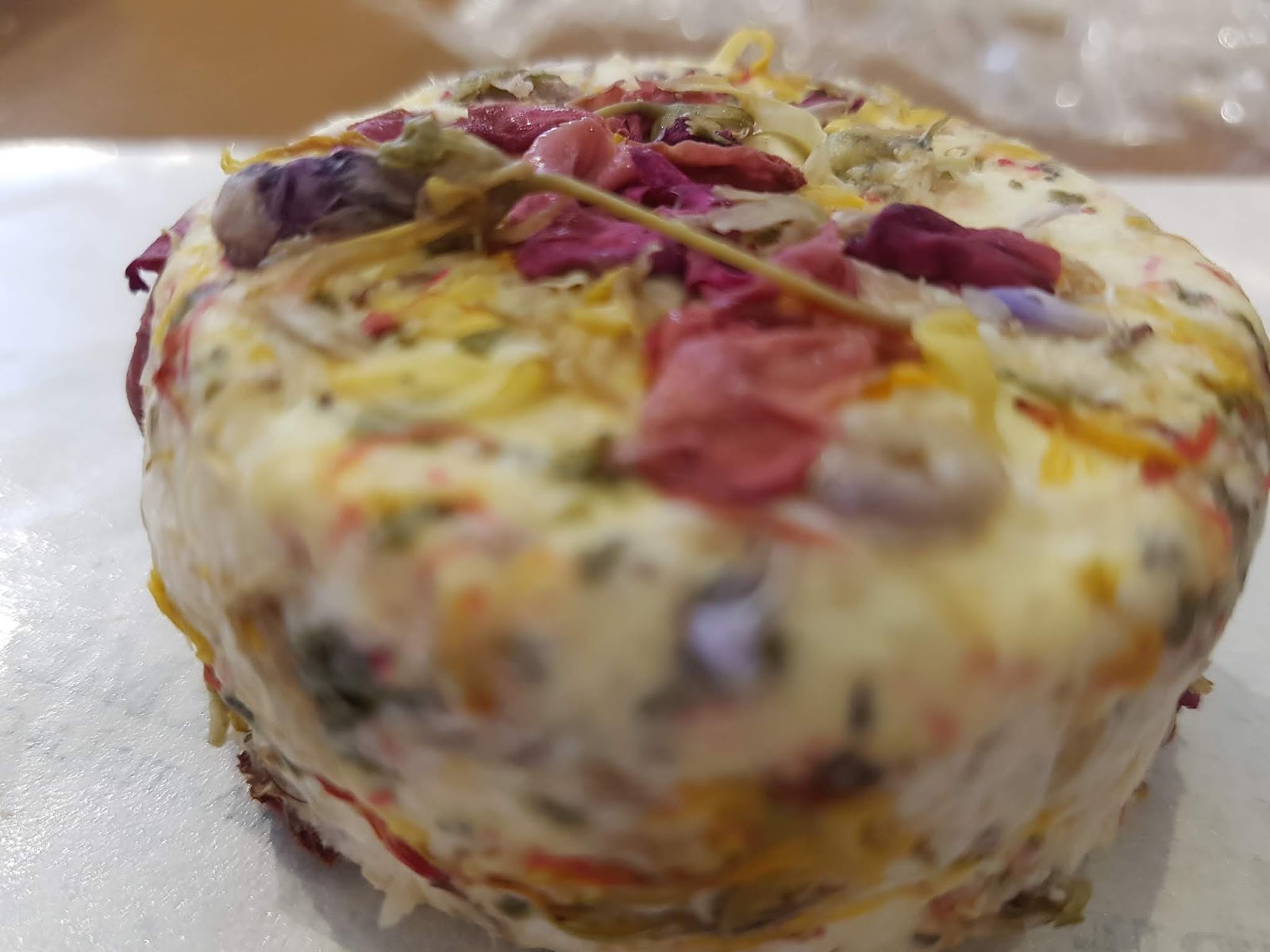
 
Satonnay Aux Fleurs


For an absolute hands-down pairing, it had to be the Persillé de Tignes with the Akatsuki. This unique cheese in a cylindrical shape made by single producer, Paulette Marmottan in the French Savoie region, using raw milk from her herd of around 80 goats and 20 cows, stole the show with its complex flavour profile, tangy lactic, fruity and hazelnut at the core, expanding to damp cellar and mushroom at the rind, tingling the palate with its delicate saltiness and refreshing acidity. When paired with Aktasuki, the intensity of the flavours went up one notch. This was umami in symphony! Absolutely amazing.

 
Persille de Tignes


The previous three sake styles were all made with Yamada Nishiki rice, but the last two sake styles were made using a table rice called Hitomebore.


En, Tokubetsu Junmai, has a distinct hint of sweetness and rice-based umami note. It has a balanced earthy note, with a nashi pear crunch at the finish. With this sake, we paired it with an Italian cheese, Pecorino Toscano Oro. This is a sheep milk cheese, handselected by the cheesemakers to be transformed into the Oro Antico style (referring to the golden hue of the paste of the finished cheese). The aromatics were pineapple, dried fruit, lanolin with a distinct buttery note. The flavours were earthy and citrus, with a lingering pineapple note. This cheese showed a good level of salt and acidity. The pairing with En was superb, sake and cheese complementing each other in the earthy and fruity notes, and contrasting the light saltiness of the cheese with the delicate sweetness of the cheese. A pairing that did not tire the palate.

 
Pecorino Toscano Oro


Lei Sapphire, Junmai Ginjo, with its alcohol level of 12% and 55% seimaibuai, is distinctly sweet and fruity. It reminded us of a Spätlese style Riesling. This style was created to suit the palate of those new to sake, but also as a sweet rich style to go with meat sauces with distinct sweetness. My favourite pairing for this sake was with Mimolette Extra Vieille, that never fails to remind me of soya sauce. Hailing from Nord-Pas-de-Calais of France, the Mimolette Extra Vieille with its 24 months of aging, showed pronounced savoury, earthy and yeasty notes, like marmite, overlaid with a caramelised tone, thanks to the hardwork of the microscopic cheesemites. This cheese was the epitome of umami. The texture was dense, hard, almost dry, with bitter finish. When paired with Lei Sapphire, it was like the sake coating each bite of Mimolette, resulting in an explosion of umami flavours in your palate. Heavenly! Still savouring this!

 
Mimolette Extra Vieille


Finally we paired the Lei Sapphire with a subtle blue cheese, Gorgonzola Dolce, the cow milk blue cheese from Piemonte/Lombardia. This was produced by a family-owned farm Caseificio Tosi. Gorgonzola Dolce is a cheese made for gourmands, creamily indulgent like a dessert, with lively acidity, good dose of salt and mild blue notes just enough to tingle the palate, without being aggressive at all.
Gorgonzola Dolce (courtesy: www.buonissimo.hk)

A beautiful end to this umami-filled experience. An experience to be remembered! (And repeated!!!)


I wish to thank Jacky Cheng, the sake expert of Berry Bros & Rudd HK, for guiding us through this special tasting of Katsuyama sake, and to Enrique Romera of Buonissimo (www.buonissimo.hk) for providing the gorgeous Italian cheeses!


Thank you to everyone for sharing this experience with me!
Venue: Metropolitan Workshop


Notes:

1 Sake made with rice, water and koji, with no addition of alcohol

2 All the French cheese were sourced from La Cremerie, Wanchai and all the Italian cheeses from Buonissimo (www.buonissimo.hk)

3 Seimaibuai: Rice polishing rate, expressed as the amount of rice grain that remains after polishing

4 Fukuro-shibori: an ancient drip method that separates the clear sake by hanging in filter bags and allowing gravity to separate the clear sake from the sediments

5 Enshi-shibori: pressing using a centrifugal separator

Sunday, 3 March 2019

Bourgogne's Grape Revolution: The Renaissance of Aligote

Though sharing genetic material with Chardonnay, being offspring from the same parents, Pinot Noir and Gouais Blanc, Aligoté has not always enjoyed the same recognition as Chardonnay. Its lineage was already well-recognised as early as the 17th Century. A few synonyms exist including “Plant de Trois” used in Gevrey and Châtillon, with reference to its three bunches per cane. Before phylloxera, Aligoté was considered an equal to Chardonnay, and was found planted in Corton-Charlemagne and Montrachet. Though naturally vigorous as a variety, it gradually lost ground to the easier-to-cultivate Chardonnay that was producing more pleasing and accessible wine. In fact, its hardy ability to withstand the cold and tough environments had it relegated to being planted on less favourable locations, leaving the better vineyard sites in favour of Chardonnay and Pinot Noir after the ravages of phylloxera in Bourgogne. Even though there now still exist parcels of Aligoté in Meursault, Puligny-Montrachet and Pernand-Vergelesses amongst other villages, its plantings dwindled substantially, making it the second white grape variety of Bourgogne. Difficult to grow well in less favourable locations, Aligoté gained the notoriety of making tart neutral wines. At the end of the Second World War, the mayor of Dijon, Canon Félix Kir, made an effort to promote Aligoté by using the wine as the base of the eponymous cocktail, blended with a dash of Crème de Cassis to make it more palatable. He could not have anticipated that it would take three quarters of a century for Aligoté to make its comeback as a serious grape variety.


Perfect cheese pairing with Aligote wines from Bourgogne: Dome de Vezelay and Comte


With an area under vines of 1,800 ha, Bourgogne represents around 5% of the world’s total plantings of this variety. Elsewhere in France, only another 200 ha exist. According to “Wine Grapes” by Jancis Robinson et al, the majority of the world’s plantings are found in Eastern Europe (Ukraine, Republic of Moldova, Romania, Bulgaria and parts of Russia), with about 34,000 ha. Here the vines tend to be high yielding, thus producing wine of lesser quality. Some minor plantings can be found in Switzerland, California, Washington, Canada and Australia. To make high quality wine from Aligoté, it is important to control its yield.

Therefore, the recent renaissance of Aligoté in Bourgogne is a very welcomed development. Through the efforts of a group of dedicated growers, Aligoté is gaining traction with a new generation of Bourgogne lovers seeking wines of personality, vigour and a unique mineral expression.


An eager audience learning about this enigmatic variety


To celebrate the refreshed focus on Aligoté, the Bourgogne Wine Board (BIVB) kicked off the 2019 programme of live training with a special look at this long under-appreciated and misunderstood variety.

Apart from its role as a blending grape in Crémant de Bourgogne and Coteaux Bourguignons, Aligoté has its special place as the only permitted grape variety at two appellation levels in the Bourgogne hierarchy. The regional appellation of Bourgogne Aligoté was created in 1947, after a succession of laws recognising the place that this grape held in Bourgogne, a grape variety that faithfully translates the terroirs in which it is grown. Growers in the village of Bouzeron in Côte Chalonnaise understood that the terroirs in their village enabled Aligoté to be interpreted in a very unique manner and led by Aubert de Villaine, lobbied hard for this recognition by INAO. In 1979, the village name of Bouzeron was permitted to appear alongside the Bourgogne Aligoté appellation. Eventually, Bouzeron was formally awarded a village appellation in 1997 for wines made uniquely with Aligoté. At the height of its expression, Aligoté is the key varietal for a premier cru vineyard, Clos des Monts Luisants, in Morey-Saint-Denis, Côte de Nuits.

An expert from each of these three expressions of Aligoté was invited to speak about their experience with Aligoté in this edition of BIVB live training.

Sylvain Pataille explained how he started with just Gamay and Aligoté vines in 1999. He did not wish to make fruity wines, rather he wanted to make wines that spoke of terroir. He regarded Aligoté as a serious variety, that could be grown in limestone, marl or granite, in different regions. Besides the Bourgogne-Aligoté, Pataille makes 4 different cuvées of Aligoté from single vineyards. They are: the pure and saline Champ Forey, the powerful and precise Clos du Roy, the balanced and textural Auvonnes du Pépé and La Charme aux Prêtres, the ultimate expression with an intensity, complexity and minerality that is not like the others. Pataille believes in the ageing ability of Aligoté wines, and how it can develop into complex vines with 30-40 years of cellaring. When asked to compare Aligoté to an animal, he suggested “alligator”, not only for the phonetic similarity but also for the survival instincts in both grape and animal!

Pierre de Benoist of Domaine de Villaine, also admired the “wild” and “untameable” character of Aligoté by likening it to the wild horse from the Camargue, with unrestrained freedom to gallop in the wild. Bouzeron became the only village in Bourgogne to honour this variety by making it the lynchpin of its village appellation. Aligoté in Bouzeron does not taste like any other Aligoté because of the microclimates and slopes of this village and the special clone Aligoté doré.

Aligoté doré is a mutation of the Aligoté grape and has thinner skin than the original variety to allow better ripening and better balance between alcohol and acidity. Only wines made from Aligoté can be bottled as village appellation wine. When Pierre de Benoist became President of the village appellation 12 years ago, he encouraged the other growers to work with him to create a nursery to preserve the genetic material of Aligoté doré. The work based on massale sélection has allowed them to identify 11 selections of Aligoté doré that adapt best to the terroirs of Bouzeron for future plantings.
Map of Bouzeron (www.bourgogne-wines.com)


The village of Bouzeron is nestled in a dry valley, flanked on both sides by Montagne de La Folie on the east, and Montagne de L’Ermitage on the west. Vineyards adorn both hillsides of Oxfordian marl, at heights between 250 and 350 metres, thus benefiting from different exposures and the abundance of poor soils to limit the yield. To appreciate the differences, one has to taste the wines from the climats. Jean-Pierre Renard, the Official Educator of L’Ecole des Vins of BIVB, explained that climats such as La Tournelle, Les Pertuzots and Les Corcelles have a north-west exposure and vines take longer to ripen, translating into sinewy wines of greater freshness and distinct herbal complexity. On the opposite side, the climats of La Fortune, Les Clous and La Digoine for example benefit from a southeastern exposure and the morning sun, and tend to show more generosity and fuller body. Not only are the exposures different, the soil compositions vary as well. For example, Les Clous is more stoney, with more limestone, whereas Les Corcelles is more marl. While Aligoté enjoys prime hillside locations, the lower slopes are planted with Chardonnay and Pinot Noir, contrary to other villages, and wine made from these two varieties could only be bottled as Bourgogne Côte Chalonnaise.


Finally, Rose-Marie Ponsot of Domaine Ponsot spoke about these special vines planted by “Uncle William” in the east-facing monopole climat of Clos des Monts Luisants, as far back as 1911. From the 2005 vintage, this premier cru has been made 100% with Aligoté grapes from vine stocks dating to 1911, despite Chardonnay and Pinot Gouges being included in this vineyard at earlier times. With cellaring, Aligoté takes on layers of complexity, almost like curry spice with iodic character, not unlike an aged Vin Jaune. Rose-Marie Ponsot shared her experience of tasting the domaine’s 1985 bottling of Clos des Monts Luisants and how it was extraordinary.


This BIVB live training finished with a tasting of 6 different expressions of Aligoté:


Bourgogne Aligoté, 2017, Domaine Catherine et Claude MARECHAL

Bourgogne Aligoté, 2016, Caves BAILLY-LAPIERRE

Bourgogne Aligoté, 2016, Domaine Manuel OLIVIER

Bourgogne Aligoté, 2015, Domaine Pierre-Louis et Jean-François BERSAN

Bouzeron, 2015, Maison Louis JADOT

Bouzeron Les Corcelles, 2016, Domaine Les Champs de Thémis


The characteristic floral, herbal and citrus scented notes were present in all six wines, with some showing more of the flinty mineral note than others. Cellar-ageing helped develop a slightly honeyed note. The two Bouzeron wines showed a rounded mouthfeel, balanced by vivacious freshness, but could both be described as youthful with much development potential. The Bouzeron Les Corcelles by Xavier Moissenet and the Domaine Bersan’s Bourgogne Aligoté received the most votes from the participants in Hong Kong, but not exclusively, with Domaine Marechal’s Bourgogne Aligoté finishing a close third.


To compensate for not being able to participate in the Q&A with Jean-Pierre (HK missed the original live session as it took place during the Chinese New Year holidays), I decided to prepare a little something extra and special to share with my guest participants. As if inspired by Rose-Marie’s comment, I brought to this tasting a bottle of 2001 Bourgogne Aligoté from the home collection to pair with a piece of Comté 18 months. The pairing was exceptional, as a beautiful Vin Jaune with some maturity would have delivered a similar effect with the nutty savoury cheese still with a fruity edge! The younger Bourgogne Aligoté was perfect with the demi-affiné Dôme de Vezelay. 


I wish to thank Berry Bros & Rudd Hong Kong for letting me host this session in their lovely tasting room.


Comte 18 months