Tuesday, 28 June 2016

9th Edition of Musique et Vin au Clos Vougeot

June 2016: We felt very privileged to be invited to join a couple of events at the 9th edition of Musique et Vin au Clos Vougeot, a music and wine festival that brings together amateurs of Bourgogne wine and music to raise funds to support young artists. David Chan, Concert Master at the Metropolitan Opera Orchestra, has been artistic director of this festival since 2008. Through the participation of David and his friends, a Franco-American inter-cultural exchange has been fostered in the spirit of music and wine. The 2016 festival also saw the brilliant performance by violinist Renaud Capuçon, cellist Gautier Capuçon, baritone Ildar Abdrazakov, and soprano Hyesang Park, who along with violinist Vladimir Percevic, are the two 2016 winners. Conductor Charles Dutoit delighted the audience with his brilliant and animated leadership of the orchestra and singers at the final concert at Clos Vougeot, which consisted of arias from the Barber of Seville and Don Giovanni, as well as a beautiful Concerto No. 1, by Camille Saint-Saëns and a symphony by Georges Bizet. The entire concert was able to take place open air, under a canopy which rather nervously supported the strong winds.

Two days prior to the final concert, we also attended the concert at Château de Meursault and were regaled by such magnificent pieces of Johann Sebastian Bach’s Concerto Brandebourgeois No. 1, No. 4 and the most captivating No. 3, with the flawless performance by a number of musicians, including violinists David Chan, Abraham Appleman, Catherine Ro and Katherine Fong, and flautists Magali Mosnier and Jose-Daniel Castellon, amongst others. The concert had actually decamped to the church nearby in anticipation of the storm that threatened to arrive early evening. This was followed by La Paulée Musicale at Château de Meursault, whereby everyone took a bottle (or more!) to share with other guests. The atmosphere at La Paulée is always very convivial, with plenty of vinous generosity, banter and animation of Le Bon Bourguignon. We tried so many wines that we failed to record them all. However I recalled tasting an excellent 1995 Charles Heidsieck Blanc des Millénaires, an elegant 2008 Château Lafleur and a brilliant 2001 Raveneau Chablis Les Clos, a 1989 Clos Vougeot Gros Frère et Soeur, a 1990 DRC Grands Echézeaux, 1988 Clos de Tart (magnum) and the 2006 DRC Romanée-Saint-Vivant which we rather tasted hastily, I felt. We took a magnum of 1988 Domaine des Chézeaux Griotte-Chambertin and that was rather delicious too!

Anthony Hanson and Clement working hard at auctioning the lots
The finale evening at Château du Clos Vougeot finished with a charity auction, with the generous support of various domaines. A well-fed and suitably ‘wined’ audience eagerly awaited every lot being declared by auctioneer Anthony Hanson who rattled through the 31 lots (2 impromptu lots were added during the course of the evening) with electrifying speed and was most persuasive with his succinct and effective descriptions of each lot in both French and English. The result was an enormous success, raising EUR 250,000 compared to EUR 178,000 last year. Some really special lots featured such as 2 magnums of Clos de Vougeot Cuvée des Moines de Cîteaux 1997 (being 2 of 150 magnums produced from a single barrel to celebrate the 900th anniversary of the foundation of the Abbaye de Cîteaux, using grapes from every climat of the Grand Cru), a jeroboam of Clos de Vougeot Hommage à Jean Morin, Château de La Tour, 2013 (an ultra-rare cuvée launched in 2010 and only declared in exceptional vintages, made with only the first cluster from the first shoot of the very old vines dated from 1910, ) and a bas relief sculptured wood representation of Saint Vincent, with original polychrome paint (this was won by our friends at Fine Wine Experience!). The final lot of a magnum of DRC Romanée-Conti 2005 went for an extraordinary sum of EUR 100,000, making it the most expensive lot. The second most expensive lot went for EUR 12,000 and it included a magnum of Corton Clos Rognet, Méo-Camuzet 2006, a magnum of Clos Vougeot, Domaine du Clos Frantin 2012 and a bottle of DRC La Tâche 2009.

Hyesang Park delighting the audience with her Korean rendition

Over the years, the festival has received much support from both France and overseas, including a number of overseas sponsors. No doubt the enthusiasm for the auction at the Clos Vougeot dinner was prompted by the quality of the wines that were served at dinner! Ildar Abdrazako and Hyesang Park respectively captivated the diners with renditions in their own languages, Russian and Korean.


Here were the wines served at dinner: 

Champagne Blanc de Blancs, Delamotte

Meursault Charmes-Dessus 2013, Château de Meursault

Puligny-Montrachet Les Pucelles 2004, Domaine Leflaive

Chambolle-Musigny Les Beaux Bruns 2012, Joseph Faiveley

Clos des Lambrays 2011, Domaine des Lambrays

Echézeaux 2009, Domaine de la Romanée-Conti

Château d’Yquem 2005

Liqueurs Gabriel Boudier


The weather behaved extremely well during the week-long festival. Apart from the extreme heat and torrential storm on 24 June, we had clear sky and mild temperatures that made it a most pleasant week. We look forward to joining the festival again next year!

Monday, 27 June 2016

Chaptalisation is like adding that pinch of salt....


24th June 2016, at 32°C outside, the cool cellar of Domaine Mugneret-Gibourg was a welcome change. The inflorescence has now formed but the first budbreak has not happened yet in Bourgogne. Continued sunshine and warmth would be perfect, but every vigneron was dreading the hailstorm that was predicted to arrive later in the evening, that would threaten to decimate the crop, especially after the ravages of late April frost. Domaine Mugneret-Gibourg had already lost 99% of their Chambolle-Musigny Les Feusselottes to frost. It was difficult to imagine how hail could materialize when all we could see was ferocious heat and bright blue sky.


We were received by Marie-Andrée at Domaine Mugneret-Gibourg. The domaine was created in 1933 upon the marriage of Jeanne Gibourg and André Mugneret. Georges Mugneret was their only son, a trained ophthalmologist, who kept his medical career going while being involved in the family profession. He met his wife Jacqueline while serving in Algeria. Marie-Andrée and Marie-Christine, her elder sister of 9 years, took over the domaine when their father passed away prematurely in 1988, after having finished the vinification for that vintage. Marie-Andrée was still at school then and she formally joined her sister a few years later, in 1992. The two sisters share responsibilities in the winery, for example bottling is Marie-Christine’s sole responsibility and Marie-Andrée fiercely defends her chaptalisation responsibility. According to Marie-Andrée, chaptalisation is like adding a pinch of salt when baking. It adds a certain dimension to the taste but it is inconspicuous on the palate. For her, chaptalisation is vital for the balance of wine, adding between 0.2 – 0.5% abv, religiously every year. An exception is 2009 when there was so much phenolic and sugar ripeness that no further adjustment was necessary. The culinary comparison does not stop here: Marie-Andrée assures us that adding sugar to fermenting must creates a most enticing aroma.


In the vineyards, they prefer la lutte raisonné, instead of definitively going down the route of organic, to be assured of a safe and healthy crop. For example, in 2013, they had to spray herbicide against flavescence dorée, and in 2016, they had to spray against mildew. However, in 2015, with such fine and warm weather, no chemical products needed to be used.


We tasted a range of 2014 of their wines. Flowering was early in 2014, happening at end May (unlike end June this year), summer began hot but a big hailstorm wreaked havoc on the last Saturday of June, affecting mostly Pommard, Volnay, Savigny. August remained cold (that the heating had to be switched on). Fine weather returned beginning of September and they were able to harvest around 20th September.


The domaine’s maximum production is around 120 barrels, but on average it’s around 100 barrels, with some vintage variations, such as 68 barrels in 2012, 102 barrels in 2014 and 90 barrels in 2015.


We tasted Vosne-Romanée village (from the climats of La Croix Blanche, Au Bas Combe, La Colombière and Les Chalandins), Nuits-Saint-Georges Les Chaignots, Chambolle-Musigny Les Feusselottes, Echezeaux (50% from Les Rouges du Bas climat which brought minerality, and 50% from Les Quartiers de Nuits which contributed power, like in Clos Vougeot), Ruchottes-Chambertin (Ruchottes du Bas) and finally Clos Vougeot. The Ruchottes-Chambertin was a very elegant balance between finesse and power, with just perfect concentration. The domaine bought this parcel in 1953 and replanted in 1954. The Clos Vougeot seemed more austere with a firmer structure, having come from vines over 60 years of age. The family had owned another parcel of Clos Vougeot previously and Georges was given some large formats from the 1929 vintage. This parcel was subsequently sold. The 1929 Clos Vougeot was such a great wine that Georges decided to purchase a parcel of Clos Vougeot located in the Montiotes Hautes climat, while still in medical school then.


The last jeroboam from the glorious 1929 vintage was drunk last year on the occasion of Jacqueline’s 80th birthday.
 
Marie-Andree explaining to us that it's the family tradition to taste the Clos Vougeot after Ruchottes-Chambertin

We then tasted a few 2015’s from barrel. We tasted Echezeaux, Ruchottes-Chambertin and Clos Vougeot. The last two were particularly impressive, with such freshness, concentration and character than the 2014 vintage. They seemed such complete wines at the moment, that they would be rather sensational with some bottle age. In 2015, the natural alcohol was between 12.5 abv and 13.2% abv.

The domaine uses 4 coopers for their different characters.


The wines all showed distinct expression of terroir, with beautiful balance, silky texture, refined tannins and subtle power for the Grand Cru wines. This is a domaine that delivers consistently and produces some really beautiful and expressive and harmonious wines. 2015 clearly showed a big step up on 2014! Do not miss the Ruchottes and Clos Vougeot when released en primeur.


NB. The hailstorm predicted for 24 June did not materialize to the relief of all vignerons. Instead, we had a furious rainstorm that lasted all night.

Sunday, 19 June 2016

Bourgogne’s regional appellation wines finding their place in a crowded global market

18 June 2016: Last Wednesday (15 June), on behalf of BIVB, I hosted a blind tasting of white Bourgogne wines for a group of over 20 trade professionals, including sommeliers, importers, educators and press, at HIP Cellar in Hong Kong (www.hipcellar.com). As per the format of previous trainings, it was broadcast live by BIVB to a number of cities at the same time.  The theme of the session was "Fresh Bourgogne White Wines for Hot Moments".  The reason for the blind tasting and the lack of mention of regional appellation wines in the invitation was to allow local trade to appreciate the diversity and regional nuances of regional appellations of Bourgogne, without being prejudiced.

 
HIP Cellar and Another Place by David Myers

Of the 100 appellations in Bourgogne, 23 appellations are at the regional level, 44 at the village level and 33 at the Grand Cru level. Looking at the average data between 2009 and 2013 (a somewhat representative period which included the sizeable crop in 2009 and the much reduced crops of 2010, 2012 and 2013), the regional level accounts for just over half (around 51%) of total Bourgogne production of about 200 million bottles. The Grand Cru level contributes scarcely over 1% of the production. This leaves the balance of the production volume to village level wines which represent around 38% of the production, and their 640 Premier Cru climats, the remaining 10% or so.

Regional level appellations are generally regarded as the entry point to the world of Bourgogne wines, and can typically be spotted by having the word ‘Bourgogne’ in the appellation. Immediately springing to mind would be Bourgogne Pinot Noir, Bourgogne Chardonnay, Bourgogne Aligoté and Crémant de Bourgogne. However, they can also be associated with a delimited region, eg Bourgogne Côtes d’Auxerre, Bourgogne Hautes Côtes de Beaune or a village, eg Bourgogne Vézelay or Bourgogne Chitry, or even a climat, eg Bourgogne Côte Saint Jacques.  There are 4 such regional appellations associated with a climat, the other three are Montrecul, Le Chapitre and La Chapelle Nôtre-Dame.   The exceptions without the word 'Bourgogne' in the appellation name are: ‘Mâcon’, ‘Mâcon-Villages’ and ‘Mâcon + name of one of 27* villages’.

Speaking to the audience behind the screen during a live broadcast directly from Beaune, Jean-Pierre Renard, Official Educator of the Ecole des Vins de Bourgogne, said in his introduction, these wines could be described as: convivial, easy-to-drink when young, friendly, fresh and lively, and a festive ring to the Crémants. However, even at the regional level, there is diversity in character and that the style (and quality) is certainly not homogeneous. They are wines of terroir especially the Bourgogne Plus and Mâcon wines.  The yields in general for the Bourgogne Plus wines are generally lower than for Bourgogne Chardonnay or Bourgogne Pinot Noir.  Production volumes and sizes of delimited areas vary amongst the different regional appellations. Mâcon and its variations are produced from around 3,868 ha. Area of production for Bourgogne Hautes Côtes de Nuits is 698 ha for its red, rosé and white wines. Bourgogne Vézelay currently covers about 330 ha, with production of 312,000 bottles.  Crémant de Bourgogne, with its production volume of over 17 million bottles in 2015, technically can be produced anywhere in Bourgogne as long as it is produced according to the requirements in terms of grape varieties, production method and ageing.

One thing that I have often found baffling is that the area of production of Chablis is also large – it is about 3,367 ha, without counting the Premier Cru and the Grand Cru sites. The official yield limit for Chablis is 60 hl/ha. For the Mâcon white, it is 70 hl/ha, whereas Mâcon + village name, it is 66 hl/ha. [Out of interest, the actual average yield for Bourgogne Hautes Côtes de Nuits was about 50 hl/ha between 2007 -2011.] One would expect that the actual yield is lower and does not differ so much between Chablis and Mâcon+village, for example, especially in the hands of quality-conscious growers. Therefore, I find it interesting that Chablis is a village appellation and Mâcon and its villages are mere regional appellations. It is true that Chablis has garnered a widely recognized brand - the Chablis growers have invested much time and resources to achieve this and that they have marketed their uniqueness derived from a very unique soil of Kimmeridgian marl. Parts of the Grand Auxerrois region also seem to share this epoch of soil, as we were reminded during the live broadcast training. This explained the flinty character and saline finish of the Bourgogne Côtes d’Auxerre, although it was somewhat masked by 10% new oak in an ambitious effort on the part of the producer.  However, Bourgogne Vézelay, in the southern part of the Grand Auxerrois region, though on clay-limestone soil, has much more clay than Chablis, giving rise to more fruity wines.

Another really interesting point is ex-cellar pricing for regional and some of the village appellation wines. Ex-cellar pricing for regional wine is about EUR 5-10 per bottle, as we were told during the training. I guess Petit Chablis and Chablis are pretty much in the same range, with some Chablis Premier Cru leaving the cellars at around EUR 10 a bottle for a sizeable order.

 
We learnt from Mathieu Woilliez, Owner of Domaine de La Crox Montjoie, the exciting new development for Bourgogne Vezelay, that of the 330 ha, 250 ha will be upgraded to a village appellation, Vezelay AOC, in 2017, with the balance remaining as Bourgogne Blanc.

For this tasting, BIVB selected the following 6 wines. Under blind tasting conditions, the participants had to guess which regional appellation each wine came from. The wines from Le Mâconnais showed more generosity, balanced with freshness, in the difficult 2014 vintage, marred by cool weather early season, humid summer and issues of millerandage. The two wines from the Grand Auxerrois region showed a clear expression of terroir between the two: one crisp and fruity with a saline finish from the higher clay content in the soil and the other more ambitious with its new oak treatment and a flinty character, with its association with the Kimmeridgian marl. The Hautes Côtes de Nuits, from vines that overlooked Nuits Saint Georges, showed structure and complexity that distinguished it from the others. The Crémant showed elegance, balance and layered complexity.

Of our group of 20, 2 people got 4 out of 5 correct! And some got 2 or 3 correct, with quite a few getting none correct! [It had to be 5 as the Crémant was rather too obvious!]


Mâcon-Milly-Lamartine, Château des Bois, 2014, Château de la Greffière

Mâcon-Igé, Château London, 2014, Domaine Pierre-Yves & Olivier Fichet

Bourgogne Vézelay, L’Elégante, 2014, Domaine de La Croix Mont-Joie

Bourgogne Côtes d’Auxerre, Cuvée Louis Bersan, 2014, Domaine JL & JC Bersan

Bourgogne Hautes Côtes de Nuits, Les Dames Huguette, 2014, Domaine Guy & Yvan Dufouleur

Crémant de Bourgogne, "J'aime être gourmande" par Colette, Caves Bailly Lapierre

We took a vote of which wine the participants liked best amongst the still wines and the Bourgogne Hautes Côtes de Nuits received the most votes at this tasting, although the two Mâcon wines had their supporters too. Everyone thought the Crémant was of very high quality.

Regional appellations are not a static group - in fact they represent a dynamic image and they work hard to attract more consumers.  They constantly look for ways to improve quality of their wines and to generate consumer interest in their innovations.  For example, the Union des Producteurs-Elaborateurs de Crémant de Bourgogne launched a new premium classification system earlier this year: Eminent (min. 24 months ageing on lees) and Grand Eminent (min. 36 months ageing on lees, only using the cuvée (or juice from first pressing), and based on Pinot Noir and/or Chardonnay only, plus other requirements on dosage, time between disgorgement and release and minimum alcohol content). This move is to explain to consumers the higher quality wines of Crémant de Bourgogne from the label and to differentiate from standard Crémants which only have minimum ageing requirement of 9 months on lees.


It was hoped that this tasting would introduce some of the lesser known regional appellations to the trade so that they could explore further afield than just Bourgogne Rouge and Bourgogne Blanc for their by-the-glass programme. As Mathieu Woilliez of Domaine de La Croix Montjoie said, these Bourgogne regional appellations are suited for people who already know Bourgogne well and who are keen to explore. Feedback from the audience afterwards seems to confirm that an excitement about these appellations was certainly incited, the quality and terroir expression acknowledged and interest generated.


There seems a two-fold challenge: availability and an apparent lack of means to be marketed and distributed in a competitive marketplace, especially against the better known Chablis or simply Bourgogne Rouge/Blanc. This begs the question of education – the more the trade professionals know about these interesting regional appellations, the more willing they will be to seek them out, and the more effective they will be in convincing the consumers to try something different. Lafon and Leflaive have both included Mâcon wines in their portfolios, and I believe the ‘star’ power has helped cast the spotlight on some lesser known regional appellations that deserved attention. But that has only worked for the Mâcon, to a limited extent. More needs to be done. Borrowing the Prosecco example, a short vintage in 2015 sparked speculation that other categories of sparkling wines could capitalize on the supply-demand gap and make a dash for increasing market share. Perhaps a vintage with reduced Chablis production could give these regional appellations a chance to position in the international market, or where the difference of a Euro per bottle ex-cellar could make a big difference to the wholesaler/importer? However, we must not forget that each regional appellation has its own identity and unique style, let alone style of the winemaker. There cannot be one solution for the regional appellations!

This was a great demonstration of the richness and diversity of Bourgogne as a region, that even at the regional level, there was so much to offer, and it left us all with a strong impression of the quality of regional appellations. It seems to me that each producer will need to find his/her own market-positioning solution, with the support of BIVB, international media and wine experts. It will be a great day when I see a Bourgogne Côtes d’Auxerre on a restaurant wine list in Hong Kong! 


* NB: Of which, 26 can produce white (including variations on this theme, ie some can only produce white, some can produced white, red and rosé), but with one of the 27 only producing red and rosé.

Sunday, 12 June 2016

Magnificent 1971 Conterno Barolo

11 June 2016: Invited to friends' home for dinner.  It was the original intention to have an Italian evening and our very hospitable hosts prepared a sumptuous menu of dishes including homemade taglioni with cuttlefish ink.


The evening started with a delicious 1998 Dom Perignon which was followed with a bit of diversion from Bourgogne and Portugal, before we homed in on the original Italian theme. The 1996 Vosne-Romanée Les Petits Monts, Joseph Drouhin was elegant and silky, showing its age but gracefully.


We were all rather impressed by the 2013 Meruge, Lavradores de Feitoria.  It was a blend of Tinta Roriz, Touriga Franca and Touriga Nacional, from a vintage marked by unusually low temperatures in April/May, followed by a hot dry summer and a wet September. This was a remarkable effort showing elegant balance, with an uplifting vibrancy, richness of fruit, spicy complexity, and a smooth texture. The alcohol, though high, did not throw the wine out of balance, supported by the ripeness of fruit.  The oak would need a bit more time to integrate completely but it was not too offensively overt (the wine was matured in new French oak for 12 months).  It was a well-crafted wine that could please the palate now or for further cellaring for 6 - 8+ years for further evolution.  Established in 1999, Lavradores de Feitoria is a co-operative consisting of 18 growers, with vineyard area of around 800ha in the Douro, from a range of altitudes 200 - 500 metres.  For Meruge, the grapes are sourced from two north-facing cool vineyards, thus explaining the freshness (for 2013, it recorded 5.3 g/l acidity).

Although it was brought by us, we had to admit that it was the star of the evening for us: 1971 Conterno Barolo, our last bottle. The last bottle was quite out of condition, so it was with a bit of anxiety when our host served it from the decanter. (We blind tasted all the wines.)  Underneath a slight whiff of volatile acidity, there was a glorious mature Barolo bouquet of dried roses, earth, hint of tar and leather.  The palate was silky and the finish long and harmonious.  A beautifully aged Barolo.  Richard felt that there was cellaring potential but I probably wouldn't keep this any longer.

The estate famed for premium Barolos with extreme longevity, was founded by Giovanni Conterno in 1908.  Giovanni believed in making the best Barolo and therefore it would only be made in great vintages.  When his son Giacomo returned from WW I, he joined his father in running the estate. Giacomo's 2 sons, Giovanni and Aldo, worked together until 1969 when Aldo broke off to set up Poderi Aldo Conterno.  Until the 1970s, the estate had no vineyards - it made wine from bought grapes.  As more and more farmers began bottling their own wine, the estate decided to purchase its own land.  In 1974, the estate purchased the densely planted 17-acre Cascina Francia vineyard in Serralunga d'Alba, one of Piemonte's great monopole vineyard (SW exposure, 400 metres high). Winemaking is traditional here from Giacomo's days: natural yeast, temperature-controlled fermentation, long maceration and ageing in Slavonian botti and bottles for 4 years before release.  So this bottle would have been made by grapes sourced by the estate.


The other wine that I particularly liked was the 1994 Gaja Sitorey (mostly Barbera with some Dolcetto).  I had thought it was a mature Barbaresco, still retaining plenty of freshness, but with the tannins softened out.  The new oak was well-integrated, and the bouquet was hint of spice, dried cherry, tar, and some leather. The acidity was still prominent and made great pairing with the roasted chicken and mozarella parcel. It was a very stylish wine, quite different from the humble Barbera and Dolcetto!  1994 was a disastrous vintage in Piemonte.  Angelo Gaja declassified 50% of his crop.


Wednesday, 8 June 2016

An American's Road to Burgundy - 8 years on

7 June 2016: As part of the Winemaker Dinner Series at Crown Wine Cellars, a small group of HK’s collectors, trade and media professionals had the opportunity to meet Ray Walker, owner and winemaker of Maison Ilan and author of “The Road to Burgundy” that documented the extraordinary story of an American falling in love with Burgundy wine, convincing his then pregnant wife that they should abandon life in the US, his job and salary at Merrill Lynch to move to Burgundy to make wine, when he only had one harvest experience under his belt and nothing else. It was a captivating story – a page-turner that kept you fascinated, and made you want to meet Ray and try his wines!


Almost 3 years after reading this book, I finally had the opportunity to meet Ray Walker. 2016 would be his 8th vintage in Burgundy, having launched his first wines from the 2009 vintage. Since writing the book, Ray has now complemented his hands-on experience with some technical training. He believes in minimal intervention, likening his wine to ‘sashimi’, not even ‘sushi’ with garnishes of rice, mirin, sesame and seaweed – just plain good quality fish, served ‘naked’ without any embellishments. In his minimalist cellar, he only has a destemmer, some hoses, fermentation vats (stainless steel tanks) and seasoned barrels. You will not find new barrels at Maison Ilan. Ray typically uses 2 or 3 year oak barrels to age his wines. Older barrels are used too for extended ageing: an example was his 2011 Chambertin, which he aged in barrel for 27 months. Having experimented with stems in 2009, he now only practices whole berry fermentation but not whole clusters.

No stems, no oak, no additions (except sulphur) and gentle extraction form the framework of his modus operandi. High temperature tends to over-extract. So he keeps the temperature to a moderate level, while only punching down 3 times in total during fermentation/maceration, rather than the traditional practice of 2 – 3 times, for 10 – 14 days. He adds nothing to his wine, except sulphur - all yeast and lactic acid bacteria are ambient. Instead of the usual topping-up of barrels during ageing, he drops marbles into the barrels to replace any empty head space. The minimalist approach involves just one racking, before bottling.

So how were the wines? We tasted 2 bottles from his first vintage 2009: Morey-Saint-Denis Les Chaffots and Chambertin. One could say this was the first Chambertin made by an American! Also tasted were samples from 2011, 2012 and 2013 vintage.

 
Ray Walker and the wines he served at Crown Wine Cellars


Ray had them served in this order:

2013 Volnay 1er Cru Les Robardelles

2013 Morey-Saint-Denis 1er Cru Les Monts Luisants

2013 Morey-Saint-Denis 1er Cru Les Chaffots

2013 Mazoyères-Chambertin

2013 Charmes-Chambertin ‘Aux Charmes Hauts’ (to differentiate from Charmes Bas)

2011 Chambolle-Musigny Les Feusselottes (from a parcel of 85-year-old massale selection vines)

2011 Morey-Saint-Denis Les Chaffots

2011 Chambertin

2009 Chambertin

2009 Morey-Saint-Denis Les Chaffots

2012 Chambertin (2 bottles were shown, with noticeable bottle variation)

The group was evenly split between those who liked Mazoyères and others who were partial to Charmes. Ray said people could get very emotional about his sauvage and sinewy Mazoyères and commented that its followers were usually also lovers of truffle – the umami factor? The Charmes showed precision, purity, finesse, depth of character, with a velvety texture.


To be the minimalist he is, Ray needs access to high quality fruit. The quantity of fruit he bought since he started has grown from 10.5 barrels of the 2009 vintage to 30 barrels of the 2015 vintage. He went back to 18 barrels with the small-crop 2012 vintage. The prices keenly reflect the demand for high quality fruit in Burgundy – Ray is now paying double what he paid when he started buying in 2009.

According to winesearcher.com, his 2011 Charmes Chambertin Aux Charmes Hauts is about GBP 100 a bottle and his Chambertin 2011 about GBP 85 a bottle.

Ray admitted to earlier challenges with logistics and distribution, but he believes there is now a much more organised and efficient system to allow him to focus on other projects, including a TV production sequel to his book. Fans of his first book would need to wait quite a bit longer for the second volume.

Sunday, 5 June 2016

From 1945 La Tache to 1999 Mugnier Chambolle Les Amoureuses

Level shown here after pouring just the amount in the glass
4 June 2016: We did not expect this to be promising, given the below shoulder level, but there was just this glimmer of hope, especially with such a precious bottle.  Coffee, hazelnut, caramel, burnt sugar, leather, with a high level of aldehydes wafting from the glass. Sercial-like on nose. Volatile acidity dominates the aftertaste but there is still a shade of the bygone glorious and elegant persona. A grande dame that sadly is in the decline ramp.

So we switched to the 1999 Chambolle-Musigny Les Amoureuses, Mugnier. Ruby hue. The purity of fruit overlies the developing tertiary character of sous-bois, mushroom and sweet spice of cardamom and vanilla. Sinewy, vibrant with an initial austerity/tightness characteristic of the vintage. I feel I can taste the brilliance of the winemaking and the attention to the vines during the growing season. There is no hurry to drink this beautifully and sensuously textured and layered nectar. Just coming into drinking window, and more evolution over next 10-15 years. 19/20


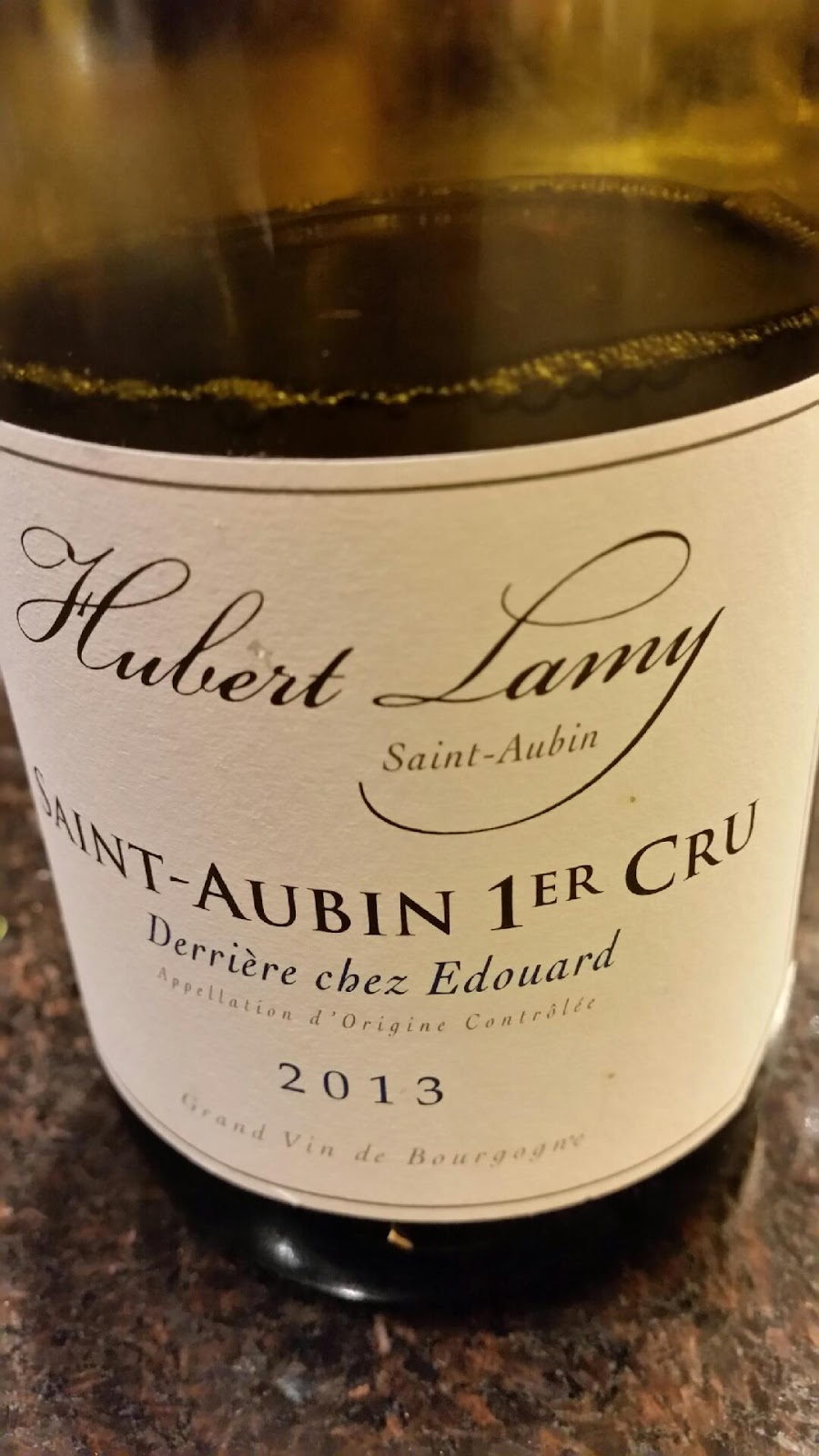
We started the evening with a really tasty 2013 Saint Aubin Derrière Chez Edouard, Hubert Lamy. I adore this name for its idiosyncratic image. It is vibrant, with plenty of tension to complement the complexity, followed by a nice long finish! A well-made wine for now or the next 5-6 years. The difference between 2012 and 2013 is very poignant. Such a welcome return to a classic style with an approachability that is so appealing. 17/20


Monday, 2 May 2016

1989 La Tache

1 May 2016:

1989 La Tâche: Richard chose this for the long weekend. Initially, it was rather ungenerous, with just tertiary character of leather, mushroom and sous-bois, overlaid with a hint of volatility. The structure concurred it was a wine of pedigree and finesse, but the palate seemed a little tired, lacking in concentration and depth and finishing dry. We were relieved that after about 2 hours, it started displaying signs of life and vibrancy. The fruit notes returned, together with dried rose and cardamom character, and the mid palate also filled out nicely, leading to an elegant finish. It seemed a wine in its prime, at the plateau of its drinking and would continue to drink well for 8 - 10+ years. 17/20 (Richard gave it 92.)