Sunday, 16 September 2012
Birthday Wines
16 Sep 2012: It's not usual for the birthday boy to buy the wines, cook the food and even mop up shattered glass pieces at a birthday dinner! As it happened, our friend Paul did all of that and he even put up with our dietary request for vegetarian dishes instead of the very delicious boeuf bourgignon that he lovingly prepared. The Chinese alternatives of "ma po to fu" and "stir fried long beans" were really yummy, as was Julie's nicely-textured cauliflower mash, which looked and tasted healthy.
2002 Clos des Goisses, Philipponnat. Racy, precise, showing purity and depth of gorgeous underlying fruit. A bit on the austere side now, this is a serious champagne that would benefit from 4 - 5 more years of cellaring to allow further development of flavours and bouquet. It showed much better with a couple more hours of aeration: green apple, peach, white flowers, smoke and spice, with detailed minerality. 18.5+/20
2001 Bourgogne Chardonnay, Coche-Dury: This was the biggest surprise of the evening. An opulent and complex bouquet of floral, marzipan, pear, roasted pineapple, fig, toasted almonds and smoke, laced with beautiful minerality and spices. Very smooth mouthfeel, nicely weighty on the palate, balanced by very vibrant acidity, with a lengthy finish. Drinking at peak and will drink well for another 4 - 5+ years! 18/20 The quality of this Bourgogne surpassed its appellation level. Wonder if this was declassified stuff? This went so well with the peaty smoked salmon that Paul ordered from this place called Hebridean Smoke House (www.hebrideansmokehouse.com) - I highly recommend - very difficult not to love it! I would have to have it again with a dram of peaty whisky!
1978 Beaune-Grèves Vigne de L'Enfant Jésus, Bouchard: A nicely mature nose of coffee, pot pourri, autumn leaves, tea leaves, floral and coriander seeds. Silky on the palate, with a sweet entry and some depth, but the sharply acidic kick at the finish would indicate it being past its peak. An elegant and classy wine but probably 3 - 4 years past its peak. 15.5/20
2001 Gevrey-Chambertin Clos Saint Jacques, Rousseau: I rather liked this - a more extracted forward style. Bright medium ruby. Savoury, animal saddle notes, complementing the bright red cherry and raspberry notes, with violet, spice and earthy nuances, all layered with bright minerality. Gorgeously balanced, velvety ripe tannin, with richness, weight and concentration that left you gobsmacked. Will continue to develop over next 12+ years but why wait! 18/20
2000 Meursault-Perrières, Lafon: Ripe concentrated fruit, apple, peach, toasted almonds, with heaps of stony minerality. Classy and sophisticated, with phenomenal precision and purity. Crisp and very long finish. Drinking beautifully now and for next 10 - 15 years. 18/20
Thank you again Paul and Julie for an excellent evening and the doggy bags of peaty smoked salmon!
Thursday, 13 September 2012
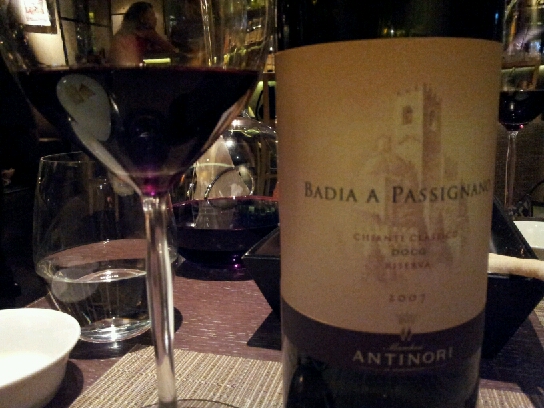
2007 Chianti Classico Badia a Passignano Riserva, Antinori
12 Sep 2012: Dinner at Otto e Mezzo, HK
2007 Chianti Classico Badia a Passignano Riserva, Antinori
100% Sangiovese. A plush style of Chianti Classico, with intensity of fruit flavours and silky tannin structure. Deep ruby. With a bit of aeration (30 - 40 minutes in the decanter), the classic floral, kirsch and red cherry bouquet layered with nuances of liquorice and smoke, was very attractive. Silky ripe tannin on the palate, with a good dose of acidity to balance the concentration of flavours. Lovely clean and long finish and the freshness, given the ripeness of the vintage, was very admirable. A pretty well-made and perfectly balanced wine, but not a profound one. Just the perfect accompaniment to the pappardelle dish with slow cooked lamb and mushroom, scented with rosemary at Otto e Mezzo. Drink now and over the next 6 - 8 years. 16.5/20
Friday, 7 September 2012
1978 Nuits-Saint-Georges Les Pruliers, Henri Gouges
7 Sep 2012: Ruby core, garnet rim. A very classic nose of raspberry, autumn leaves, Asian spices, savoury, truffle and coffee notes, with great intensity. Delicate frame, silky tannin, vibrant acidity, keeping the palate remarkably fresh, wet stone mineralty on the palate. Lengthy finish. A wine of pedigree, character, refined style and purity. A fantastic effort for a Premier Cru. Drinking at peak now, and for next 5 - 6 years. 18/20
1966 La Tache and 1988 Krug
1 Sep 2012: A rather special occasion for us to enjoy some fine bottles with a couple of friends at Spoon Restaurant in Hong Kong. We started with a 1988 Krug, which the sommelier chose to serve in these slightly modified Marie-Antoinette champagne coupes, where the wine fills the stem of the glasses. These glasses were certainly pretty but I was not quite sure that they were entirely helpful in concentrating the aromas of our fine champagne and the bit in the stem was not doing very much! Bright golden hue, with persistent fine bubbles. A mature and richly intense bouquet of honey, figs, toasted hazelnuts and smokey notes. On the palate, it reveals an impeccably balanced opulence in flavours, gorgeously creamy texture, freshness delivered by the right amount of acidity and nicely developed warm notes of marmalade, dried apricot, guava and almond croissant. Seriously yummy, with a very long finish! Gorgeous now and for the next 8 - 10+ years. 18/20
Our white wine was a 1978 Corton-Charlemagne, Bonneau du Martray. Pale gold. Richard found it too rich and mature for his liking. I rather liked it and it went really well with the steamed foie gras that Frank and I both ordered. (A hearty portion size of foie gras - best shared by 2 people, I think.) Toasted macadamia and hazelnuts, caramel popcorn, quince, with notes of white chocolate, nutmeg and coriander seeds. Medium acidity, keeping the wine fresh on the palate, medium bodied, quite unctuous. Long spicy finish. Definitely for drinking now, while it's still balanced. 17/20
The sommelier again offered a strange choice of glassware for the 1966 La Tâche. He served it in small white wine glasses, citing reason that the wine was going to collapse very quickly in a normal Burgundy glass. For me, while this wine did not require decanting (provided careful pouring), it would benefit from a suitable amount of aeration to allow the wine to open up and the elements to come together. Ruby core, with a garnet rim. Very enticing bouquet of raspberry, dried rose petals, sous-bois and Asian spices. Initially the palate was a little subdued, but came through, after some aeration, with earthy notes of mineral and wet stones, and some coffee. A very refined structure of silky tannin, showing a little astringency, with medium acidity still in balance, a classy lengthy finish. A fine wine, showing plenty of finesse, elegance and complexity, but much less complete/exuberant than the Romanée Conti from same vintage, the memory of which still lingers in my mind 6 years after tasting it. 18.5/20
We finished with 1983 Château d'Yquem. Medium-deep amber in colour. Richly intense marmalade, dried apricot, dried pineapple, beautifully laced with toffee apple notes on nose and palate. The voluptuous body is lifted by vibrant acidity, giving this wine a vigorously long finish. For my palate, I would like it with a bit more tension and less of the richness. 17/20
We were spoilt but great wines really reveal their greatness in the company of special friends.
Our white wine was a 1978 Corton-Charlemagne, Bonneau du Martray. Pale gold. Richard found it too rich and mature for his liking. I rather liked it and it went really well with the steamed foie gras that Frank and I both ordered. (A hearty portion size of foie gras - best shared by 2 people, I think.) Toasted macadamia and hazelnuts, caramel popcorn, quince, with notes of white chocolate, nutmeg and coriander seeds. Medium acidity, keeping the wine fresh on the palate, medium bodied, quite unctuous. Long spicy finish. Definitely for drinking now, while it's still balanced. 17/20
![]() |
| Steamed foie gras |
We finished with 1983 Château d'Yquem. Medium-deep amber in colour. Richly intense marmalade, dried apricot, dried pineapple, beautifully laced with toffee apple notes on nose and palate. The voluptuous body is lifted by vibrant acidity, giving this wine a vigorously long finish. For my palate, I would like it with a bit more tension and less of the richness. 17/20
We were spoilt but great wines really reveal their greatness in the company of special friends.
Thursday, 16 August 2012
Beauties from Central Italy
16 Aug 2012: Wine tasting dinner earlier this week and the theme was 'Anything Red but Bordeaux'. We went to Zhejiang Heen (very tasty food!!) The food was Shanghainese (or nearby) cuisine, with all the usual favourites, such as braised meatballs, honeyed ham sandwiches, stir fried chicken and pine nuts in a rice crispy cone, smoked fish, and crispy eel, etc. Given the theme, the wine selection was rather eclectic amongst the 16 people who attended. There were some rather big and powerful wines, such as the inky dark monolithic 2008 Joseph Phelps Insignia, with painfully intense aromas and flavours of cassis liqueur, blackberry jam, liquorice and tar, packed into an unctuous texture with ripe but very toothsome tannins. Great concentration, lengthy finish but it really wasn't ready, even with the 2.5 hours of decanting time. Try again in 5 years time. The 2005 Chave Hermitage was equally backward and needed every bit of the 2.5 hour of decanting time that we gave it.....but it could do with tons more. Compared with the 2003 that we had recently, this was made in a slightly more austere style (earthy, herbal and spicy notes) with quite angular tannin and bright acidity, quite extracted, which would require a lot more patience to mellow to display its superior heritage. Should give it another 8 - 10 years before enjoying again, with a very long life ahead.
What really impressed me and what really went so well with the food were the Italian wines! I was particularly impressed by the magnum of 2001 Sportoletti Villa Fidelia, a Bordeaux blend mainly consisting of Merlot with some Cabernet Sauvignon and Cabernet Franc, from Umbria. Made by the Sportoletti family, with advice from Riccardo Cotarella. Lovely cedar, graphite, blackberry, blueberry and liquorice notes, with velvety tannins and marvellous intensity and balance. A very charming wine, an absolute pleasure to drink now and went amazingly well with the braised meatballs and honeyed ham sandwiches! Drink now and for next 6 - 8+ years for optimum enjoyment. 17.5/20
The other wine I really liked and which I thought went beautifully with the crispy eels (and other dishes!) was the 2003 Isole e Olena Cepparello (100% Sangiovese from the estate's best sites in northern Chianti Classico, aged in French barrels for about 18 - 20 months). I loved the gorgeously classic bouquet of floral, plum, cherry, spicy liquorice and some earthy notes, with a most elegant structure and balance of acidity and ripe velvety tannin. There was this wonderful definition of generous ripe fruit and balance that gave the wine much elegance and poise, without any signs of over-ripeness from the hot vintage. A beautifully crafted wine with a very long finish, bravo to the proprietor Paolo de Marchi. Drink now and for the next 10 - 12 years. 18/20
The 2004 Argiano Brunello di Montalcino was a little muted on this evening. It could have done with a bit more aeration to flaunt its elegance and finesse. There was some hint of ripe fruit but it lacked depth and intensity on the palate.
While on the subject of Italian beauties from Central Italy, I enjoyed a bottle of 1998 Falesco Montiano last night with a few friends and was absolutely delighted by a most charming and elegant wine, fashioned out of 100% Merlot from Lazio, aged in French oak barrels. A mature bouquet showing black cherry, plum, chocolate, liquorice, tobacco and some hints of leather. The palate was a very smooth, cashmere-like texture of silky tannin, with just sufficient acidity to give the wine a very harmonious structure to pair with the eggplant parmigiana that I made. Gorgeous effort (the wine and my eggplant parmigiana). Loved the long finish! 18/20
Tuesday, 14 August 2012
A long way from Hamburgers!
14 Aug 2012: A friend's wedding in Denmark put Hamburg on the map for us - so we decided to visit this northern German city, en route to Kusaa, Denmark. Despite the large-scale devastation in the Second World War, the city has very handsomely rebuilt itself, while retaining a little of the old worldly charm - the promenades, the galleries, the harbour, lakes and canal.
We stayed at the Fairmont (or better known by the locals as the Hotel Vier Jahreszeiten or the Four Seasons Hotel). It was very well-situated, facing the Binnenalster (or Inner Alster) and right in the middle of the chic shopping area, with a good spread of charming Italian ice-cream parlours/cafes and Starbucks to offer well-deserved respite to weary tourists and shoppers. We arrived on a gorgeous day, with balmy weather, brilliant sun and a light breeze that kept refreshing the ripples off the shimmering surface of the Binnenalster. Find yourself a nice table at one of the cafes along the Binnenalster, order a beer or ice cream sundae, and you will be wanting for nothing more (at least for a couple of hours), against the backdrop of the cawing of seagulls and the chatting of merry holiday-makers. For a bit of culture, we highly recommend the Hamburger Kunsthalle which boasts a comprehensive collection of paintings and sculptures from Old Masters to impressionists and modern art, plus the occasional special exhibition (Alice in Wonderland at the moment).
The food scene was most gratifying. We had some great meals there and we highly recommend Landhaus Scherrer and Restaurant Seven Seas, the gourmet restaurant at the Süllberg Hotel (www.suellberg-hamburg.de). We thought we didn't do too badly on the wine front, given how little we both knew about German wines - Hugh Johnson's Pocket Wine Book came to the rescue (yes, we carried it around!)
At Landhaus Scherrer, we were very well-looked after by the female maitre-d'. She very patiently explained to us the different dishes which interested us and very happily changed our bottle of wine when it didn't taste quite right. The amuse bouche was a composition of tomato dishes: from an intensely flavoured tomato consomme topped with some tomato-flavoured foam to tomato-flavoured sorbet and a tomato-flavoured cream. For starter, I had a delicately-flavoured bouillabaisse with a clear broth and very fresh fish and mussels, aromatically lifted with the addition of fresh basil leaves. Richard had a lobster salad which he said was the best he'd had for a long time! For main courses, we both had fish. Richard had a turbot dish with broad beans and I had a steamed trout-like fish, with a bean stew and mire-poix, the sauce lightly scented with rosemary. It was so delicious - the fish was very tender and moist and the beans added complexity to the texture. Truly excellent.
As for the wine, we ordered a bottle of 2010 Westhofen Morstein Riesling Trocken GG, Weingut Wittmann. Wittmann is based in Rheinhessen, practising biodynamic viticulture since 2004 (www.weingutwittmann.de). Morstein is one of 4 top vineyard sites in Westhofen where the Wittmanns have land under vines. It is situated on the south-facing slope that stretches from Gundersheim to Westhofen. The subsoil consists of massive limestone rocks. Pale gold, quite an open nose, with good intensity of peach, grapefruit and lime blossom, with some honey notes. Very lively acidity and a certain austerity giving away its young age, revealing much complexity on the palate, with a chewy texture. A complete wine with a lovely long firm and minerally finish. Drink now and over next 10+ years. 17/20
We asked if they had a half bottle of Rudolf Fürst (www.weingut-rudolf-fuerst.de) to offer, as we learnt from our 'bible' that Fürst (based in Franken) was arguably the best producer of Spatburgunder, in an almost Burgundian style. (I thought this would keep Richard happy!) They didn't have but the maitre-d' very kindly opened a bottle of 2009 Parzival, Furst and offered a glass to Richard. A very generous gesture! Parzival is a red wine blend of Pinot Noir and Domina (a crossing between Portugieser and Pinot Noir). It was indeed a tasty drop, well-balanced with a medium body and notes of red fruit, underbrush, game and savoury minerality, and became our benchmark red! I can't wait to try other signature wines by Paul Fürst: the Weissburgunder, labelled as the most Burgundian white in Germany; the Frühburgunder (a mutation of Pinot called Pinot Madeleine) which has its own following and his top drop, the Spätburgunder Spätlese R (from Bürgstadter Centgrafenberg with its south-facing moderate to steep sites of cool sandstone and loam content). Paul had to leave his viticultural studies at Geisenheim at the age of 21 when his father Rudolf suddenly passed away. He has since established a name for himself as the winemaker who turned the world's attention to Spätburgunder from Germany - his 1990 served blind at a wine tasting was mistaken for a Burgundy wine from Beaune. Fermentation on skins and maturation in French oak count amongst his vinification techniques.
Our next dinner was at the gourmet restaurant at the Süllberg Hotel called Seven Seas. Richard found this place from the Michelin Guide but it wasn't very clear that it was part of a hotel in the suburbs, miles out of Hamburg City Centre. In fact, if you wanted the perfect view of the River Elbe, you should dine at Deck 7 instead because the tables are on the exposed terrace and offer an excellent view of the river. At the gourmet restaurant, the tables were a bit more tucked inside but we did nevertheless get a glimpse of the River Elbe (without straining too much the neck muscles).
We were very well looked again by a knowledgeable sommelier and friendly waiting staff. Our only complaint was that we were given far too many amuse-bouches! There were 3 platters/dishes that came before our proper starter! The first was a platter of a few bits and bobs, including a tube of crustacean broth which was really tasty, and a tiny baked potato with braised pork. Then came a monkfish carpaccio which neither of us ate. Then we were given another dish which we felt that we'd better eat before we would be served the food we actually ordered. For starter, Richard had a langoustine dish which again was pretty near perfect, and I had a lovely green salad. For main course, I had the sole with field mushrooms, spinach and a rich truffle sauce. Richard had the turbot. Both dishes were excellent and prepared with the freshest ingredients. We really were very impressed by the quality of the food.
For wine, we chose a 2010 Niederhäuser Hermannshöhle, Riesling Trocken GG, Weingut Hermann Dönnhoff (Nahe). It was more austere and vibrant than the previous night's Wittmann. Citrus, honey and ripe peach notes on the nose. A lovely savoury minerality on the well-textured palate, with plenty of acidity, leading to a nice long refreshing finish. Nicely weighty, with great balance. A harmonious wine with class and elegance. Drink now and over next 10+ years. 17.5/20
We did return to Hamburg on our back from the wedding in Denmark, and we stayed another night at the Fairmont. We arrived in time for a late lunch at Le Plat du Jour, in the Old Town. Of course, we took ages to find it....as it's tucked inside a little street within what looked like the Financial District. Richard had the seabass of the day and I ordered the traditional chicken liver salad - it was yummy if a little too smothered in rich sauce (I needed the restorative effect and the umame flavours of chicken liver after indulging on too much of the lipsmacking 2008 Tignanello at the wedding banquet the previous night!). Good hearty French bistro fare in the middle of Hamburg! For dinner, we ate at the Grill at the hotel, but food was nowhere near as good as at the other restaurants we tried. My pike perch was overcooked and Richard's steak was rather tough. The side dishes were tasty though - the bean cassoulet and the pan-fried chanterelles were both delicious. We would have tried the gourmet restaurant (Restaurant Haerlin) if it weren't closed for holiday. Our white wine choice was a half bottle of 2011 Kiedrich Grafenberg Riesling Trocken, Weingut Robert Weil. Green apple and citrus. It could do with a bit more age. This was followed by a half bottle of 2009 Parzival.
Hamburg gave us a really pleasant surprise and if you could call it disappointment, it was that we didn't have a single hamburger!
As a side note, do check out this hotel in Denmark, just across the border from Germany, Fakkelgaarden (www.fakkelgaarden.dk) in Kollund, Kusaa. It was a really charming hotel, with only 26 suites all facing the Flensburg Fjord, a gourmet restaurant and a very well-stocked cellar. It also offers cooking classes. I took this picture just before 6 in the morning - the warm glow of dawn in Nordic serenity.
| View of the Binnenalster from our hotel |
The food scene was most gratifying. We had some great meals there and we highly recommend Landhaus Scherrer and Restaurant Seven Seas, the gourmet restaurant at the Süllberg Hotel (www.suellberg-hamburg.de). We thought we didn't do too badly on the wine front, given how little we both knew about German wines - Hugh Johnson's Pocket Wine Book came to the rescue (yes, we carried it around!)
At Landhaus Scherrer, we were very well-looked after by the female maitre-d'. She very patiently explained to us the different dishes which interested us and very happily changed our bottle of wine when it didn't taste quite right. The amuse bouche was a composition of tomato dishes: from an intensely flavoured tomato consomme topped with some tomato-flavoured foam to tomato-flavoured sorbet and a tomato-flavoured cream. For starter, I had a delicately-flavoured bouillabaisse with a clear broth and very fresh fish and mussels, aromatically lifted with the addition of fresh basil leaves. Richard had a lobster salad which he said was the best he'd had for a long time! For main courses, we both had fish. Richard had a turbot dish with broad beans and I had a steamed trout-like fish, with a bean stew and mire-poix, the sauce lightly scented with rosemary. It was so delicious - the fish was very tender and moist and the beans added complexity to the texture. Truly excellent.
| Gorgeously delicately flavoured bouillabaisse |
| Trout dish at the Landhaus Scherrer |
| Steamed trout with bean stew |
As for the wine, we ordered a bottle of 2010 Westhofen Morstein Riesling Trocken GG, Weingut Wittmann. Wittmann is based in Rheinhessen, practising biodynamic viticulture since 2004 (www.weingutwittmann.de). Morstein is one of 4 top vineyard sites in Westhofen where the Wittmanns have land under vines. It is situated on the south-facing slope that stretches from Gundersheim to Westhofen. The subsoil consists of massive limestone rocks. Pale gold, quite an open nose, with good intensity of peach, grapefruit and lime blossom, with some honey notes. Very lively acidity and a certain austerity giving away its young age, revealing much complexity on the palate, with a chewy texture. A complete wine with a lovely long firm and minerally finish. Drink now and over next 10+ years. 17/20
We asked if they had a half bottle of Rudolf Fürst (www.weingut-rudolf-fuerst.de) to offer, as we learnt from our 'bible' that Fürst (based in Franken) was arguably the best producer of Spatburgunder, in an almost Burgundian style. (I thought this would keep Richard happy!) They didn't have but the maitre-d' very kindly opened a bottle of 2009 Parzival, Furst and offered a glass to Richard. A very generous gesture! Parzival is a red wine blend of Pinot Noir and Domina (a crossing between Portugieser and Pinot Noir). It was indeed a tasty drop, well-balanced with a medium body and notes of red fruit, underbrush, game and savoury minerality, and became our benchmark red! I can't wait to try other signature wines by Paul Fürst: the Weissburgunder, labelled as the most Burgundian white in Germany; the Frühburgunder (a mutation of Pinot called Pinot Madeleine) which has its own following and his top drop, the Spätburgunder Spätlese R (from Bürgstadter Centgrafenberg with its south-facing moderate to steep sites of cool sandstone and loam content). Paul had to leave his viticultural studies at Geisenheim at the age of 21 when his father Rudolf suddenly passed away. He has since established a name for himself as the winemaker who turned the world's attention to Spätburgunder from Germany - his 1990 served blind at a wine tasting was mistaken for a Burgundy wine from Beaune. Fermentation on skins and maturation in French oak count amongst his vinification techniques.
| View of the Elbe from the terrace at Deck 7, Sullberg Hotel |
| Sole with field mushrooms, pea puree and smokey potato |
| Turbot dish at Restaurant Seven Seas |
For wine, we chose a 2010 Niederhäuser Hermannshöhle, Riesling Trocken GG, Weingut Hermann Dönnhoff (Nahe). It was more austere and vibrant than the previous night's Wittmann. Citrus, honey and ripe peach notes on the nose. A lovely savoury minerality on the well-textured palate, with plenty of acidity, leading to a nice long refreshing finish. Nicely weighty, with great balance. A harmonious wine with class and elegance. Drink now and over next 10+ years. 17.5/20
We did return to Hamburg on our back from the wedding in Denmark, and we stayed another night at the Fairmont. We arrived in time for a late lunch at Le Plat du Jour, in the Old Town. Of course, we took ages to find it....as it's tucked inside a little street within what looked like the Financial District. Richard had the seabass of the day and I ordered the traditional chicken liver salad - it was yummy if a little too smothered in rich sauce (I needed the restorative effect and the umame flavours of chicken liver after indulging on too much of the lipsmacking 2008 Tignanello at the wedding banquet the previous night!). Good hearty French bistro fare in the middle of Hamburg! For dinner, we ate at the Grill at the hotel, but food was nowhere near as good as at the other restaurants we tried. My pike perch was overcooked and Richard's steak was rather tough. The side dishes were tasty though - the bean cassoulet and the pan-fried chanterelles were both delicious. We would have tried the gourmet restaurant (Restaurant Haerlin) if it weren't closed for holiday. Our white wine choice was a half bottle of 2011 Kiedrich Grafenberg Riesling Trocken, Weingut Robert Weil. Green apple and citrus. It could do with a bit more age. This was followed by a half bottle of 2009 Parzival.
As a side note, do check out this hotel in Denmark, just across the border from Germany, Fakkelgaarden (www.fakkelgaarden.dk) in Kollund, Kusaa. It was a really charming hotel, with only 26 suites all facing the Flensburg Fjord, a gourmet restaurant and a very well-stocked cellar. It also offers cooking classes. I took this picture just before 6 in the morning - the warm glow of dawn in Nordic serenity.
A Few Burgundies: 1996 Roumier, 2000 Lafon and 1997 Engel
14 August 2012: Recently, we've enjoyed a few burgundies.....
2000 Meursault Perrières, Lafon
Golden robe. More developed nose than anticipated. Very intense fig, ripe pear, marzipan, with earthy and spicy notes. Rounded waxy texture, with same stony/mineraly notes on palate. Rich but well-balanced and a long finish. Perhaps a little short of acidity to ensure a long life ahead. Drink now. 17.5/20
1996 Bonnes Mares, Roumier
A beautifully balanced and elegant wine. Aromatically very enticing, black fruit, sous-bois, mushroom and spicy aromas. Quite mute on the palate initially, despite being decanted for an hour, took a good part of 2 hours for the palate to become more interesting. A wine of incredible elegance and balance, understated power and richness that would be very rewarding for years to come. A tad too young at this point. Drink from 2015+. 18/20
1997 Grands Echézeaux, Engel
A classic mature Burgundian nose of tertiary notes of autumn pot pourri, Asian spices of coriander seeds and five spice, farmyard and rusty nail, with some underlying compote of black fruit, slightly burnt. Probably just past peak...but I still like the acidity (which cut through the cream in my chicken in vin jaune sauce) and the very harmonious mouthfeel, still showing a nicely integrated structure. Great food wine, so approachable now, so easy to enjoy. Slightly drying on the finish, but not yet a worry at this stage. Drink now. 16.5/20
Subscribe to:
Posts (Atom)