Thursday, 31 May 2012

Accademia del Barolo in HK

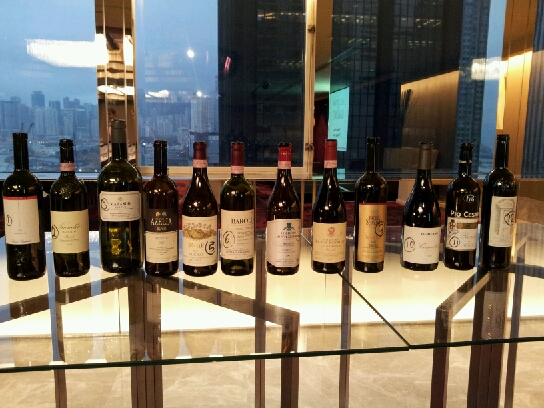
28 May 2012:  It was really a privilege to be invited to a Masterclass tasting of the 2007 vintage with the distinguished members of the Accademia del Barolo, which counts 14 producers amongst its members:  Azelia, Michele Chiarlo, Conterno-Fantino, Damilano, Poderi Luigi Einaudi, Gianni Gagliardo, Franco M. Martinetti, Monfalletto-Cordero di Montezemolo, Pio Cesare, Prunotto, Luciano Sandrone, Paolo Scavino,  Vietti and Roberto Voerzio.  This is the first time the Accademia's members visited Hong Kong. All except 2 (Luciano Sandrone and Roberto Voerzio) of the members sent in a representative (family member or the winemaker himself) or wine samples and in most cases, both!  The mission statement of the Accademia is to spread the word about Barolo and improve the overall public's knowledge of this King of wines (and wine of Kings).  Great kudos to Debra (and Sarah) who convinced the producer members to come visit HK during Vinexpo, to spread the word about Barolo to HK wine-lovers, and even better to bring their best bottles! 

All the wines showed amazingly well, each extremely expressive of the style of the producer, the character of the Nebbiolo grape and that of the terroir. Some were made in a more 'rustic', slightly more austere style,  while others showed more extraction (albeit retaining much elegance) wrapped in a more modern, readily approachable style.  It would be very hard to rank the wines because they were all so delicious.  Debra encouraged us to taste and re-taste the wines in the glasses, once they had had time to flourish and develop with aeration. All showed gorgeous ripe fruit and depending on the style, either floral or spicy, with chocolate/liquorice notes. All were extremely well balanced and beautifully structured.  My favourites were: Vietti Barolo Brunate which was feminine and voluptuous, Monfalletto-Cordero di Montezemolo Barolo Enrico VI which was aristocratic, lush and concentrated, and the Michele Chiarlo Barolo Cerequio which was very stylish, with great character and seductive aromas.....but I also admired very much the Paolo Scavino Barolo Bric del Fiasc (great aromatics, powerful and concentrated), the Pio Cesare Barolo (harmonious and elegantly balanced) and the Gianni Gagliardo Barolo Cannubi which was ever so ethereal, with silky tannin and very fresh fruit! 

The 2007 vintage line-up - absolutely gorgeous wines!!!
Debra and Patrick also very generously organised a private dinner for a few wine-loving friends with this distringuished group of wine producers on the previous evening, so that we would have the opportunity to speak to them in more casual setting.  Not only were we treated to some great bottles with some age, we were also regaled with a sumptuous buffet of fine cuisine prepared by Patrick (I loved the stuffed peppers - an unusual stuffing with pig's livers)!  The immaculately orchestrated procedure was rather annoyingly interrupted by an onslaught of flying termites which went on for almost an hour and a half before they retired to bed at 9 pm. I slightly lost track of what I tasted or not.....however, from memory, we tasted a very fine 2001 Vietti Barolo Brunate and a gorgeous 2006 Michele Chiarlo Barolo Cerequio with great intensity and depth.  The 1998 Paolo Scavino Barolo Riserva Rocche dell'Annunziata was definitely a favourite of mine, still flaunting so much vigour, concentration and firm structure.  Debra and Patrick were incredibly generous, as were our friends from Barolo, who were all incredibly friendly and so willing to share their passion and love of Barolo with us! 

We were all warmly invited to visit Piemonte which, like Burgundy of France, offers great food and great wine!!!  Let's drink more Barolo because it truly deserves to be celebrated!!

Thursday, 3 May 2012

A Not So Random May Day Gathering

1 May 2012: Public holiday in HK. A few of us had gone to an amazing 30th birthday party the previous night where we were treated to a generous showing of very high quality burgundy wines (my most memorable being 1984 Ramonet Montrachet, 1999 Coche-Dury Corton Charlemagne, 1996 Lafon Meursault Perrieres, 1997 Leroy Corton Charlemagne and the 1970 magnum of Rousseau Chambertin Clos de Beze that we brought!  Richard said he tasted a very nice 1962 Leroy Musigny.....but unfortunately I didn't get that far!!).  We were having a few friends home to a casual supper with a few bottles.  We hadn't quite planned the wines for the evening but one thing led to another and we went down a rather slippery path of indulgence!

2000 Pontet Canet. Deep ruby colour.  Bouquet of chocolate, blackberry preserve, spices, underbrush,  truffle, smoke and mineral.  A wine of masculine proportions, with gorgeous tannic structure, and plenty of ripe phenolic substance. This wine has just started to unfold its big and brooding structure.  It will reward the patient.  17.5/20

I looked around the cellar and thought the 1990 L'Evangile would be a worthy successor. A seductive wine, sensual and shapely.  Smokey, cedar, blueberry, mocha, floral and leather characterise the very attractive bouquet. A wine that boasts great balance, concentration, depth and complexity on the palate, with a very long finish.  A classic Pomerol beauty.  18.5/20

Then Richard quite fancied the look of the 1966 Vieux Chateau Certan.  Cedar, meaty and leather bouquet.  Glorious tertiary aromatics. A little disappointing on the palate, which was still relatively fresh but devoid of fruit character, with a somewhat bothering astringent aspect.  A wine that would never quite resolve its elements!  16/20

After that, there was no return......out came the 1955 Graham's: Viscous and concentrated.  Caramel, dried fruit, walnuts, dark cherry pie, with hints of chocolate. A rich and unctuous nectar that had very little difficulty slipping down our throats! Quite a spirity finish.  19/20


2002 Raveneau Montee de Tonnerre

3 May 2012: 2002 Raveneau Montée de Tonnerre. Rather youthful and could definitely benefit from further bottle age.  I rather admired the austerity and flinty minerality of this young wine, showing lots of tension and energy, made more appealing with a decidedly citrus character, with smokey and spicy notes emerging after a while in the decanter. Very firm acidity bolstering the broad structure.  Slightly aloof, but stylish nonetheless, and lengthy in the finish. Drink now and for next 8 - 10 years. 17.5/20

On the same evening, we also opened a bottle of 1999 Vosne-Romanée Cuvée Duvault-Blochet, DRC.  Very elegant and showing some graceful ageing.  Raspberry, spicy, chocolate and some underbrush characterised the charming bouquet.  The flavours, while not hugely intense, show remarkable complexity, within the framework of well-integrated soft tannin and harmonious acidity.  Some sappy notes on the persistent finish. A wine of elegant subtlety and intellectual content, that seeks to harmonise, rather than overwhelm. Drink now and for the next 6 - 8 years. 17/20

1947 Petrus and 1982 Petrus


28 Apr 2012: A little while ago, I spotted some 'weeping' from the capsule of a bottle of 1947 Petrus (van der Meulen bottled), followed by something that seemed to be bubbling away at the edge of the capsule.  So I suggested that we should just open it to see what it's like, expecting the worst.  Initially, it tasted rather unexciting, to the point that it was totally lacking in character, even when no obvious faults could be detected.  Perhaps it was our imagination, there seemed to be a little prickle on the palate, offputting but not offensive.  It would seem such a waste to pour it down the sink.  Instead, we pumped out the air and left it in the fridge for 24 hours.  What emerged the following day was something quite amazing.  It had taken on this lush, luxurious and opulent texture, with the nose showing distinct chocolate, mocha, sweet black fruit, leather and smoke.  The middle palate had become much more substantial, generously coating the mouth with rich and sweet flavours, and leaving a very long finish.  A rich and powerful wine, that was drinking at peak now and would continue to drink beautifully over the next 8 - 10 years, based on this bottle's miraculous performance! It was much richer than the 1949 L'Evangile, which sadly did not improve in the course of the evening.  19.5/20 for the 47 Petrus and 16.5/20 for the 49 L'Evangile.

We also opened a bottle of 1985 L'Evangile, which was well-balanced and beautifully integrated, aromatically enticing with blackberries, cocoa, mocha, earthy, and floral notes.  Medium bodied, with elegant acidity.  A lovely wine drinking at peak now, but it didn't quite have the concentration nor seductive power of the 1947 Petrus,  which simply became better and better as the evening progressed!

Last night we needed a bit of cheering up. So we opened a bottle of 1982 Petrus, from an OWC.  Richly intense aromas leapt out of the glass.  Chocolate, mocha, black cherry preserve, blackberries and cedar enrapturing the olfactory senses.  There was just a hint of vegetal character adding to the complexity rather than detracting from it,  in our view.  On the palate, medium bodied, still showing a fair amount of astringency from an earlier much more tannic existence, intensely black fruit and liquorice.  Very long finish, with a slightly woody aftertaste.  A superb wine that just started to drink beautifully and will continue to mature over next 10 - 15 years. 18/20

Sunday, 15 April 2012

La Fete du Bouzeron et du Persille de Bourgogne

La Fete du Bouzeron
16 Apr 2012: Just before our main trip to Salzburg during Easter, we managed to squeeze in a few days  of visit to Burgundy.  We had some great tastings of the 2010 vintage at a few domaines, including Dujac, Meo-Camuzet, Patrick Javillier and Lejeune, and a few delicious meals at our favourite restaurants, including Lameloise (I loved my frogs' legs dish !), Ma Cuisine and Caves Madeleine, whose warm salad of red cabbage and bacon remains a highlight throughout the entire trip. 


The Frogs' Legs dish at Lameloise
 We also did something a little bit more interesting this time. We went along to La Fête du Bouzeron et du Persillé de Bourgogne on Sunday, 1st April (I looked up the local website prior to our trip and spotted this interesting Sunday activity!).  For the price of 7.50 Euros per person, we each got a souvenir wine glass, 6 tasting coupons (for either wine or jambon persillé) and a lucky draw ticket.  Bouzeron is an appellation in the Côte Chalonnaise, specifically dedicated to the much less glamorous cousin of Chardonnay, Aligoté.  If not for the gusty wind, which could be quite tiresome, it was a fine spring day, with bright blue sky and warming sunshine.  We thoroughly enjoyed the festival, which involved walking through the village, sampling wine (Bourgogne Blanc, Bourgogne Rouge, Crémant and Bouzeron) and jambon persillé at different stands, as well as other goodies,such as caramelised peanuts, macarons, chutneys, French fries and steak sandwiches, etc.   A band of colourfully-attired musicians also partook in the festivities and delighted onlookers with their cheerful tunes.  

A brief word on Bouzeron and this wonderful form of charcuterie.  The brochure described it as a springtime wine - "un vin de printemps".  It has an aromatic richness, with a nose nuanced with minerality, as well as notes of acacia, white flowers and hazelnut. On the palate, there is freshness and roundness, revealing the typicity of the terroir and the grape variety of Aligoté, which is so unique to this appellallation.  As for jambon persillé, it is a Burgundian speciality of charcuterie, made with ham, parsley, garlic and Aligoté (amongst other ingredients).  The natural marriage of these two products has thus made this festival possible.


A&P de Villaine watching the musicians at the Bouzeron Festival
 Monsieur de Villaine and his wife are both great supporters of the village and it was really nice seeing them taking a stroll round the festival, showing their support.  13 domaines exhibited their wine at the stands, including Bonnet, Borgeot, Briday, Chanzy, Chaussin, Cruchandeau, de la Mugnière, André Delorme, de Villaine, Jacqueson, Lechenault, Chateau Saint-Michel and Moreteaux.  We didn't really have the chance to taste all the wines from the different domaines but from the ones we tried, we felt that the de Villaine Bouzeron clearly seemed the superior Bouzeron....(perhaps we were just biased!).....

After the visit, we took a lovely stroll back to Chagny, on a hiking path named La Folie! 

The Temple of Haute Cuisine

16 Apr 2012: Before the Salzburg visit, we did a short hop to Lyon. Why? It’s all about Paul Bocuse, the master chef who made Lyon proud, who has inspired thousands of culinary students and aspiring chefs all over the world and who at the age of 86 (born in February 1926) is still at the helm of his eponymous restaurant after 50+ years. His restaurant at Collonges au Mont d’Or is the ‘temple’ of haute cuisine and no visit to Lyon would be complete without paying homage for any self-respecting gourmands. We arrived a little after 8 pm when it was still light, so that we could ‘admire’ the façade with its ‘kitsch’ (or ‘garish’/’immodest’) artwork. I wonder about the meaning of the artwork.


Monsieur Paul
The service from beginning to end of the experience chez Bocuse was impeccable. The attention to detail, the professionalism and efficiency was all extremely impressive. All 4 of us decided that we would go for the ultimate experience and that we would all take the Menu Grande Tradition Classique. The menu read like this:


Foie Gras pan-fried in verjus

Truffle Soup VGE
 

Sole with noodles in cream sauce
 

Chicken with morel and truffle in cream sauce
 Before the meal, we were given a very intensely flavoured rich pea soup with a dollop of truffle cream as amuse-bouche. This was really delicious and set the tone for the rest of the rich dishes. We all agreed that the foie gras was beautifully cooked and paired very well with verjus. Having had my fill of foie gras, I felt compelled to remove the foie gras bits from the piping hot truffle soup VGE (I had already carefully removed the buttery puff pastry from the soup so that there would be no contamination), but perhaps a little too late, as some of the foie gras had already dissolved into the rich savoury consommé, with the liquid fat visibly floating atop. A couple more spoonfuls of this cholesterol-challenging soup sent an alarming bell to my system that my constitution could not cope further. So there I paused. The next course was even more challenging – fillet of sole with noodles in a rich baked cream sauce. The fish tasted fresh but it was almost smothered by the intensely rich cream sauce which I found rather off-putting. Nor did I understand the rationale for the noodles. I took a couple of bites before giving up on this as well, thinking that having deprived myself of at least one and a half course, I would be in better shape to tackle the chicken cooked in bladder, with creamy truffle sauce. Well, the chicken arrived and was served. I did my best but admitted again to defeat at the third mouthful. Charles and I both looked admiringly at our neighbours’ simply roasted chicken, served with simple salad. The succession of insanely rich dishes had left me in hysterics, as I had then realized how the traditional menu was built on cream, cream and more cream – ‘Death by Cream’. When the pre-dessert of chocolate cream arrived, I could do no more than stare at it. Then we had cheese, dessert and petits fours. None of us could manage more than a few strawberries and raspberries.


Menu Grande Tradition Classique chez Bocuse
 It is incredible how cream featured so heavily in these traditional classics, and which gave French cuisine this bad-boy image of something heavy. I wonder how people in those days coped with it all – they must have had the constitution of an ox!

For wines, we started with a bottle of 2000 Taittinger Comtes de Champagne, followed by a 2000 Bouchard Chevalier Montrachet La Cabotte and a 2005 Clos des Lambrays. The 2000 Chevalier Montrachet La Cabotte was a lot more advanced in its evolution than expected but it was not oxidized, despite its bright golden appearance. A gorgeous wine with complexities of nougat and honey, with ripe fruit of lemon, melon, apricot and fig, liquorice and spicy notes. It had sufficiently acidity to balance its richness, giving it a rather harmonious presentation. It did match rather nicely with the truffle soup. It was so more-ish that we finished it rather quickly and we sought out a 2005 Leflaive Puligy-Montrachet Clavoillon in half bottle to accompany the fish dish. Unfortunately, it was heavily pre-moxed. The sommelier brought a second and it succumbed to the same fate. It was a little annoying that only after 2 half bottles had been pronounced ‘out of condition’ that the sommelier admitted to having lots of problem with this wine in half bottles. Could he have been a little more honest upfront, instead of trying his luck, that we might just accept the pre-moxed bottle? He then brought us a few glasses of the white Santenay on the wine list. The 2005 Clos des Lambrays was rather delightful to drink now. It boasted ripe red fruit, cherry and redcurrant, with earthy and Asian spice undertones. The firm tannin had mellowed quite a bit, still chewy, but much refined, and the acidity was rather nice. Finishes rather long. It was a great value Grand Cru, and it’s actually drinking well now and will continue to develop in the next 10 – 15 years.

I could not at all participate in the sharing of the bottle of Coteaux du Layon, having been saturated with rich food and sauces. So I opted for a glass of champagne to refresh the palate!

Richard said that he felt he had unfinished business at Bocuse and that a return visit to try the ‘other’ dishes was almost necessary. I equally feel the same, that we haven’t done justice to the restaurant’s high quality culinary skills. On reflection, perhaps we should have chosen more wisely - we should have gone for more modern creations from the menu..…. In any case, we have the photos to testify having paid homage to Monsieur Paul, at least once!


Bouchon in Lyon: Le Merciere

Salade Lyonnaise
 As for Lyon itself, it’s a most charming city with Roman origins, previously known as Lugdunum, evidenced by the relics of Gallo-Roman amphitheatre. Two main rivers La Saône and Le Rhône give definition to the City’s commercial infrastructure and social landscape, lending a romantic air to the City’s general being. Particularly worth visiting are the Musée des Beaux Arts, which would need to be selectively explored, based on the richness of its collections, the St. Jean Cathedral, the much smaller but prettier, Gothic-style Eglise St Nizier, which Jean-Luc described to us as having lacy towers, and the Gallo-Roman amphitheatre. I also made a quick visit of Les Halles de Lyon-Paul Bocuse but was rather disappointed to find that it was rather small and a touch too ‘civilised’ without the hustle and bustle of a serious market, such as La Boqueria in Barcelona which I visited last year. For the ‘bouchon’ experience, of course, one needed to visit Rue Mercière. We took the advice of Jean-Luc, whose maternal side had Lyonnaise connections, and headed for Le Mercière. I had the Salade Lyonnaise and Richard had a most delicious whole roasted sea bream. Of course, not to be missed, a most appropriate ending to the meal: the famous bistro staple of pear tart!!!

Music and wine at Salzburg


View of Fuschlsee from the Hotel Restaurant at Schloss Fuschl
 16 Apr 2012: A visit to Europe is always a treat for me, but this year Richard made it more special by taking me to the Easter Festival at Salzburg (Osterfestspiele Salzburg). This festival is particularly special for its long and celebrated association with the late Herbert von Karajan and the Berliner Philharmoniker, now directed by Sir Simon Rattle. This association, of course, will soon be changed as the Berliner Philharmoniker will be delighting the Easter crowds at the spa town of Baden-Baden instead after this year’s performance, renouncing its 45-year allegiance to the City of Salzburg. This ‘unexpected’ decision by the Berliner Philharmoniker, as described in the official brochure, has irked and disappointed a number of loyal patrons and friends who have been faithfully turning up every year for this Easter event. One vocal member of the audience during the ‘Rehearsal Concert’ spoke out about their feelings of ‘betrayal’ and was applauded by the audience for his intervention. Sir Simon had no doubt anticipated this outbreak of emotions and had diplomatically expressed his deepest regrets about this very difficult decision and cited financial and political challenges as reasons for the departure. We, being first timers at this festival, were very much delighted that the awkward and emotional intervention was suitably diffused and the frustrated audience was charmed with a pleasant surprise: a marvelous performance of Brahms’ Violin Concerto, which justly deserved the standing ovations from the audience. This remained for me the best performance of the entire festival, which comprised Beethoven’s Piano Concerto No. 2 in B-flat Major, Mahler’s ‘Das Lied van der Erde’ (Song of the Earth), Schumann’s ‘Nachtlied’ - Piano Concerto in A Minor, Fauré’s Requiem, Bruckner’s Symphony No. 8 in C Minor, the Opera ‘Carmen’ and a tiny little piece in memory of Martin Luther King by Luciano Berio, ‘O King’ – Sir Simon called it beautiful – the best way I could describe it was something akin to an art object by Damien Hirst.


Sir Simon Rattle responding to the frustrated loyal supporter of the Osterfestspiele Salzburg


Statue of Diana at Schloss Fuschl, by the lake
 We came out of the Bruckner’s Symphony No. 8 feeling rather drained by the 80-minute long zealous performance by the orchestra expertly directed by the world-famous Zubin Mehta. It was an overwhelming performance, marked by its heroic proportions in every sense, the sheer number of musical instruments, the head-spinning ‘frenzy’ in which the orchestra played, and the voluminous music that almost overpowered the human ear. It was hard to say that we enjoyed the music, but we certainly admired the way the orchestra played. Over dinner, I googled Anton Bruckner for his birthplace and stumbled upon an article by a journalist at the Independent on 6 April 2012, entitled ‘Anton Bruckner Makes Me Lose the Will to Live’……..we found the journalist’s words and feelings sympathetic and resonated with how we felt at the end of the concert (the resonance was more poignant when the article was read after listening to the piece)!!! (For those interested: http://www.independent.co.uk/arts-entertainment/classical/features/anton-bruckner-makes-me-lose-the-will-to-live-7621907.html)

‘Carmen’ was a predictably good but not exhilarating performance……we were almost expecting more of a finale type of adieu to the Berliner Philharmoniker, but the audience and the performers all seemed rather keen to leave the Concert Hall after a physically and emotionally challenging festival for what’s left of the long Easter weekend.

Snow-covered Schloss Fuschl
A very international, well-heeled and well-dressed audience, from many different countries, including a number of faithful followers and patrons from Asia, flocked to the antiquated city of Salzburg for this very high quality music festival (and the Tafelspitz and Apfelstrudel (apple strudel) amongst other Austrian delights). The Festival has survived a number of changes, not least the relaxation of the dress code. According to Charles who had inspired us to join him on this trip, the ‘jeans’ have apparently made an appearance in an otherwise ‘strictly black tie’ dress code of bygone days! While preparing for my limited travelling wardrobe, I was more concerned with keeping warm than looking dazzling (not in the literal sense). The 10-day weather forecast had not quite prepared us for the sharply descending temperatures during the Easter weekend. They went sub-zero (and the thermal undergarments that I got from Vivienne for Christmas became rather handy)!

When I looked out of the window on Easter Sunday morning, the snow-dusted fir trees and white stretches of fresh snow on the ground reminded me more of Christmas than Easter. The falling snow flakes, featherlight and delicate, have cast a magical and calming spell on the city. The landscape of snow-topped fir forests in the surrounding hills was a most striking sight. It continued to snow quite hard throughout the Sunday but Easter Monday greeted us with radiant sunshine, turning the landscape around Schloss Fuschl (where we stayed) into the most mesmerizing sight which would remain etched on my mind for a long time to come. The sun brought out tranquil reflections of turquoise from the vast expanse of shimmering water of Fuschlsee, against the backdrop of snow-topped hilly landscape which alternated between undulating mountainous spurs and jagged escarpments, forming the most striking contours.

The Schloss Fuschl was really a fabulous location, well-positioned, with very friendly and efficient staff. We took advantage of the 11 km walk around the lake to take in much appreciated fresh air and charming country. The only disadvantage about the hotel was that it was a 30-minute drive from the City Centre, and I felt rather harassed by the daily transfers between hotel and the City to attend the various events, which substantially shortened our days by comparison to people who stayed in the City Centre.

A must-do during Easter is the 10 o’clock Easter service at the Salzburg Cathedral on Easter Sunday, presided by the Archbishop. It was a 2-hour service with extremely high quality singing and music playing, with 4 soloists (tenor, bass, soprano, mezzo-soprano), who all sang most beautifully, especially in the grandiose and romantic settings of the Cathedral, with its baroque architecture and Renaissance art. We felt like attending another concert (free of charge!) and with the bonus of heated seats. On reflection, the solemn Fauré’s Requiem from the festival programme could have been better interpreted in the Cathedral than a concert hall.


Tafelspitz at Hotel Sacher, Salzburg
 I can comfortably say that food has not been a highlight in Salzburg. We did like a place with modern and minimalist décor called Richard Brunnauer in Magazin, which had some tasty and interestingly presented fish dishes (and Charles had the “Wiener Schnitzel”, with a well-priced wine list. (There is an interesting-looking wine shop next door, assumably by the same owner.) Carpe Diem, at the end of the quaint Getreidegasse (the main street of the old town) where Mozart’s birthplace was located, was also a good venue for stylish finger food and simple fare. The traditional fare at K+K was also quite tasty (especially the Pork Sausage), without being extraordinary. We managed to squeeze in an “Apfelstrudel” for sharing. Dinner at the rather glamorous Hotel Sacher was decidedly disappointing…….I ordered a dish which looked more like an assembly (rather than a culinary creation) of totally disconnected and uncomplimentary ingredients: gnocchi, white asparagus and insipid, watery and mushy crayfish (that could not be described as fresh!). (Apparently the Tafelspitz was much more acceptable.) The compulsory (for first-timers) traditional pancake (“Kaiserschmarr'n”) made up of broken-up pancakes, raisins and other dried fruit, rich and stodgy than fluffy, made edible by traditional plum compote. The pancake with curd cheese was quite tasty, despite its name. Dinner at the packed-out Hotel Goldener Hirscher, steeped in tradition, took my memory straight back to college food – over-cooked salmon fillet served with ‘no longer green’ beans that tasted as though they had been cooked for hours, and potatoes with hardly any taste. Dinner at the Schloss Fuschl was no more exciting, which was quite disappointing given the effort the hotel management has gone into renovating the rooms and installing high quality fitness and spa facilities. We went to an interesting Italian restaurant, Pan e Vin, which turned out respectable Italian-style food and a reasonably interesting wine list. The Cometa Planeta that I ordered was not available unfortunately. I was rather skeptical of the 2005 Redoma Branco Reserva, which the manager highly recommended as an alternative, not least because it would mean a deviation from the Italian theme, but that the wine appeared as a rather dusty bottle, with seriously bin-soiled label. The label also looked strangely unfamiliar, quite different from the other Redoma Branco bottles that we had tried in the past. Nonetheless, it tasted very well, with mineral, honey and citrus qualities, a little fragrant, but not headily so. Well-balanced and harmoniously rich, while keeping a good deal of freshness about it.

Although we remain unconvinced about the quality of dining out at Salzburg, we were more pleased to be able to appreciate the rising quality of Austrian wine. Before the trip, I thought I had better do some research on Austrian wines, by consulting the experts. I must have looked quite convincing with the copious notes (thanks to Jancis Robinson’s Purple Pages). So I was assigned with important task of wine selection at most meals (a task which I proudly accepted as a real highlight for me on this trip). Here is a selection of the wines we tried:

2009 FX Pichler Loibner Berg Grüner Veltliner Smaragd, Wachau (14% abv) – Rich and quite oily. Ripe fruit, apricot, honey, spicy, peppery, infused with minerality. Firm acidity balancing the richness. A style better paired with food. 17/20 (Check out: http://www.fx-pichler.at/) According to the winery’s website, “this is one of the steepest and most austere primitive-rock sites encountered in Loiben [at the eastern end of the Wachau]. The Loibner Berg, Wachau’s largest coherent single vineyard, is fully exposed to the south and accordingly warm. The wines derived from this site are shaped by the unique composition of this first-class soil, which imparts longevity to them. Here, opulent, intense and yet subtle wines develop – Riesling showing a fruity texture (peach, apricot) and Grüner Veltliner being full-bodied with underlying minerality, even slightly smoky and tobaccoy notes.”


2010 FX Pichler Loibner Oberhauser Riesling Smaragd
 2010 FX Pichler Loibner Oberhauser Riesling Smaragd, Wachau – Layers of honey, exotic fruit, spice and mineral. Very fine structure, with refreshing and balancing acidity and plenty of ripe and pure fruit substance. A very long and elegant finish, with plenty of minerality. A wine of depth, finesse and precision. Almost too youthful right now. Drink 2012 – 2020. 17/20


2006 Wieninger Preussen Gruner Veltliner
 2006 Wieninger Preussen Grüner Veltliner, Wien (14% abv) – We were rather impressed by the complexity, balance and length of this gorgeous wine, with the relatively high alcohol well tucked away. Totally harmonious and well-integrated, with layers and layers of honey, ripe apricot, guava and mineral, uplifted by a spicy and peppery finish. A wine that is drinking at its peak and will probably continue to drink well for another 8 – 10 years. 17.5/20 (http://www.wieninger.at/)

2011 Franz Hirtzberger Steinfeder Grüner Veltliner, Wachau (11.5% abv) – a great quaffing wine, well-balanced, with lovely minerality and some complexity, that makes it a drink that does not wear you out! Nice crisp finish. Drink now to 2015. 15.5/20 (http://www.hirtzberger.com/)

2006 Paul Achs Spiegel Blaufrankisch and 2011 Franz Hirtzberger Steinfeder Gruner Veltliner
2006 Paul Achs Spiegel Blaufränkisch, Burgenland (12.5% abv) – needed some aeration. Sour cherry, plum, savoury, earthy and smokey, with graphite minerality. Slightly chewy tannin, with a nice showing of acidity, giving it a robust structure. Could do with some charm but plenty of interesting character. Drink now to 2020. 16.5/20 (http://www.paul-achs.at/)

2008 Johanneshof Reinisch Grillenhügel Pinot Noir Reserve, Thermenregion (12.5% abv) – from a 2-hectare single vineyard in the Thermenregion, south of Vienna. Some resemblance to a well-made Hautes Côtes quality Burgundy. Red fruit, savoury and some tea leaf character, slightly spicy. Rather charming, albeit in a light-styled frame. Drink now to 2016+. 16+/20 (http://www.j-r.at/)

2008 Umathum Pinot Noir, Burgenland – quite New World like. More muscular and dense, with layers of dark cherry, plum, herbal, boiled sweet, liquorice, with savoury nuances. Not as charming. Quite a bit of depth and character and would be interesting to see how this develops. Drink now to 2018+. 15.5/20 (http://www.umathum.at/) 2008 was a challenging vintage, with much rain and hailstorms, a cool early summer, but fortunately followed by fine late summer weather, which helped the final stages of ripening. Strict sorting was critical.

2010 Bründlmayer Heiligenstein Riesling, Kamptal (12.5% abv) – well-made but a little simple. Stone fruit, floral, with minerality. Youthful…could benefit from further development in the bottle. Lacks complexity and depth. 15.5/20 (http://www.bruendlmayer.at/)

2008 Reinisch Grillenhugel Pinot Noir and 2006 Kracher Grande Cuvee Nummer 6 TBA Nouvelle Vague
2006 Kracher Grande Cuvée Nümmer 6 Trockenbeerenauslese Nouvelle Vague, Burgenland (11.5% abv) – A blend of Chardonnay and Welschriesling. Opulent and gorgeously delicious. Honey, candied fruit, quince, apricot and orange peel, with hints of liquorice and cinnamon. Richly layered and textured. Balanced by scintillating acidity. Lusciously sweet, harmonious and utterly more-ish. Could do with a slice of Sacher Torte (all in the name of sharing, of course!). 18/20 (http://www.kracher.at/)

Enough said…….suffice to say the quality of Austrian wines is now very respectable and they easily make worthy contestants to quality wines from Burgundy, Sauternes and Italy, at different levels. The debate between Salzburg and Baden-Baden has not been resolved, but the wines, historic sites and beautiful countryside are all very good reasons for a return trip to this charming country…..perhaps by then, the dining scene may have improved somewhat! And lastly, thank you to Charles, for all your thoughtful arrangements. We wouldn’t have discovered Salzburg and its music and wine without your encouragement!