Showing posts with label Germany. Show all posts

Tuesday, 29 March 2016

How useful is the Michelin Guide? (And to Whom?): Reflecting on recent experiences in Beaune, France and Germany

March 2016:  Do you rely on the Michelin Guide to make your restaurant choices when you visit a city that is covered by the Guide? The Michelin Guide started publishing in 1900 in France, as a guide with maps, given away free of charge to motorists so that they could locate local mechanics, hotels and petrol stations. In 1926, the Guide started awarding stars to dining establishments. In 1931, the hierarchy of one, two, and three stars was introduced and at the same time the cover of the Guide changed colour from blue to red. In 1936, the criteria for the starred rankings were published:

  • *: "A very good restaurant in its category" (Une très bonne table dans sa catégorie)
  • **: "Excellent cooking, worth a detour" (Table excellente, mérite un détour)
  • ***: "Exceptional cuisine, worth a special journey" (Une des meilleures tables, vaut le voyage)
Later, the Guide added the Bib Gourmand feature, listing restaurants offering “exceptional good food at moderate prices”.  So what prices are deemed moderate?  The menu items must be priced below a threshold determined by local economic standards.  (Wonder how often these economic standards are reviewed?) “Bib” is the company’s nickname for Bibendum, the Michelin Man, the corporate logo.

I was driven to research the above guidelines as I am increasingly confused by the standards represented by various rated restaurants. My experiences at equal-ranked restaurants in different cities have certainly been varying – for example, compare Hong Kong and London.  There seems to be a lack of global consistency. Some restaurants should be really categorized as Bib Gourmand, rather than the venerable starred restaurants.  At least for Hong Kong, the presence of a star does not mean much in terms of quality of food, and the rating rather equates to the degree of difficulty in making a reservation.  For example, ‘three stars’ means close to impossible, unless you try many months in advance or you have special connections.  (Having said this, Richard is a loyal ‘collector’ of the Guide and he buys all the European Guides and the rather unhelpful HK Guide every year.  What is more, they usually make up a reasonable percentage of luggage weight when travelling to Europe.)

During the week of Les Grands Jours de Bourgogne (21 - 25 March 2016), we had the opportunity to dine at a few restaurants in Beaune which boasts a couple of one-Michelin-starred restaurants (the city has 4 altogether, with no higher rated restaurants), as well as a number of casual places.  


Our Poulet de Bresse being prepared.
The Bistro de L’Hotel was our first dining venue.  It produced good honest bistro cuisine, with consistent quality, from potato cream soup, deep-fried artichoke, to ris de veau and a perfectly roasted Poulet de Bresse, complete with crispy skin, succulent meat and tasty garlic-flavoured jus.  One could describe it as gastro-bistro, to justify the elevated prices for a Poulet de Bresse (EUR 90 per Poulet to be shared by two or a Poularde de Bresse at EUR 110). The main course of ris de veau was EUR 42. The starters were relatively less expensive, with the Vichyssoise at EUR 16 and the deep-fried artichoke at EUR 17.  These prices matched those of the city’s one-Michelin starred restaurants, as we will see.  (I was told it was frequented by a number of serious wine collectors, from the US as well as Asia. One might draw comparison with another famous bistro in Paris: L’Ami Louis.)  And not to forget ‘les frites’ (the French fries). The wine list was extensive (especially for the Bourgogne selection) and included a number of vintages, which was a plus for their targeted clientele as most restaurants in Beaune would typically feature wines no older than 2007/2008, and even then would only be less than 5% of the selection, with the majority being 2011 – 2014.  (The Michelin Guide did comment on the impressive wine list.) Service was impeccable and Jeremy the sommelier looked after us and the bottles of 2005 Raveneau Chablis 1er Cru Montée de Tonnerre (EUR 210) and 2002 Fourrier Gevrey-Chambertin 1er Cru Les Goulots (EUR 385) drank brilliantly.  Both bottles were chosen from the restaurant wine list.  The champagne by the glass was a grower blanc de blancs, perfect for the job at EUR 16 a coupe.  Approximately EUR 250 per head including the wines mentioned. The restaurant allows brought-in bottles and corkage is EUR 50 a bottle. Sounds like a fair deal.

The following evening we dined at a similar convivial set-up: La Maison du Colombier set in a building that dates to 1574 and includes a charming hexagonal turret. Chef Roland Chanliaud formerly ran the kitchen at Le Jardin des Remparts is at the helm at La Maison du Colombier producing seasonal dishes and creations of the moment. We actually returned a subsequent evening for an apero before dinner.  We were five people and were assigned a nice table upstairs.  Downstairs is a lively bar area made up of 3 vaulted cellars where people just come in for small bites/tapas, washed down with a nice selection of reds and whites by the glass.  At the time, they offered 2 crémants and 2 champagne by the glass (an Extra Brut (EUR 12 a glass) and a Bollinger).  When we were there, there were a 2013 Ladoix (Camille Giroud), a 2011 Volnay (Thomas Bouley) and a 2013 Auxey-Duresses blanc (Benjamin Leroux).  For our dinner, we shared a few tapas (excellent mackerels poached in white wine and vinegar, mini sardines on Poilâne toast, smoked salmon rillette and monkfish liver with piment d’Espelette, a plate of Bellota ham). All were about EUR 8 to EUR 16 per dish.  For main courses, I had 3 plump scallops (with coral), grilled with chorizo crumble and garlic butter (EUR 7 per scallop).  The others had a creamy gâteau de foies (like a mousse), with langoustines and a lamb stew (about EUR 15 – 17 per main course).  Portions were moderate and designed to be preceded by a few tapas.  I loved the atmosphere, the ambiance and the efficient and charming service.   For wine, we had a bottle of 2012 Hubert Lamy Saint Aubin 1er Cru Clos de La Chatenière (EUR 84) and a 2010 Hubert Lignier Morey St Denis 1er Cru La Riotte (EUR 142).  Roughly EUR 85 per person.  Somewhere I definitely look forward to returning to…and they even have a few apartments/suites.

Le Jardin des Remparts

The following evening, dinner à deux at Le Jardin des Remparts, a one-Michelin starred restaurant, set inside a lovely 1930’s villa bourgeoise with the remparts behind. In the summer, the terrace is a lovely spot for pre-dinner cocktails.  We arrived about 8:30 pm and we finished our meal around 10 pm.  We only delayed departure so that we could finish our bottle of 2008 Marquis d’Angerville Volnay Taillepieds. The amuse-gueles arrived in a hurry, even before our white wine was served.  They showed creativity and the boudin noir and mushroom ball was rather delicious. We decided not to have an aperitif as disappointingly they only had one choice of champagne by the glass, a Veuve Clicquot yellow label, nothing wrong with the consistent quality of the Grande Marques, but one would expect a restaurant of this quality to feature a more eclectic option to excite the palate. The chef’s welcome dish also arrived rather promptly. This was not as interesting as the 4 little amuse-gueules earlier. In fact, I could describe it as a plate of two large and bland-tasting beans – we could not see the point in this welcome dish.  I ordered a small salad to start – the chef was kind to accommodate my off-menu order but my first few mouthfuls of lamb’s lettuce (mâche) were filled with grit.  Richard’s white asparagus was much more successful and up to standard, as was his sirloin beef main course was excellent, perfectly executed, tender and juicy (The dish was Pièce de Bœuf Rôtie, Pommes de Terre Fondantes et Condiment Échalote, Kumquat de Michel et Bénédicte Baches, at EUR 45).    I ordered another starter as main course and the concept behind this creation really eluded me: the over-creaminess (taste-wise) of the avocado cream rather exaggerated the blandness of the squid confit (tasted more like steamed). It definitely needed lots of black pepper!  (The dish was: Crémeux d’Avocat, Encornets à l’Huile de Genièvre Frais des Hautes Côtes de Nuits et Bergamote at EUR 35.) According to the sommelier, she only had one bottle of Bourgogne red wine from a vintage older than 2007 – it was 2006.  We asked for a 2007 bottle and it was already sold out.  The selection of Bourgogne reds spanned about 3 pages, but did not feature that many appellations, with very rare appearance from the Côte Chalonnaise or even some Côte de Beaune emerging appellations (Pernand-Vergelesses, Savigny, for example).  I thought it was a slightly feeble attempt to feature a single Fixin, after the Gevrey-Chambertins, and it was from Domaine Leroy, vintage 2009, priced at almost EUR 280. They did not clean the table (clearing away the crumbs) before serving the cheese course either.  The cheese platter here was EUR 14 (compared with EUR 15 at Bistro de L’Hotel). The sommelier looked hassled and uninterested to entertain any discussions about the wines.  She didn’t look as though she was enjoying herself as all she did the whole evening was going round the tables, topping water and wine and opening bottles.  Service lacked charm and I couldn’t help feeling like being ‘processed’ in a factory.  It was about EUR 230 per person with wine included (think the 2008 Angerville Volnay Taillepieds was around EUR 150).


The evening before we left Beaune, we tried another one-Michelin-starred restaurant, Le Carmin.  We heard great things.  The chef Christophe Quéant was previously at Michelin-starred Château de Pommard. Le Carmin has a great location, right on the Place Carnot and very close to L’Hôtel Dieu. I liked the modern chic and clean décor, using grey and red colours, with contemporary lighting fixtures.  I often find the amuse-gueules served with aperitif exciting and innovative creations by the chef.  However, here they seemed rather mundane and disappointing, compared to those served at Le Jardin des Remparts.  The cold and soggy gougère was particularly off-putting.  To accompany the amuse-gueles, we had a glass of Henriot champagne (EUR 12 a glass). The rest of the food was tasty but did not hit high notes.  Richard had a slow-cooked egg with morels and green asparagus (EUR 33), followed by a simply grilled pork chop, served with rich mashed potato (EUR 36).

Steamed monkfish with carrot and ginger jus
I tried the salmon, smoked with vine ‘sarments’, served with lemon cream, white toast and a small salad (EUR 21), followed by steamed monkfish with carrot jus and ginger (EUR 44). It sounded a lot more exciting than it tasted.  It was not a harmonious creation – while the carrot and ginger enhanced the endive that wrapped the monkfish, these two flavours did not make great company for the monkfish.  Richard ordered a tarte fine aux pommes (EUR 12) which strangely arrived cold – normally, it would be made à la minute, served hot with the ice cream just about to melt on top.   The service was charming and professional.  The wine selection was well-appointed, with offerings across a number of Bourgogne appellations, with price per bottle ranging from EUR 40 to 400. There were good showings from Auxey, Ladoix, Marsannay, Beaune, Savigny, Chorey, Nuits, Pommard and Volnay, just that the vintages tended to be rather young – 2013 and 2014. (Big tick from me!)  We ordered two half bottles: a 2010 Louis Jadot Chassagne Montrachet Morgeot Clos de La Chapelle, Duc de Magenta and a really yummy 2011 Bouchard Beaune-Grèves Vigne de L’Enfant Jésus (the latter EUR 67 for half bottle).  I was very impressed by the manager/sommelier’s immediate acknowledgement of the white’s prematurely oxidized state (when he poured for us to taste before serving) and prompt recommendation of a 2014 Rapet Pernand-Vergelesses Clos du Village (EUR 37 for half bottle).  When asked if it would be too young, he assured us of the accelerated development in a half bottle and that 2014 would not seem young at all.  (Sad to report) he was absolutely correct!  The red was really delicious with silky texture and harmonious mouthfeel, beautifully integrated flavours, and not too young to enjoy either!   About EUR 140 per person.  We were not convinced about its 1- star award. 

As mentioned above, 1-star means the food is very good in its category, according to the Guide.  Le Carmin is listed under Cuisine Classique and Le Jardin des Remparts Cuisine Moderne.  The differences in these category definitions are a little too subtle in this case.     

Earlier in the day, we made room for lunch at Caves Madeleine. I had exactly the same dish that I had there 3 years ago. It was a warm cabbage salad with bacon.  It was simple but really tasty.  Richard said he had the best cabillaud ever, served with olive oil from the Douro, and a tasty Vichyssoise to start. (He said the cabillaud was far better than the fish course he had at a 3-Michelin starred restaurant in the Black Forest where we were 9 days ago, on this same trip.) Our guests had a lovely endive salad, a suprême de canette in a nice broth and a great vegetarian pot-au-feu.  Portions were well-measured, and prices were reasonable.  EUR 12 for my salad.  EUR 28 for the daily menu.  Caves Madeleine features a classic selection of wines, as well as paying attention to interesting new domaines, natural wines and even a biodynamic beer. We had a gorgeous bottle of 2012 Lafon Meursault Désirée and a 2008 Lafarge Volnay Clos des Chênes – a great comparison with the Angerville Taillepieds from the previous evening.  I found the Angerville more appealing at this stage while it seemed a bit precocious to enjoy the Lafarge now, given its more serious structure. Convivial ambiance, friendly service.  Definitely a place to return to. 

Both the Caves Madeleine and La Maison du Colombier are not listed in the 2016 Michelin Guide.
We would have loved to try La Dilettante (also not listed) if we only we could get in! I was also recommended Bissoh for great yakiniku and sushi, if you felt like a late supper and the chef would just prepare in front of you. It would be ‘mission impossible’ to convince Richard to go to a Japanese restaurant in Beaune though.

Just before Beaune, we spent 5 days in Germany where we tried a number of restaurants, including a couple of 3-Michelin starred restaurants within 6 km of each other within the Black Forest.  
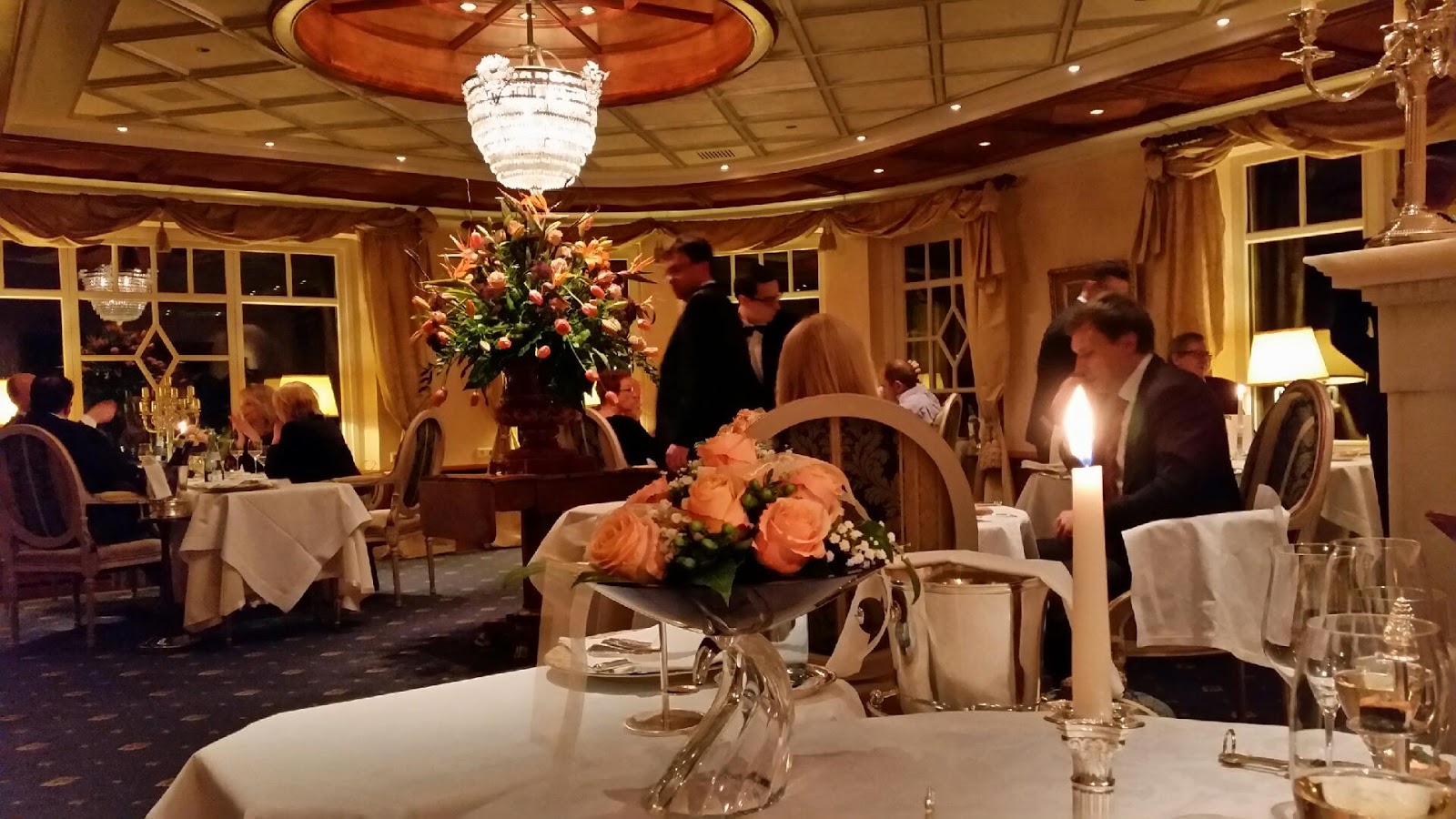
The very charming dining room at Hotel Bareiss
The gastronomic restaurant of Hotel Bareiss in Baiersbronn-Mitteltal is a paragon of 3-star holder. It got its first star in 1984; a year later the restaurant was awarded one more star till 2007 when it was awarded 3 stars and has been since.  Everything is impeccable here, from service to ambiance to quality of food.  If you had to criticize something, you could argue their bread selection is rather limited.  It is a lovely dining room, not too big, with classic upholstery, a warm crimson colour, and a beautiful large chandelier as centre-piece.  The ambiance is cosy and romantic. The prestige cuvée by the glass was a Pommery Cuvée Louise 2002 (EUR 25 a glass), and a very delicious one too!  They very kindly accommodated my request for a small salad to begin, followed by what I thought was the best sole dish I have ever had in a restaurant (bravo to Chef Claus-Peter Lumpp). 

The pan-fried sole with croutons
It came in 3 ways: 1) pan-fried with croutons, served with asparagus tips and Béarnaise sauce, 2) gratinated sole cannelloni with asparagus noodles and grape seed oil vinaigrette and asparagus consommé with strips of sole and small spring vegetables.  It tasted fresh, and each way of cooking as exciting as the last, with the firm texture of the sole forming a great contrast with the soft texture of the white asparagus, and the flavours melted into one harmonious assembly. This dish was EUR 76.  Richard rated his turbot middle course equally highly: Breton turbot, semolina with sorrel lemon powder and lemon butter sauce. The lamb dish was perfectly executed (Cassolette of milk-fed lamb with raw marinated artichokes fregula sarda and wild garlic).  Dessert is a highlight here – the pastry chef does a really fine job if you still have room.  Otherwise, the petits fours are quite divine too.


The dining room at Schwarzwaldstube

6 km away in Tonbach, the Schwarzwaldstube has continuously been a 3-Michelin-starred restaurant since 1992.  We were greeted by both the proprietor and the chef Harald Wohlfahrt separately. We went for lunch – therefore it was not a direct comparison.  Perhaps it was lunch, the clientèle seemed more business-like and the décor of the dining room is an interesting mix of country wood panels and fine chandeliers.  The colour scheme here is mauve blue. They have a vegetarian menu which is every bit as exciting as the normal gourmet menu.  I actually took 2 dishes from the vegetarian menu for lunch: a salad with cereal grains and artichokes followed by the mushroom tart with truffle.  Richard had the same mushroom tart, followed by the sole.  I thought the mushroom tart was perhaps not their finest creation, as the tofu in the middle was moist and let out quite a bit of moisture into the shortcrust pastry, which was a bit too thick for our liking and absorbing the moisture from the tofu, it turned a bit soggy.  The salad of grains was really delicious though.  Richard’s sole was over-cooked and not quite a 3-Michelin star quality dish.  Another great feature about this restaurant was its wine list.  There were some great (reasonably-priced) gems here, especially from France.  Something we started noticing was that the prices of top German Spätburgunders on wine lists were very similar to some Village/Premier Cru wines from top domaines in Bourgogne. 

The Bareiss was definitely a 3-star experience, but we need to return to Tonbach to have dinner for a proper verdict.  Based on the lunch experience alone, it did not quite merit 3 stars.

In Baden-Baden, we visited 2 restaurants, one with 2 stars (Brenners-Park) and the other with just one (Le Jardin de France).  There was one really positive thing about the Park restaurant was that there was one whole page of vegetarian menu and one whole page of gluten-free and lactose-free menu, out of a 4-page menu!  

A very fine vegetarian starter
I did not feel that my dishes lived up to the Michelin star standard, in fact, my monkfish was rather unexciting.  It did not help that I had to have a long discussion with the manager/sommelier that we didn’t like the wine he recommended, that we all thought it was too ‘bretty’ and simply not enjoyable (it was a 2005 GG Spätburgunder), and I didn’t react too well when his only comment was that he had sold a few bottles of this wine and nobody had complained before. In the end, we just paid for it but also ordered another bottle of a much younger Spätburgunder.  Aside from this interlude, the service was generally friendly, but I did not feel that we had any high points. Richard was indifferent about his turbot main course.  Approximately EUR 230 per head.  I don’t particularly feel a hurry to return.   It would be hard to call this worth a detour, as it was right in the heart of Baden-Baden.  Perhaps the Guide has another definition that they internally use.

Le Jardin de France on the other hand is a small restaurant run by a couple.  The room is not particularly charming, in fact, with the conservatory-like exterior, it felt a little ‘cold’ and ‘impersonal’, compared with the warmth of the old world décor at the Brenners Park.  The food was classic French, with probably too much cream in a few dishes, but tasty and suitably salty.  It was asparagus season and 4 out of 5 of us had the stir-fried white and green asparagus in a parmesan cheese cream sauce, with morels.  I had that as my main course and started with a cappuccino of asparagus velouté above a tasty green pea mousse.  Richard’s main course of rack of lamb was perfectly executed while others enjoyed the monkfish and lobster casserole in a rich lobster sauce. We returned to a French wine selection of Condrieu followed by Pichon Baron 1999.  The patronne served us herself and she was charming and friendly.  Bread was very good here, with the potato bread being particularly recommended!

Did they live up to their Michelin star award?  I thought the Park’s 2-star award was questionable and Le Jardin de France deserved its star for tasty classic cooking that delivered consistent quality each time we visited (we have been 3 – 4 times) but lacked creativity/innovation.

A bit like wine-tasting I suppose, a lot of factors could affect our dining experience: mood, ambiance, company, freshness of ingredients, execution (often less is more!), and expectations based on food critics and guides.  From our week in Beaune, I felt that we had far better/more satisfactory experiences at places that don’t even feature in the Michelin guide and certainly without a star.  And as a consumer, my first question is always: “Would I return to it?”, recalling the Michelin Guide’s definitions of the award system.  For me, it has to be more about the food – the food is but one aspect of the entire experience.  Sometimes simple honest food, well-cooked with quality ingredients, with friendly and charming service, combined with the ambiance of the room, is well worth a return. 


Monday, 21 April 2014

Return to Baden

19 Apr 2014:

The bed of tulips outside Hotel Bareiss's reception

We’re back in Baden-Baden for our annual visit to the Osterfestspiele 2014. Before Baden-Baden, we made a detour to the Hotel Bareiss in Baiersbronn in the Black Forest for an unforgettable experience at the venerable 3 Michelin star institution of Claus-Peter Lumpp. The hotel was going through a major renovation of its guest rooms at the time of our visit but despite the disruption, the service was maintained at a highly professional level. View of the densely planted fir trees in the Black Forest basking in warm spring sunlight was entirely captivating. The fresh mountain air was like heavenly manna to those pollution-filled lungs – each deep breath had felt like an energising boost, a sort of purging of those impurities!


View of a Black Forest hillside from our hotel room


A glass of welcome champagne, a few nibbles of the petits fours in the room, and a restorative visit to the spa, we were ready for an indulgent meal at the gastronomic restaurant. It was so refreshing to be able to enjoy a Michelin star quality meal where every dish distinguished itself by the intensity of flavours, freshness of produce, elegant presentation, meticulous execution and professional service, without any ‘foam’, ‘dust’, ‘jelly’ or mousse! The dishes were refined interpretations of classic flavours and combinations. I started with a cream of sorrel soup, with char caviar and egg of quail, accompanied by a separate dish of char poached in olive oil with herb vinaigrette and pea puree. The char was fresh and delicate, with an almost creamy texture from the poaching in olive oil, this was well balanced by the tartness of the sorrel. My main course consisted of 3 different preparations of sole: sole fillets fried in croutons on glazed tips of asparagus, sole fried in brown butter on asparagus risotto, Bearnaise sauce and spring blossoms, and strips of sole poached in olive oil in warm asparagus salad and chives. All three dishes were excellent, with great contrasts of texture and flavours, something citrusy balancing the brown butter and olive oil. The sommelier recommended a 2011 Castelberg Weissburgunder by Martin Wassman (Bereich Markgräflerland, between Freiburg and Basel) that would have sufficient weight, richness and acidity to go with Richard’s foie gras starter, and yet it would not be too over-powering to pair with my sole dishes later on. A perfect choice. Good aromatic intensity on the nose, with notes of honey, pineapple, almond, toast and smoke. On the palate, the wine was nicely voluptuous, without being too heavy, and well-balanced by the refreshing lift of a lively acidity. Finishes long and refreshing, without any cloying sensation. Perfect now! 16/20


For Richard’s suckling lamb dish, he had gone for a 2005 Volnay Santenots-du-Milieu, Comtes Lafon. The colour was a medium ruby. The bouquet was dominated by primary fruit still, blackberry, dark cherry, dried strawberry, hint of fig and cinnamon. Fleshy texture on the palate, characterised by ripe tannin, which would need quite a few more years to soften and integrate into the wine. At the moment, it felt astringent and not yet in total harmony. Finishes long. A rich and chewy wine and patience will be required. Drink from 2018+. 17/20

The cheese selection was excellent and served with a comprehensive bread selection….at this point, I had had to admit defeat to jetlag! But it did look very tempting!

(I did search for the Black Forest Gâteau but could not find it anywhere in Baiersbronn....I did eventually find it in Baden-Baden! So it exists!)


Advertisement of Black Forest Gateau and coffee at a Baden-Baden coffee shop


We had arrived at Baden-Baden after some rather interesting negotiation of the city’s intricate traffic circulation. Baden-Baden looked totally transformed with spring in full blossom. How different it looked compared to the bleak and wintry feel when we were here last year! Suddenly, the town was rejuvenated with the appearance of outdoor cafés, strollers in the parks, daffodils and tulips decorating the famous Lichtentaler Allee.


Baden-Baden in full blossom

Our first meal was taken at the hotel’s restaurant – the Park Restaurant at Brenners Park Hotel. After the amuse bouche, we were served the bread and selection of condiments: pumpkin seed oil (produced by the chef’s family!), olive oil from Tuscany, butter from Alsace and Maldon sea salt from Britain. The pumpkin seed oil had a very dark colour, viscous texture and a most intense flavour. Absolutely yummy! The food was less impressive than my recollection from last year’s visit. Richard’s turbot main course was a little bland and dry – he had to add some olive oil and salt to it to revive it! I thought my crabmeat starter was adequate but lacked imagination. The organic egg yolk in egg white soufflé, on a bed of purée of peas, parmesan froth and black truffle was closer to the expected standard!


Our choice of white wine was a 2009 Ihringer Winklerberg Riesling Grosses Gewächs, Dr. Heger. We had been hesitant about this choice because of the warm 2009 vintage in Europe, but this concern had turned out to be unfounded. The freshness and minerality of the wine was stunning. The bouquet was characterised by honey, green apple, pineapple, flowers and nuances of petrol/slate/flint. Medium+ body, balanced by precise acidity, complete with vibrancy, depth and refined minerality. This minerality is believed to have come from the strong presence of volcanic soil in the Winklerberg einzellage. The soil of the Bereich Kaiserstuhl is generally based on volcanic stone, mostly covered by calcareous loess and loam top soil. The volcanic soil particularly favours Grauburgunder and Spätburgunder. A beautiful wine and perfect with food. 16.5/20


The restaurant had kindly allowed us to drink our bottle of 1990 Drouhin-Laroze Chambertin Clos de Bèze. We did not feel that the wine needed decanting and were rather perplexed by the head sommelier’s strong disapproval of our decision. A mature Burgundian bouquet of mushroom, sous-bois, animal and plum notes. The palate lacked the depth, power and concentration of a Chambertin Clos de Bèze, even though it displayed a fair degree of complexity and elegance. Finish was not particularly long. There was a good expression of the vintage characteristics but overall it lacked the presence of a top Gevrey grand cru, that it did not quite deliver what was expected of a Chambertin Clos de Bèze – it could well have been a Charmes or Mazoyères Chambertin. Drink now and over next 3 - 4 years. 15.5/20


After the performance of Puccini’s opera Manon Lescaut, we headed over to the restaurant Le Jardin de France for dinner. I thought the opera was technically well performed but it just lacked a certain emotional adhesiveness amongst the actors. The asparagus season (white and green) is in full swing at every restaurant in Baden-Baden (probably Germany too)…..and the theme of morels and asparagus took centre stage on the menu, with an appearance in 4 guises…..simply on their own, with the ubiquitous cream that seems to be an essential ingredient used in liberal amount in most culinary creations in Germany; or with foie gras ravioli, or served with pike perch or with turbot! I went for the pike perch which was really fresh and tasty! 


For white, we went for the 2011 vintage of the same Dr. Heger wine, which tasted quite similar to the 2009 vintage, with less of the richness but more acidity and the minerality was even more poignant. The 2007 Spätburgunder Selection S by Franz Keller was really delicious – Richard said it reminded him of a 2009 Nuits Saint Georges! Ripe red fruit, raspberry, plum, with earthy notes and spices, made a lovely bouquet. The palate was medium bodied, with good balancing acidity, giving it a really nice lift at the finish.  (I rated this 16.5/20.)  At EUR 95 a bottle on the restaurant wine list, this was no mean price and seemed a worthy contender to the Burgundian counterparts which would cost a bit more! We had later gone to visit Franz Keller (as below) and learnt that Selection S was made from an élevage of around 10 months in oak barrels (barriques). Selection A is made from best vines and only from best vintages, made from an élevage of around 12 - 14 months in oak barrels (barriques).


Conventionalism was well challenged by the performance of Bach’s Johannes Passion on the second evening…….the orchestra and the choir were both on the stage and it was rather difficult to follow the movements of conductor Sir Simon Rattle. Most of the time, the orchestra and the choir competed for my attention. I had to admire the choir members singing while performing some tricky ab crunches! It was a good idea to have this piece about the last days of Jesus’s life acted out….but both choir and orchestra on the stage, with the choir taking an active role in enacting the final scenes……it was confusing, at least for me!


The following day, we drove down to Kaiserstuhl for a tasting at both Franz Keller and Dr. Heger, interluded with lunch at Schwarzer Adler (Fritz Keller's restaurant that has had a Michelin star since 1969, and a comprehensive wine list featuring many fine bottles from Bordeaux and Bourgogne!). Based in Votsburg-Oberbergen, Weingut Franz Keller is a family wine estate, now run by 4th generation Fritz Keller, making high quality dry, pure and elegant wines expressive of the different terroirs from 62 hectares of vineyard. We tried a range of Pinots during our visit to the wine shop......very impressed by the Spätburgunder Selection A and S. The grapes for Selection A are mainly sourced from the Eichberg vineyard (predominantly volcanic with some loess) in Oberrotweil and also from the Kirchberg einzellage (a pure volcanic site)....and from certain parcels in Jechtingen and the Achkarrer Schlossberg vineyard (also a pure volcanic site). The terroir here lends the wines a particular harmony, complexity and minerality and a clear delineated structure. We also tried the Selection S of the Weissburgunder (with ageing in oak barrels for a few months) - a very fine accompaniment to the brulée of foie gras that was our amuse bouche at Schwarzer Adler. We each had one course at lunch - Richard had possibly the best turbot on this trip and I had a delicious langoustines in curry sauce. There were so many tempting bottles on the wine list that we decided that a revisit to Schwarzer Adler (with stay in the guest room above the restaurant) seemed like a must-do on our next visit to Baden. Fritz Keller also has another restaurant, more casual and with a focus on local cuisine, across the road - Winzerhaus Rebstock. It was closed on the Monday when we visited.


My langoustines in curry sauce at Schwarzer Adler - rather nice with the Selection S Weissburgunder!

After lunch, we beetled over to taste at Weingut Dr. Heger, based in the Ihringen village. The wine estate started in 1935 when physician Dr. Max Heger acquired some parcels of vines in Ihringer Winklerberg and Achkarrer Schlossberg (both south-facing sites have exceptional microclimate, enjoying long hours of sunshine and particularly known for the dominant volcanic content in the soil). Now it is run by Joachim Heger (since 1982) who took over from his father Wolfgang (affectionately known as Mimus which became the name of a single vineyard wine). Dr. Max Heger built his fame on Silvaner, but now the focus has switched to the Pinots and Riesling. There are two Grosse Lage wines: Winklerberg GG and Schlossberg GG. The wines are typically full-bodied, rich, with vibrant acidity, giving a strong sense of elegance, finesse and freshness, and always with that persistent saline finish. The wine estate also started an entry point range called Weinhaus Heger in 1986 for fresh fruity wines, made with grapes from contract growers. Look out for the 3-star selection of Grosses Gewächs wines.....I liked them all, especially the Grauburgunder and Riesling!


We made it back to Baden-Baden just in time for the concert of Beethoven's Emperor Concerto and Richard Struass' Ein Heldenleben (translated as A Hero's Life). After the concert, we went to a restaurant called Stahlbad, at Ausgustaplatz. I would strongly advise to focus on the 3 signature dishes highlighted on the menu. Richard had the veal schnitzel and thought it was the best he had had.....my pasta with prawns was adequately prepared but not exhilarating!


We had chosen the 2012 Schloss Neuweier Goldenes Loch GG. Schloss Neuweier is based in Bereich Ortenau, which stretches 60 km from Baden-Baden to Berghaupten, near Offenburg. The northern part is based on granite bedrock, giving extremely complex and elegant wines. Schloss Neuweier is better known for its fine Rieslings from Mauerberg and Schlossberg sites....cultivated with vines since 12th Century. The Goldenes Loch is a monopole vineyard of 1 hectare southwest facing amphitheatre between Schlossberg and Mauerberg. The name came from the leaves acquiring a golden colour in the rays of autumnal sun. This 2012 vintage expression was elegant, refined, succulent and rich with minerality.....with notes of citrus, apple, honey and an unmistakable flint-like stoney character.


Schloss Heidelberg up in the hills, overlooking the Neckar River

We left Baden-Baden the following day and headed north towards Mannheim, for the 3-star cuisine of chef Juan Amador. We stayed the night in Heidelberg and arranged for a taxi to take us to the restaurant. The taxi driver had input the restaurant address into the GPS system which took us to a carpark/warehouse site in an industrial district, adjacent to a large supermarket. When we asked various people at the carpark, nobody seemed to know about this restaurant. Then the taxi driver spotted a signage outside a reddish brick warehouse in the corner and thought we would give it a try before calling the restaurant. Sure enough, this was it! Discreetly disguised. We were greeted with a request for aperitif: Cava or sherry......the Spanish chef has instituted an all Spanish wine menu. The chef's greeting followed with a trio of 3 amazing tapas....a clam whose shell was edible and made of tofu, a dish of filled tree bark with black pudding and pear and a chicken dish with crispy skin.


Entrance to Restaurant Amador, a little south of  the city Mannheim

The decor inside the restaurant

Richard had gone for the full menu while I took the more modest 3-course menu. My 3 dishes was 1) octopus with potato, paprika flavoured oil and leek; 2) salsify made to resemble white asparagus, served with beef tongue coated with a crispy coating of quinoa; and the truffle main course, consisting of scallop (in place of the original version with sweetbread), Jerusalem artichoke and pearl onion, all laced with intensely flavoured truffle emulsion, topped with a piece of dried truffle 'bark'!

The octopus in paprika oil, with potato and leek

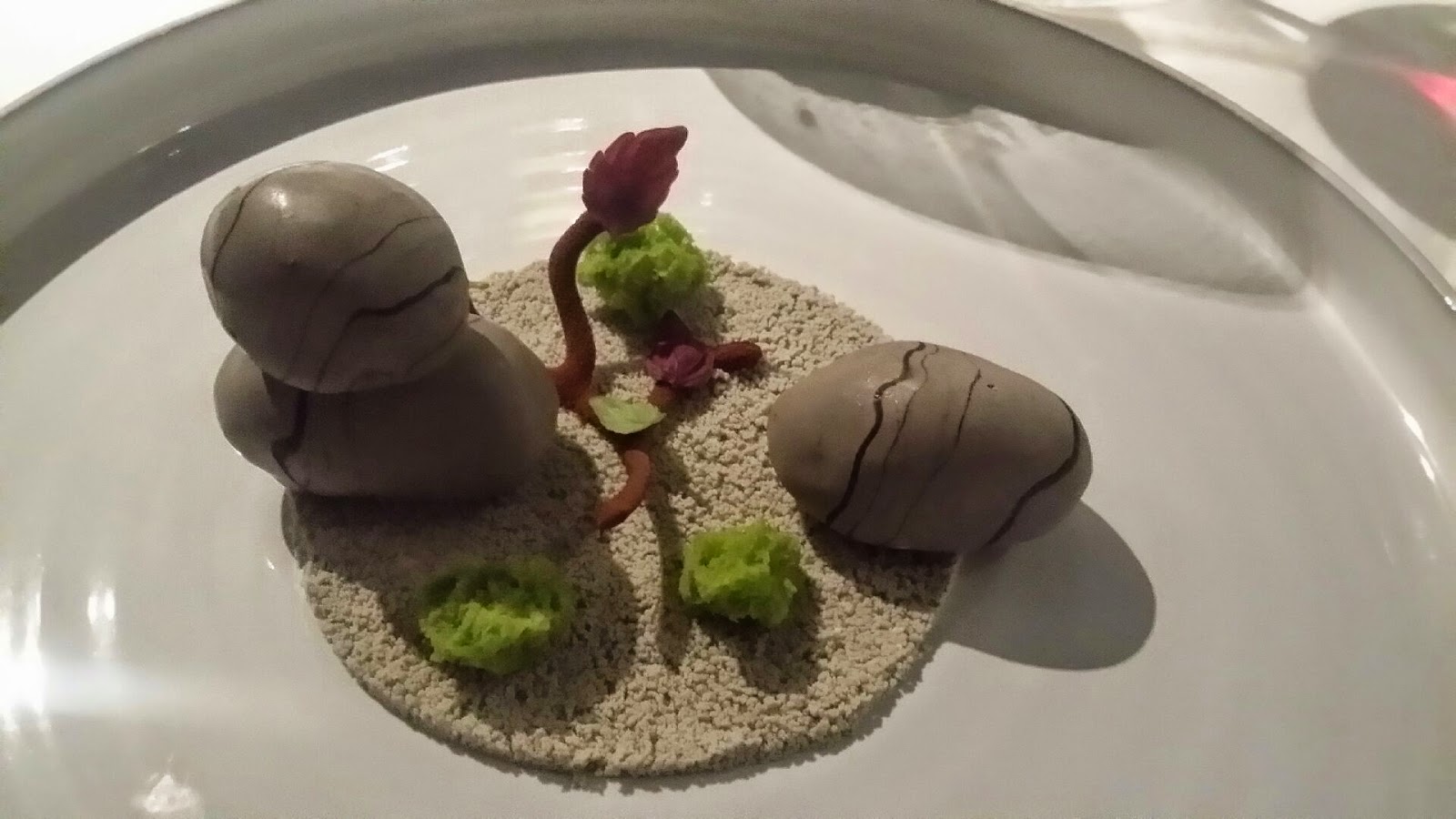
Dessert was a 'Zen' garden of Easter eggs, filled with almond cream, nougat chocolate truffle and pistachio cream. Then there were the petits fours of lollipops, and various candies! It was a remarkable tale (as we understood from the staff)......Born in Germany, this Spanish chef had already had a restaurant with 2 Michelin stars when he first went to have dinner at El Bulli. He apparently was so inspired by this dinner that he decided to dramatically change the way he cooked.....so he experimented and experimented and has now achieved his current reputation and Michelin stars, all by himself! While we were less convinced by just a couple of the creations and the combinations of flavours, we were left in no doubt about the chef's talent and dedication. The dinner had been an absolutely extraordinary experience and one that was truly memorable. Good news for us is that Chef Amador is actually coming to HK in June, cooking for a few days at the Jockey Club....and watch this space!


Dessert in the form of a Zen garden!


The menu actually offered a wine-food pairing option, but we had gone for our own wine choices instead (with the help of the enthusiastic and knowledgeable sommelier): a 2010 Tomás Postigo Rueda, Fermentado en Barrica and a 2007 Roda I Reserva.


The 2010 Rueda went rather well with a number of dishes, especially the octopus and Richard's gooseliver course. Herbal, citrus, pear, honey, ginger, with a hint of smoke. Medium body, could do with a bit more acidity to keep the palate fresh.....15/20.

The 2007 Roda I Reserva was a great wine, but worked less well with our food. Deep ruby colour. Red fruit, sandalwood, and spice. Ripe but still firm tannin coating the palate, with acidity giving the wine a nice refreshing lift at the finish. Quite a powerful wine, but there was plenty of elegance and vibrancy to keep this harmonious and intriguing to the palate. Gorgeous now with some aeration....and over the next 10 - 15 years.....a roast lamb rack with harissa or lamb tagine with couscous would have been a better choice with the wine. 17/20

This concluded our visit to Baden in 2014.......and with the few new tips acquired from this trip, we are already planning the next visit!

Wednesday, 11 September 2013

The Enigma of Clos de Vougeot

11 Sep 2013: Clos de Vougeot: this iconic enclosed vineyard, initially created by the Cistercian monks in the early part of the 12th Century, is a Grand Cru appellation that accounts for almost 75% of the Vougeot appellation area. Given its large size of almost 50 hectares, and the number of producers (about 80 in all), it has often been criticised for its lack of consistency across the myriad of producers and terroirs within the 'clos'. At the top where there is a thin (40cm) topsoil of chalk and gravel on limestone , the vineyards that abut Musigny and Grands Echézeaux, enjoy better drainage at 255 metres above sea level. The middle part (250 metres) offers moderate drainage, with a shallow topsoil of softer limestone and brown clay, with some gravel, overlying broken limestone. The vineyards at the bottom (240 metres) that extend towards the D974 and having regional and village level vineyards as neighbours, have a deeper topsoil of brown colour (90cm) on top of a layer of marl, rich in clay and alluvium. Blending across the clos is a possibility for producers owning different plots.

The Clos de Vougeot Line-Up

A few days ago, a group of us got together over dinner to try some Clos de Vougeot bottles, across different vintages and producers, to see whether we could differentiate between the terroir expression and the winemaker's style. I looked up some official sources for a description of Clos de Vougeot, and here's an amalgamation of what I found: "a suave bouquet.....roses, violets, mignonette,......blackberry, raspberry, wild mint, liquorice and truffle.....underbrush.....fur.......on the palate....succulent and mellow....full-bodied and fleshy......combining elegance and delicacy with meaty fullness.....discreet acidity.....muscular and quite long on the finish......long ageing potential".

Before we started with the reds, we enjoyed some Vougeot 1er Cru Clos Blanc de Vougeot by Domaine de La Vougeraie. We had a magnum of 2006 Clos Blanc, which seemed to be drinking a point now, rich and concentrated, perhaps a little lacking in acidity. The 2009 showed much more tension and structure and paired rather well with the smoked trout pâté!


We decided to start from old to young this time, allowing the younger wine further aeration and a chance to pair with some French cheese (sadly no Cîteaux, the cheese still made by the monks of the Abbey of Cîteaux, which would have been the ideal marriage)!


1959 Clos Vougeot, Joseph Drouhin: Level was upper to mid shoulder. Brick colour, with a warm and sweet bouquet that suggests richness and a fine maturity, reminiscent of prune, coffee, sous-bois, truffle, earth, animal and savoury notes, with a complementary nuance of caramel. Almost sweet on entry. Mouth-coating silkiness, delivering a refined degree of richness and depth of flavours, which just went on and on. Just a hint of dryness on the finish. Simply sublime, elegant and mature! A very well-stored bottle, showing perfect pedigree and character of the vintage. 19/20

1969 Clos de Vougeot, Jospeh Drouhin: Garnet colour. Underneath the strong note of volatility and evidence of maderisation, there was a bouquet of undergrowth, wet leaves and earthy notes. Sound underlying material for the wine, but sadly succumbed to oxidation and volatility.

1961 Clos de Vougeot, Leroy: This needed some time to coax the plethora of Burgundian aromas, including dark fruit, Asian spice, mushroom, violet and some sauvage character. The complex flavours glide across the palate, affirming intensity, concentration and a fine robust structure. Good level of acidity keeping the palate fresh. I feel that we did not quite give it enough time to breathe and blossom......18.5/20


1988 Clos Vougeot, René Engel: Initially, a little subdued....except for nuances of animal, earth and farmyard. With aeration, this revealed a core of red fruit and mineral note underneath the firm structure. Lithe and elegantly poised. Rather attractive, except for the dryness on the finish. I would drink this wine now! 17/20


1988 Clos de Vougeot, Méo-Camuzet: A suave and stylish interpretation of Clos de Vougeot. Mature bouquet of dark cherry, plum, Asian spice, violet with some earthy notes. Not a wine that impresses by its volume or concentration, but rather its velvety texture, fine backbone of vibrant acidity and velvety tannin. Very fine indeed. 17.5/20


2001 Clos de Vougeot, Georges Mugneret: Here's a very fine Clos de Vougeot. Notes of dark fruit, coffee, sweet tobacco and sauvage character. Intense, with profound concentration, and a muscular core. The linear structure deftly balanced by richness. Finishes extremely long. Excellent winemaking here. 17/20


2003 Clos de Vougeot, Méo-Camuzet: From a warm vintage, this showed a warm and rich bouquet, a mouthcoating velvety texture but also a fantastic freshness, keeping everything in balance! Dark fruit, cloves, liquorice and coffee. Ripe but firm tannins and vibrant acidity giving an opulent but not clumsy structure. Perhaps there was none of the minerality or restraint that we love to see in Burgundies but this was a very fine effort for the vintage. 17.5/20


We finished with a 1971 Wehlener Sonnenuhr Beerenauslese, S.A. Prüm. A golden amber colour. Notes of dried apricot, mango and marmalade leapt to the nose. Medium-bodied and firm acidity. Finishes long......Quite fine, good complexity and balance, but not an intensely rich or profound example. 17/20


Did we reach a conclusion? I think we certainly did reach one: in the right hands, Clos de Vougeot was certainly capable of living up to its long-ageing reputation......the 1959 and 1961 were very fine examples of how well they aged!

Thursday, 4 April 2013

Great Finds in Baden: Food, Wine and Music!

4 April 2013: We enjoyed the performance of the Berliner Philharmoniker so much at the Easter Festival in Salzburg last year that we decided to support their move to Baden Baden and signed up for a couple of their performances this year. It was not a good idea to go to a 3-hour opera with jetlag - it was the Magic Flute! I had difficulty staggering out of the concert hall. The second evening's performance of Mahler Symphony No. 2 was much more animated, especially with so many instruments and musicians being involved - the percussionists at the back were most agile in their swift but unhurried manoeuvres from one station at one end of the stage to another at the other end. (You can also find the Sir Simon Rattle recording of Mahler Symphony No. 2 in the Cathay Pacific's inflight music library!!)

We stayed at the Brenners Park Hotel (www.brenners.com) where there is a 1 Michelin star restaurant Brenners Park-Restaurant. The hotel probably belonged to another era, with its opulent grandeur, classic architecture and elegant deluxe, but the service was extremely friendly and professional. We had a room which looked onto the famous Lichtentaler Alley behind the hotel, blending into one picturesque scene. With the overnight snowfall just before our departure, this was transformed into a romantic view of calm and splendor, rather mesmerizing.


I highly recommend the gourmet restaurant which featured a wonderful à la carte menu, together with two degustation menus, one the gourmet menu and the other thoughtfully designed for vegetarians! My favourites were the carrot dish and the espuma of potato and leek with black truffle - vegetarian dishes can be so beautifully presented and complex in texture and flavours!  Here are our recommendations:


Greetings from the chef - I loved the combination of beetroot, smoked eel and green apple foam!

Purée of Ancient Carrot, finger carrots, earth of mixed grain bread and golden quail egg
(Almost too pretty to eat!)

Espuma of potato and leek with black truffle
(Richness without heaviness - heavenly!)

Two kinds of brussel sprouts and savoy cabbage, with macadamia nuts,
purée of butternut squash and lemongrass-coconut emulsion

Breton turbot with perigord truffle butter, ravioli with confit onio and watercress
(best turbot dish Richard has ever had!)

Whole seared sole, with balsamic-caper glace, baby leaf spinach and artichokes (I did not take a picture but it really was very tasty - can easily be the best Dover sole dish I've ever had!)


The young chef Paul Stradner (who arrived in 2012) came out to greet us on our last evening there - his enthusiasm and dedication clearly reflected in the quality, designe and presentation of the dishes! We had less luck with the senior sommelier, who dismissed our questioning of the condition of a bottle of Spätburgunder from 2000 (with the alarming whiff of rusty nail and nail varnish), and authoritatively put it down to our lack of experience with local Spätburgunder!


Needless to say the food went particularly well with wines from the region. We were so impressed by the white wines from Baden, the warmest and most southern region in Germany with very diverse soil types, from granite and gneiss in Ortenau to volcanic soil in Kaiserstuhl and chalky-loess hills of Tuniberg. A third of the area under vines is planted with Spätburgunder with Weissburgunder and all other Pinot varieties accounting for about half of the land under vines. For our visit, we were able to taste some very high quality wines from the most recent 3 very high quality vintages, from the very ripe 2009, the more classic 2010 and the superb 2011 vintage: Grauburgunder, Weissburgunder and Riesling (locally called Klingelberger), as well as some Spätburgunder. The Gutswein of Grauburgunder and Weissburgunder from high quality estates offer particularly good value, at somewhere between EUR 6 - 8 a bottle ex-cellars! Given the established reputation of Spätburgunders from Baden, the wine list at the Brenners Park seemed a little light on the Spätburgunders from the region: we had hoped to see a wider selection. I wondered if it's because the top Spätburgunders had such strong followings amongst the locals that they were sold out almost as soon as they were released? We managed to visit one weingut (well, just the shop as we did not manage to get an appointment) - Schloss Staufenberg (www.markgraf-von-baden.de) (a weingut owned by the Markgraf von Baden, a relative of the UK's Prince Philip, so we were told, and recently joined the ranks of VDP!!) but sadly the top Spätburgunder was already sold out!


Following are highlights of wines that we did try and would definitely recommend:


2011 Riesling Kabinett Trocken, Schloss Neuweir: located just 5 km outside of Baden Baden, in an idyllic village called Neuweier. We had lunch at this place called Traube, a hotel-guesthouse with a very good restaurant that serves hearty dishes of local cuisine (as well as something as delicate as steamed seafood with an Asian lightly spicy lemongrass sauce) - perfect for Sunday lunches en famille (www.traube-neuweier.de). The friendly chef came out to greet us....in English!


2011 Grauburgunder, Schloss Staufenberg


2011 Grauburgunder, Dr Heger (www.heger-weine.de): great value wine, excellent quality


2011 Weissburgunder, Dr Heger: great value wine, excellent quality


2009 Ihringer Winklerberg, Riesling GG, Dr Heger: pale lemon. Expressive noes of lime blossom, grapefruit, pineapple, honey with a hint of petrol. Racy acidity, medium bodied, dry and crisp long mineral finish. A very elegant wine that will definitely benefit from bottle ageing. Very impresive.


This is the 2011 bottle.


2008 Durbacher Schlossberg, Klingelberger (Riesling), Spatlese Trocken, Schloss Staufenberg: Very expressive nose, full-bodied, and plenty of complexity. Loved the long complex finish. A great wine with the turbot or Dover sole dish. This is a weingut worth looking out for - just became a member of VDP in 2011. We also tried the 2011 vintage at the wine shop - really excellent, plenty of minerality and complexity.


2009 Spätburgunder, Franz Anton, Schwarzer Adler, Franz Keller (www.frankz-keller.de): Bright cherry robe. Savoury and red fruit bouquet of raspberry, redcurrant, black cherry, rose petals, with nuances of underbrush and mushroom. Medium bodied, medium acidity. Supple on the palate. Well-balanced and youthful, if a little lacking in mid palate for now....can do with some time to build out.


Germany has given us some very pleasant surprises since our visit to Hamburg last year, in terms of quality of gourmet food, price and quality ratio of local wines, and of course the German efficiency and organisation. There are a few other wineries from Baden whose wine we would love to have tried......good news is we are already planning next year's visit!  I am also hopeful that we may see some more choices of high quality local Spätburgunders on the wine list at Brenners Park!!!  It's a tempting thought to include German Grauburgunder to our repertoire of everyday white at home, which effectively means Bourgogne Blanc or Village!!!!

Tuesday, 14 August 2012

A long way from Hamburgers!

14 Aug 2012: A friend's wedding in Denmark put Hamburg on the map for us - so we decided to visit this northern German city, en route to Kusaa, Denmark. Despite the large-scale devastation in the Second World War, the city has very handsomely rebuilt itself, while retaining a little of the old worldly charm - the promenades, the galleries, the harbour, lakes and canal.

View of the Binnenalster from our hotel
We stayed at the Fairmont (or better known by the locals as the Hotel Vier Jahreszeiten or the Four Seasons Hotel). It was very well-situated, facing the Binnenalster (or Inner Alster) and right in the middle of the chic shopping area, with a good spread of charming Italian ice-cream parlours/cafes and Starbucks to offer well-deserved respite to weary tourists and shoppers. We arrived on a gorgeous day, with balmy weather, brilliant sun and a light breeze that kept refreshing the ripples off the shimmering surface of the Binnenalster. Find yourself a nice table at one of the cafes along the Binnenalster, order a beer or ice cream sundae, and you will be wanting for nothing more (at least for a couple of hours), against the backdrop of the cawing of seagulls and the chatting of merry holiday-makers. For a bit of culture, we highly recommend the Hamburger Kunsthalle which boasts a comprehensive collection of paintings and sculptures from Old Masters to impressionists and modern art, plus the occasional special exhibition (Alice in Wonderland at the moment).


The food scene was most gratifying. We had some great meals there and we highly recommend Landhaus Scherrer and Restaurant Seven Seas, the gourmet restaurant at the Süllberg Hotel (www.suellberg-hamburg.de). We thought we didn't do too badly on the wine front, given how little we both knew about German wines - Hugh Johnson's Pocket Wine Book came to the rescue (yes, we carried it around!)

At Landhaus Scherrer, we were very well-looked after by the female maitre-d'. She very patiently explained to us the different dishes which interested us and very happily changed our bottle of wine when it didn't taste quite right. The amuse bouche was a composition of tomato dishes: from an intensely flavoured tomato consomme topped with some tomato-flavoured foam to tomato-flavoured sorbet and a tomato-flavoured cream. For starter, I had a delicately-flavoured bouillabaisse with a clear broth and very fresh fish and mussels, aromatically lifted with the addition of fresh basil leaves. Richard had a lobster salad which he said was the best he'd had for a long time! For main courses, we both had fish. Richard had a turbot dish with broad beans and I had a steamed trout-like fish, with a bean stew and mire-poix, the sauce lightly scented with rosemary. It was so delicious - the fish was very tender and moist and the beans added complexity to the texture. Truly excellent.


Gorgeously delicately flavoured bouillabaisse

Trout dish at the Landhaus Scherrer

Steamed trout with bean stew

As for the wine, we ordered a bottle of 2010 Westhofen Morstein Riesling Trocken GG, Weingut Wittmann. Wittmann is based in Rheinhessen, practising biodynamic viticulture since 2004 (www.weingutwittmann.de). Morstein is one of 4 top vineyard sites in Westhofen where the Wittmanns have land under vines. It is situated on the south-facing slope that stretches from Gundersheim to Westhofen. The subsoil consists of massive limestone rocks. Pale gold, quite an open nose, with good intensity of peach, grapefruit and lime blossom, with some honey notes. Very lively acidity and a certain austerity giving away its young age, revealing much complexity on the palate, with a chewy texture. A complete wine with a lovely long firm and minerally finish. Drink now and over next 10+ years. 17/20

We asked if they had a half bottle of Rudolf Fürst (www.weingut-rudolf-fuerst.de) to offer, as we learnt from our 'bible' that Fürst (based in Franken) was arguably the best producer of Spatburgunder, in an almost Burgundian style. (I thought this would keep Richard happy!) They didn't have but the maitre-d' very kindly opened a bottle of 2009 Parzival, Furst and offered a glass to Richard. A very generous gesture! Parzival is a red wine blend of Pinot Noir and Domina (a crossing between Portugieser and Pinot Noir). It was indeed a tasty drop, well-balanced with a medium body and notes of red fruit, underbrush, game and savoury minerality, and became our benchmark red! I can't wait to try other signature wines by Paul Fürst: the Weissburgunder, labelled as the most Burgundian white in Germany; the Frühburgunder (a mutation of Pinot called Pinot Madeleine) which has its own following and his top drop, the Spätburgunder Spätlese R (from Bürgstadter Centgrafenberg with its south-facing moderate to steep sites of cool sandstone and loam content). Paul had to leave his viticultural studies at Geisenheim at the age of 21 when his father Rudolf suddenly passed away. He has since established a name for himself as the winemaker who turned the world's attention to Spätburgunder from Germany - his 1990 served blind at a wine tasting was mistaken for a Burgundy wine from Beaune. Fermentation on skins and maturation in French oak count amongst his vinification techniques.

View of the Elbe from the terrace at Deck 7, Sullberg Hotel
Our next dinner was at the gourmet restaurant at the Süllberg Hotel called Seven Seas. Richard found this place from the Michelin Guide but it wasn't very clear that it was part of a hotel in the suburbs, miles out of Hamburg City Centre. In fact, if you wanted the perfect view of the River Elbe, you should dine at Deck 7 instead because the tables are on the exposed terrace and offer an excellent view of the river. At the gourmet restaurant, the tables were a bit more tucked inside but we did nevertheless get a glimpse of the River Elbe (without straining too much the neck muscles).


Sole with field mushrooms, pea puree and smokey potato

Turbot dish at Restaurant Seven Seas
We were very well looked again by a knowledgeable sommelier and friendly waiting staff. Our only complaint was that we were given far too many amuse-bouches! There were 3 platters/dishes that came before our proper starter! The first was a platter of a few bits and bobs, including a tube of crustacean broth which was really tasty, and a tiny baked potato with braised pork. Then came a monkfish carpaccio which neither of us ate. Then we were given another dish which we felt that we'd better eat before we would be served the food we actually ordered. For starter, Richard had a langoustine dish which again was pretty near perfect, and I had a lovely green salad. For main course, I had the sole with field mushrooms, spinach and a rich truffle sauce. Richard had the turbot. Both dishes were excellent and prepared with the freshest ingredients. We really were very impressed by the quality of the food.

For wine, we chose a 2010 Niederhäuser Hermannshöhle, Riesling Trocken GG, Weingut Hermann Dönnhoff (Nahe). It was more austere and vibrant than the previous night's Wittmann. Citrus, honey and ripe peach notes on the nose. A lovely savoury minerality on the well-textured palate, with plenty of acidity, leading to a nice long refreshing finish. Nicely weighty, with great balance. A harmonious wine with class and elegance. Drink now and over next 10+ years. 17.5/20

We did return to Hamburg on our back from the wedding in Denmark, and we stayed another night at the Fairmont. We arrived in time for a late lunch at Le Plat du Jour, in the Old Town. Of course, we took ages to find it....as it's tucked inside a little street within what looked like the Financial District. Richard had the seabass of the day and I ordered the traditional chicken liver salad - it was yummy if a little too smothered in rich sauce (I needed the restorative effect and the umame flavours of chicken liver after indulging on too much of the lipsmacking 2008 Tignanello at the wedding banquet the previous night!). Good hearty French bistro fare in the middle of Hamburg! For dinner, we ate at the Grill at the hotel, but food was nowhere near as good as at the other restaurants we tried. My pike perch was overcooked and Richard's steak was rather tough. The side dishes were tasty though - the bean cassoulet and the pan-fried chanterelles were both delicious. We would have tried the gourmet restaurant (Restaurant Haerlin) if it weren't closed for holiday. Our white wine choice was a half bottle of 2011 Kiedrich Grafenberg Riesling Trocken, Weingut Robert Weil. Green apple and citrus. It could do with a bit more age. This was followed by a half bottle of 2009 Parzival.

Hamburg gave us a really pleasant surprise and if you could call it disappointment, it was that we didn't have a single hamburger!

As a side note, do check out this hotel in Denmark, just across the border from Germany, Fakkelgaarden (www.fakkelgaarden.dk) in Kollund, Kusaa. It was a really charming hotel, with only 26 suites all facing the Flensburg Fjord, a gourmet restaurant and a very well-stocked cellar. It also offers cooking classes. I took this picture just before 6 in the morning - the warm glow of dawn in Nordic serenity.